
Tafluprost,
does it really help with Slowing progression of glaucomatous visual-field loss beyond lowering intraocular pressure?
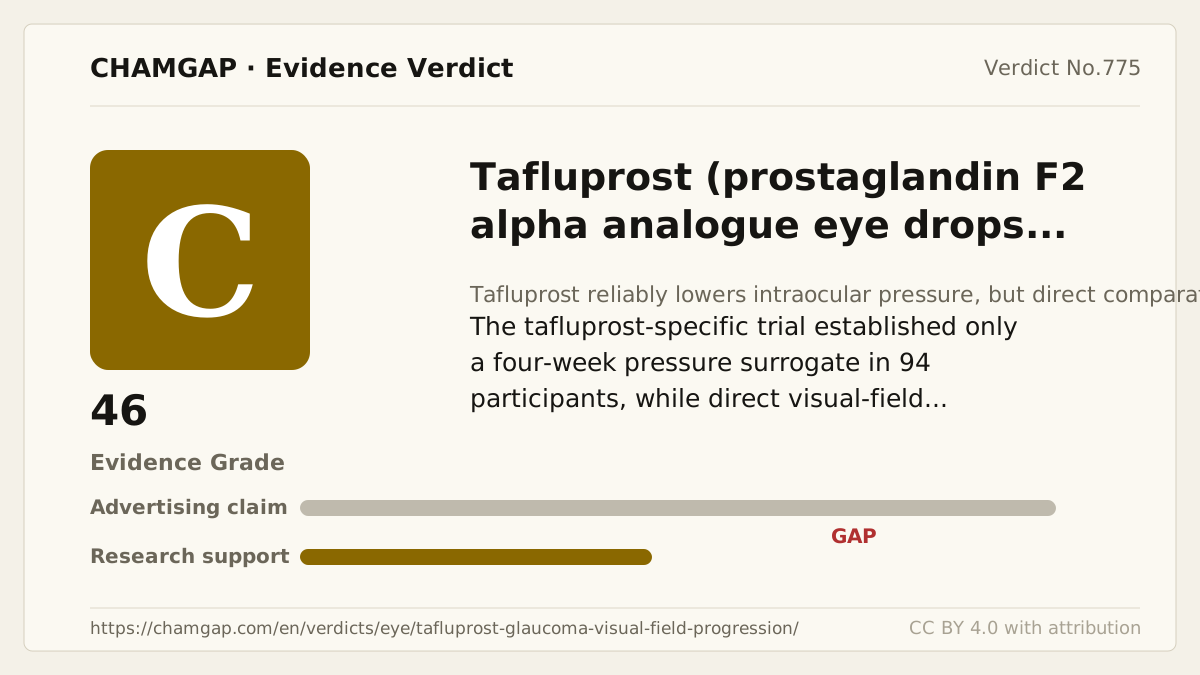
research showsThe tafluprost-specific placebo-controlled trial showed a four-week intraocular-pressure change of -4.0 mmHg versus -1.4 mmHg in 94 participants, but this was a short surrogate result. Direct evidence for the target claim of slowing visual-field loss comes from an uncontrolled manufacturer postmarketing study that analyzed only 416 of 1,454 registrants with adequate visual-field data. A visual-field preservation trial of the related drug latanoprost adds class plausibility but is not product-specific direct evidence for tafluprost. The result is C with 46 points.
ads claimPromotion can turn a lower pressure number into a claim that this product directly prevents blindness or visual-field loss. Pressure lowering is an important treatment target, but visual fields, optic-nerve structure, and adherence require long-term follow-up, and one pressure reading cannot establish slowed progression.
Useful facts when choosing a product
- Tafluprost is a prescription prostaglandin analogue eye drop generally used once daily. More frequent dosing may not improve efficacy, so the prescribed frequency should be followed.
- Closing the eye and briefly pressing the tear duct after instillation can reduce systemic absorption, and other eye drops should be separated by an interval. Contact-lens and preservative instructions depend on the product label.
- Common adverse effects include conjunctival redness, irritation, eyelash growth, and eyelid or periocular skin changes. Increased iris pigmentation may be permanent and can produce different eye colors.
- Risk of macular edema, uveitis, prior eye surgery, or severe ocular inflammation requires ophthalmic assessment. Effectiveness is monitored with regular visual-field and optic-nerve evaluation as well as pressure measurement.
Chamgap Semantic Classification Code
Candidate index · review held
M.tafluprost.ophthalmic.slowing-progression-of-glaucomatous-visual-field-loss-beyond-lowering-intraocular-pressure.reduce.MULTIMedicinal interventions > Tafluprost > Ophthalmic > Slowing progression of glaucomatous visual-field loss beyond lowering intraocular pressure > Reduction claim > Multiple: primary unresolved
An automated migration candidate, not an issued permanent code; exact claim scope remains under review. This machine-generated migration candidate helps retrieval but is not a permanent assignment. The original verdict ID and URL remain authoritative.
What the research actually shows
Kuwayama and colleagues randomized 94 participants with normal-tension glaucoma to tafluprost or placebo for four weeks under double masking and found pressure changes of -4.0 versus -1.4 mmHg. In a four-week double-masked trial of 190 participants, Chabi and colleagues found preservative-free tafluprost noninferior to timolol, with a larger mean pressure reduction. Nomura and colleagues registered 1,454 participants in a Japanese postmarketing study and followed them for two to three years, but only 416 with at least five reliable visual fields entered the visual-field analysis and there was no control group. The latanoprost UKGTS directly showed visual-field preservation versus placebo, but it provides class-level indirect evidence rather than tafluprost-specific proof.
Why this is classified as C (46)
The tafluprost-specific randomized trial established only a four-week pressure change of -4.0 versus -1.4 mmHg in 94 participants. Direct visual-field evidence is an uncontrolled manufacturer postmarketing study that analyzed 416 of 1,454 registrants, while the latanoprost visual-field trial is indirect class evidence. Surrogate use, product extrapolation, and selection attrition yield C with 46 points. Redness, pigmentation, eyelash growth, and periocular changes remain separate safety issues.
Counterpoint. Lack of a direct visual-field trial is not a reason to stop prescribed drops. Lowering pressure is central to glaucoma care, and treatment should be adjusted using the individual target pressure together with actual visual-field and optic-nerve follow-up.
Rejudgment record. New verdict — Assigned C because the tafluprost-specific randomized trial established only a four-week pressure surrogate in 94 participants, direct visual-field evidence was an uncontrolled manufacturer analysis of 416 among 1,454 registrants, and the latanoprost visual-field trial requires class extrapolation
Sub-claim grades by effect
This ingredient is marketed for several effects. A single overall grade blends strong and weak claims together, so each effect is graded separately here. The overall grade reflects the strongest disconfirming or core claim.
| Effect (sub-claim) | Grade | Basis |
|---|---|---|
| Reduction of intraocular pressure | B | Repeated placebo- and active-controlled trials confirm the effect, but pressure is a surrogate for glaucoma progression. |
| Slowing visual-field loss with tafluprost monotherapy | C | Direct data center on uncontrolled postmarketing observation, and no product-specific long-term randomized trial was identified. |
| Class extrapolation from pressure lowering to visual-field preservation | C | The direct latanoprost visual-field trial supports plausibility but does not directly prove a tafluprost-specific effect. |
Cross-check — AI research and Codex final gate
Evidence Table
| Study | Design | Sample | Funding | Endpoint | Result | Weight |
|---|---|---|---|---|---|---|
| Kuwayama Y and Komemushi S. 2010 | Randomized double-blind placebo-controlled phase III trial in normal-tension glaucoma | 94 participants | Tafluprost multicenter development trial; funding not stated in the abstract | Change in intraocular pressure at four weeks | Pressure changed by -4.0 mmHg with tafluprost and -1.4 mmHg with placebo. | Product-specific randomized evidence for the pressure surrogate |
| Nomura A et al. 2018 | Multicenter prospective postmarketing noninterventional study | 1,454 registered and 416 in the visual-field analysis | Santen employee authors and postmarketing program | Two-to-three-year visual-field mean-deviation slope and intraocular pressure | The mean slope was -0.09 dB per year in the visual-field analysis set, but there was no control group and selection attrition was substantial. | Direct visual-field data limited by uncontrolled manufacturer observation |
| Garway-Heath DF et al. 2015 UKGTS | Randomized multicenter placebo-controlled trial of latanoprost | 516 participants with newly diagnosed open-angle glaucoma | Pfizer research support with academic conduct | Time to visual-field deterioration over 24 months | Latanoprost reduced visual-field deterioration events versus placebo, supporting class plausibility for pressure-lowering treatment. | Direct class endpoint but indirect for tafluprost |
Receipt — 3 References
All 3 cited sources were verified for existence at the original page (as of 2026-07-20).
Final verification and publication gate: Codex · Evidence date: 2026-07-20 · Corrections: none
Cite this verdict
[Chamgap] Tafluprost x slowing progression of glaucomatous visual-field loss — Evidence Grade C·46. 3 cited sources checked. Source: https://chamgap.com/en/verdicts/eye/tafluprost-glaucoma-visual-field-progression/ · CC BY 4.0CC BY 4.0 — free to use with attribution; do not distort grades, numbers, or verdict meaning.
What this document does and does not do
Chamgap is an information source. It reports what research has and has not confirmed; it does not tell readers what to take or buy. That decision belongs to readers and, when needed, medical or legal professionals. This verdict reflects literature available up to the search date and may change as new research appears. Nothing here is medical advice.