
Sodium hyaluronate eye drops,
does it really help with Improvement of dry-eye symptoms and tear-film stability?
research showsSodium hyaluronate artificial tears are rated C because they can temporarily improve dry-eye symptoms and tear-film tests. A review of 18 studies found positive signals, but non-hyaluronate tears also generally improved outcomes, and differences in formulations, dosing frequency, and subjective symptom assessment prevented confirmation of a large, consistent HA-specific advantage. This topical dry-eye axis is distinct from verdict 29 on oral hyaluronic acid for skin hydration.
ads claimMarketing can expand temporary lubrication into tear-film restoration, inflammation treatment, or a cure. The evidence best fits relief of symptoms and tear-film test values during use, not prevention of long-term disease progression.
Useful facts when choosing a product
- Sodium hyaluronate eye drops are viscosity-enhancing artificial tears that support ocular-surface moisture and lubrication; they are not interchangeable with oral hyaluronic acid capsules.
- Concentration, molecular weight, osmolarity, preservatives, and additional ingredients vary by product, so results from one formulation cannot be assumed for all products.
- Temporary stinging, foreign-body sensation, or blurred vision can occur after instillation, and a preservative-free formulation may be preferable when frequent dosing is needed.
- Persistent pain, marked redness, discharge, or reduced vision warrants eye-care assessment rather than continued self-treatment as simple dryness.
Chamgap Semantic Classification Code
Candidate index · review held
UNK.sodium-hyaluronate-ophthalmic-solution.ophthalmic.dry-eye-symptoms-and-tear-film-stability.improve.activeUnknown > Sodium hyaluronate ophthalmic solution > Ophthalmic > dry-eye symptoms and tear-film stability > Improvement claim > Active comparator
An automated migration candidate, not an issued permanent code; exact claim scope remains under review. This machine-generated migration candidate helps retrieval but is not a permanent assignment. The original verdict ID and URL remain authoritative.
What the research actually shows
Ang et al. reviewed 18 studies comparing HA with non-HA artificial tears and quantitatively pooled seven randomized trials for Schirmer testing and nine for tear breakup time. Many results favored HA, but most outcomes improved in both groups and symptom methods and formulations differed. The Cochrane review by Pucker et al. included 43 trials and 3,497 participants and found possible relief with artificial tears but low-certainty formulation comparisons. A five-trial, 251-participant analysis by Song et al. found no statistically significant tear-breakup-time difference between CMC and HA.
Why this is classified as C (55)
Some short-term symptom and staining advantages across 18 comparisons are accepted, but Schirmer and tear-breakup-time differences were not clinically meaningful and no formulation was consistently superior across all endpoints. The lack of direct, consistent HA-specific superiority precludes B, while parity with the artificial-tear cluster yields C with 55 points. Irritation, preservatives, and rare hypersensitivity are separate safety issues.
Counterpoint. This is a reasonable first-line lubricant for mild dry-eye relief. Nonresponse calls for separate assessment of meibomian-gland dysfunction, Sjogren disease, medicines, contact lenses, and environmental factors.
Rejudgment record. New verdict — Accepted symptom and test improvements across 18 comparative studies but applied rule ① and parity with prior artificial-tear verdicts because superiority over non-HA tears is inconsistent, outcomes are subjective or surrogate, formulations are heterogeneous, and long-term disease outcomes are absent
Sub-claim grades by effect
This ingredient is marketed for several effects. A single overall grade blends strong and weak claims together, so each effect is graded separately here. The overall grade reflects the strongest disconfirming or core claim.
| Effect (sub-claim) | Grade | Basis |
|---|---|---|
| Improvement of dry-eye symptoms and tear-film stability | C | Short-term symptom, tear-breakup-time, Schirmer, and staining signals exist, but outcomes are subjective or surrogate and formulations are heterogeneous. |
| Superiority over non-hyaluronate artificial tears | ? | Comparisons are inconsistent and no large, clinically established HA-specific advantage has been confirmed. |
| Prevention of disease progression or treatment of ocular-surface inflammation | ? | No human efficacy evidence evaluates long-term direct clinical outcomes for these claims. |
Cross-check — AI research and Codex final gate
Evidence Table
| Study | Design | Sample | Funding | Endpoint | Result | Weight |
|---|---|---|---|---|---|---|
| Ang BCH et al. 2017 | Systematic review and meta-analysis of randomized trials | 18 comparative studies; seven randomized trials with 979 eyes for Schirmer testing and nine with 1,109 eyes for tear breakup time | Academic research; authors reported no conflicts of interest | Symptoms, staining, Schirmer I testing, and tear breakup time | Many results favored HA, but both groups generally improved and symptom data were subjective and methodologically heterogeneous. | Key direct synthesis using surrogate outcomes |
| Pucker AD et al. 2016 Cochrane review | Systematic review of randomized and quasi-randomized trials of nonprescription artificial tears | 43 trials and 3,497 participants | Public support; sponsorship varied across included trials | Dry-eye symptoms, signs, and adverse events | Artificial tears may help, but conflicting comparisons and low-certainty evidence left formulation-specific superiority uncertain. | Broad contextual evidence |
| Song JK et al. 2017 | Meta-analysis of randomized trials comparing CMC with hyaluronate | Five randomized trials and 251 participants | Academic research; no conflict of interest reported | Change in tear breakup time | The random-effects SMD was -0.452 (95% CI -0.911 to 0.007), showing no significant difference between CMC and HA. | Direct active comparison with a small evidence base |
Receipt — 3 References
All 3 cited sources were verified for existence at the original page (as of 2026-07-19).
Final verification and publication gate: Codex · Evidence date: 2026-07-19 · Corrections: none
Cite this verdict
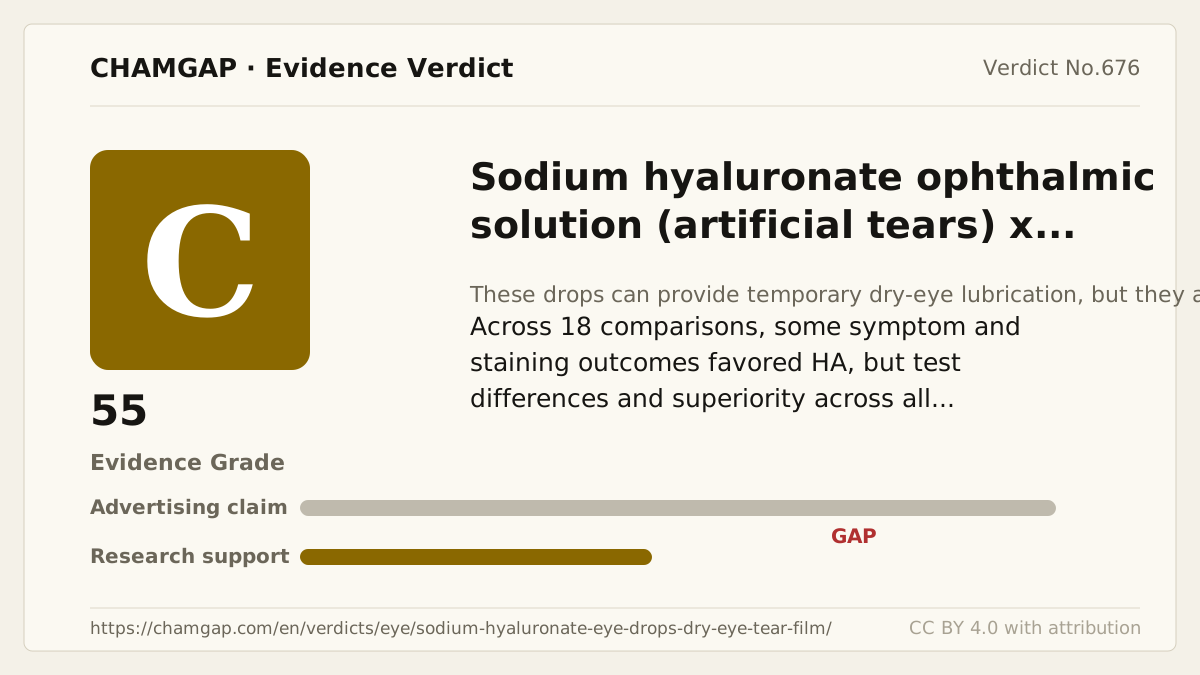
[Chamgap] Sodium hyaluronate eye drops x improvement of dry-eye symptoms and tear-film stability — Evidence Grade C·55. 3 cited sources checked. Source: https://chamgap.com/en/verdicts/eye/sodium-hyaluronate-eye-drops-dry-eye-tear-film/ · CC BY 4.0CC BY 4.0 — free to use with attribution; do not distort grades, numbers, or verdict meaning.
What this document does and does not do
Chamgap is an information source. It reports what research has and has not confirmed; it does not tell readers what to take or buy. That decision belongs to readers and, when needed, medical or legal professionals. This verdict reflects literature available up to the search date and may change as new research appears. Nothing here is medical advice.