
Sleeping in contact lenses,
does it really help with Increased microbial keratitis?
research showsThe grade is B with 70 points. A 12-month Australian prospective case-ascertainment case-control study estimated annual microbial keratitis per 10,000 wearers at 1.2 with daily-wear rigid lenses, 1.9 with daily-wear soft lenses, 19.5 with overnight soft lenses, and 25.4 with overnight silicone-hydrogel lenses. Absolute risk was low, but habitual overnight wear produced a large increase. The denominator survey had a 59.2% response rate and lacked nonresponse adjustment and sensitivity analysis.
ads claimExtended-wear approval describes intended wear and material properties; it is not immunity from infection. verdict 1765 is C with 55 points and concerns high-add multifocal soft lenses for slowing childhood myopia, a different indication and endpoint from sleeping-related infection safety.
Useful facts when choosing a product
- Per 10,000 wearer-years, daily rigid was 1.2 (1.1-1.5).
- Per 10,000 wearer-years, daily soft was 1.9 (1.8-2.0).
- Per 10,000 wearer-years, occasional overnight soft was 2.2 (2.0-2.5).
- Per 10,000 wearer-years, daily disposable was 2.0 (1.7-2.4).
- Per 10,000 wearer-years, occasional overnight daily disposable was 4.2 (3.1-6.6).
- Per 10,000 wearer-years, daily silicone hydrogel was 11.9 (10.0-14.6).
- Per 10,000 wearer-years, occasional overnight silicone hydrogel was 5.5 (4.5-7.2).
- Per 10,000 wearer-years, overnight soft was 19.5 (14.6-29.5).
- Per 10,000 wearer-years, overnight silicone hydrogel was 25.4 (21.2-31.5).
- Overall vision-loss incidence was 0.6 per 10,000 wearer-years.
Chamgap Semantic Classification Code
Candidate index · review held
UNK.sleeping-in-standard-soft.UNK.microbial-keratitis.increase.UNKUnknown > Sleeping in standard soft > Unknown > microbial keratitis > Increase claim > Unknown
An automated migration candidate, not an issued permanent code; exact claim scope remains under review. This machine-generated migration candidate helps retrieval but is not a permanent assignment. The original verdict ID and URL remain authoritative.
What the research actually shows
Stapleton and colleagues prospectively ascertained suspected cases across Australian eye-care networks for 12 months and supplemented capture with record audits. There were 285 eligible cases and 1,798 controls, while a separate national telephone survey of 35,914 estimated denominators by lens type. This is a case-control risk-factor analysis nested in prospective case ascertainment, not a cohort. The denominator survey sampled 42,749 households by postcode from a national electronic telephone directory, contacted 32,405, and enrolled 19,171, for a 59.2% response rate among contacted households. No nonresponse adjustment or sensitivity analysis was reported. Funding came from the Institute for Eye Research, CIBA Vision, UNSW, Vision CRC, and NHMRC. The original states “CIBA Vision USA (all authors)” and “The Vision CRC receives a royalty on the sales of silicone hydrogel lenses.” Thus a lens manufacturer funded all authors in a study measuring harms of lens wear, and Vision CRC received silicone-hydrogel sales royalties. Schein 1989 was a case-control study and did not test one-night sleep with modern silicone-hydrogel lenses; it is not a replication.
Why this is classified as B (70)
Prospectively captured clinical infections and lens-specific absolute incidence support a large overnight-wear risk, but the 59.2% electronic-directory denominator survey lacked nonresponse adjustment and sensitivity analysis, giving B with 70 points.
Counterpoint. Absolute incidence is low and occasional versus habitual overnight wear must be separated, yet approved materials did not eliminate the excess.
Rejudgment record. Cross-check applied — The prospective case-ascertainment design, wear-specific absolute incidence, the 59.2% electronic-directory denominator survey without nonresponse adjustment or sensitivity analysis, CIBA Vision support for all authors, and Vision CRC royalties were applied
| Endpoint | H | Hard endpoint - actual events such as death |
| Replication | R1 | Single confirmatory trial |
| Independence | I1 | Mixed funding sources |
| Effect size | E+ | Meets the clinically important threshold |
Stored derived and displayed grades match; this is not a current recalculation or validity check (B).
Sub-claim grades by effect
This ingredient is marketed for several effects. A single overall grade blends strong and weak claims together, so each effect is graded separately here. The overall grade reflects the strongest disconfirming or core claim.
| Effect (sub-claim) | Grade | Basis |
|---|---|---|
| Repeated overnight soft-lens wear | B | Incidence was 19.5 for standard soft and 25.4 for silicone hydrogel per 10,000 wearer-years. |
| Occasional overnight wear | C | Depending on product, incidence was 2.2 to 5.5 per 10,000 wearer-years, below habitual overnight wear. |
| Daily-wear rigid lenses | D | Absolute incidence was 1.2 per 10,000 wearer-years. |
Cross-check — AI research and Codex final gate
Evidence Table
| Study | Design | Sample | Funding | Endpoint | Result | Weight |
|---|---|---|---|---|---|---|
| Stapleton F et al. 2008 Australian incidence study | Twelve-month prospective case-ascertainment case-control study | 285 cases and 1,798 controls; denominator survey of 35,914 people | Supported by the Institute for Eye Research, CIBA Vision, UNSW, Vision CRC, and NHMRC; CIBA Vision supported all authors and Vision CRC received royalties on silicone-hydrogel lens sales | Microbial keratitis and six-month vision loss by lens type and wear pattern | Per 10,000 wearer-years: daily rigid 1.2 (1.1-1.5), daily soft 1.9 (1.8-2.0), occasional overnight soft 2.2 (2.0-2.5), daily disposable 2.0 (1.7-2.4), occasional overnight daily disposable 4.2 (3.1-6.6), daily silicone hydrogel 11.9 (10.0-14.6), occasional overnight silicone hydrogel 5.5 (4.5-7.2), overnight soft 19.5 (14.6-29.5), overnight silicone hydrogel 25.4 (21.2-31.5). | Pivotal absolute-incidence evidence |
Receipt — 2 References
All 2 cited sources were verified for existence at the original page (as of 2026-08-05).
Final verification and publication gate: Codex · Evidence date: 2026-08-05 · Corrections: none
Cite this verdict
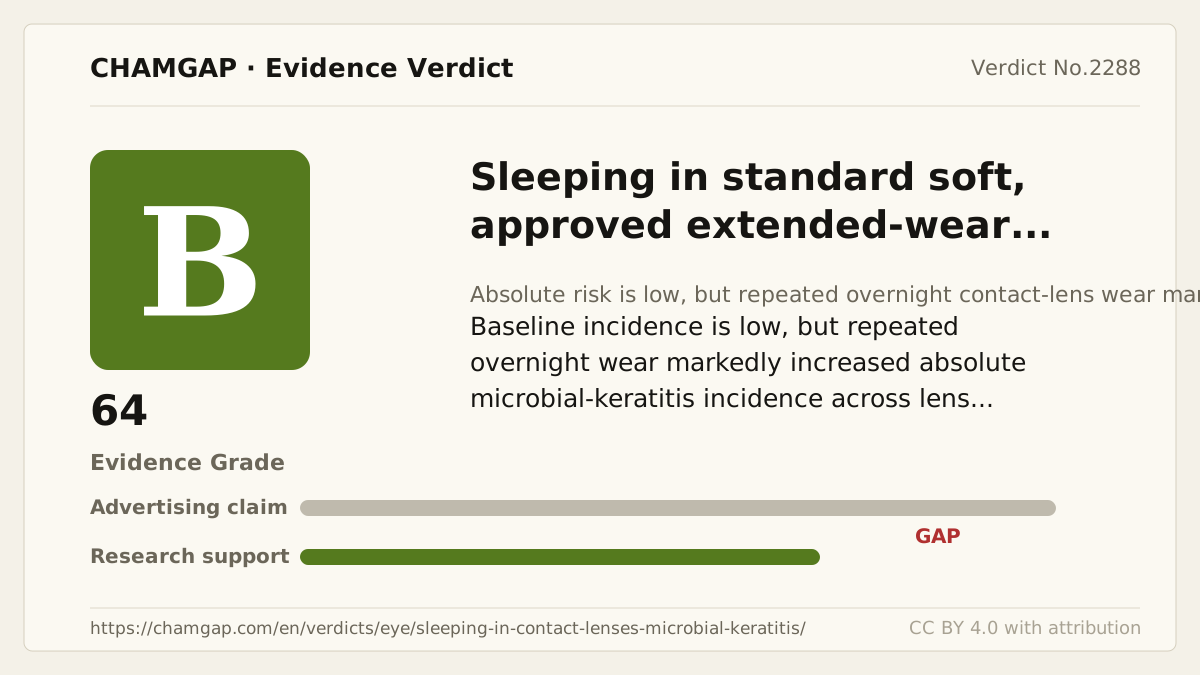
[Chamgap] Sleeping in contact lenses x microbial keratitis — Evidence Grade B·70. 2 cited sources checked. Source: https://chamgap.com/en/verdicts/eye/sleeping-in-contact-lenses-microbial-keratitis/ · CC BY 4.0CC BY 4.0 — free to use with attribution; do not distort grades, numbers, or verdict meaning.
What this document does and does not do
Chamgap is an information source. It reports what research has and has not confirmed; it does not tell readers what to take or buy. That decision belongs to readers and, when needed, medical or legal professionals. This verdict reflects literature available up to the search date and may change as new research appears. Nothing here is medical advice.