
Selective laser trabeculoplasty,
does it really help with Reduced disease progression and need for incisional glaucoma surgery as first-line treatment for open-angle glaucoma or ocular hypertension?
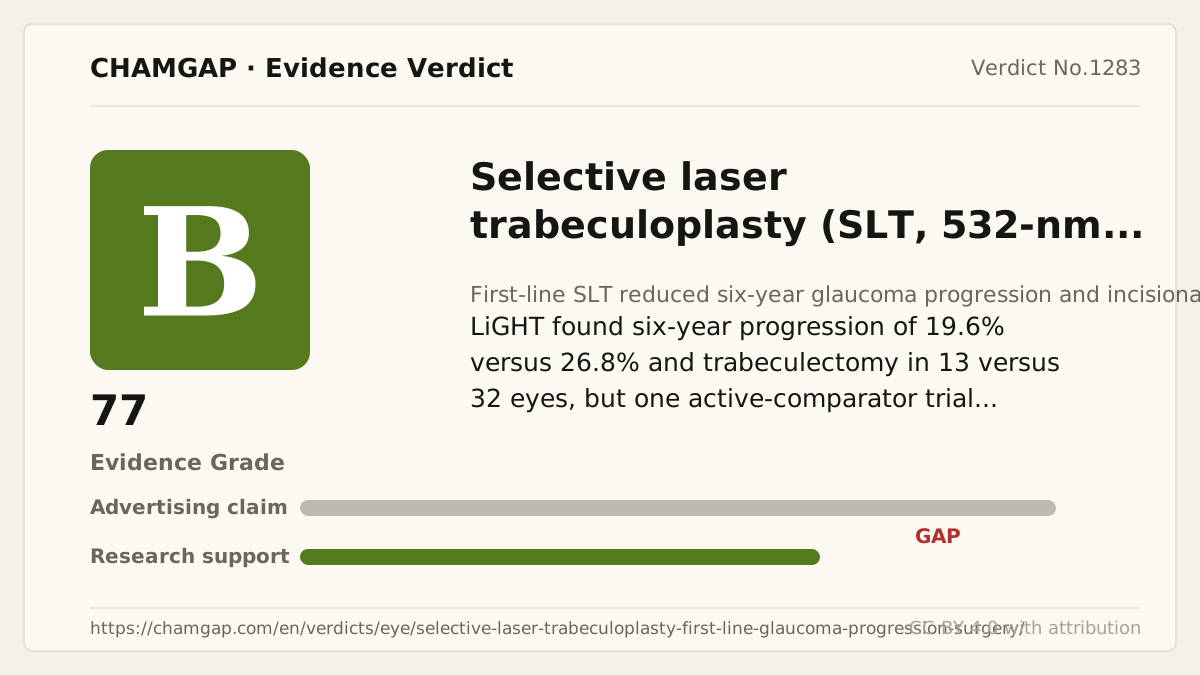
research showsFirst-line SLT for open-angle glaucoma or ocular hypertension is rated B. At six years in the randomized United Kingdom LiGHT trial, disease progression occurred in 19.6% of the Laser-First arm and 26.8% of the Medicine-First arm (P=0.006), while trabeculectomy was required in 13 versus 32 eyes (P<0.001). At six years, 69.8% of eyes in the SLT arm remained at or below target intraocular pressure without medical or surgical treatment. Progression and incisional surgery are clinically important endpoints, but blindness itself was not directly demonstrated and the core long-term evidence comes from one active-comparator trial. This supports B with 77 points.
ads claimOne laser treatment does not guarantee a lifetime without drops or surgery. The effect can diminish, repeat SLT or medication may be required, and intraocular pressure, visual fields, and the optic nerve still require ongoing follow-up.
Useful facts when choosing a product
- SLT applies a 532-nm frequency-doubled Q-switched Nd:YAG laser to the trabecular meshwork to improve aqueous outflow and lower intraocular pressure. It is an outpatient, nonincisional procedure.
- The LiGHT pathway used SLT first in treatment-naive open-angle glaucoma or ocular hypertension, with repeat SLT or eye drops added according to target pressure.
- The effect may not be permanent, so regular pressure measurement, visual-field testing, and optic-nerve assessment remain necessary. Repeat treatment, drops, or incisional surgery may be needed if targets are missed.
- Transient discomfort, redness, blurred vision, anterior-chamber inflammation, and a short-term pressure rise can occur. LiGHT reported no serious laser-related adverse events, but postprocedure pressure checking remains important.
Chamgap Semantic Classification Code
Candidate index · review held
P.selective-laser-trabeculoplasty.ophthalmic.disease-progression-and-need-for-incisional-glaucoma-surgery-as-first-line-treatment-for-open-angle-glaucoma-or-ocular-hypertension.reduce.activeProcedures, devices and tests > Selective laser trabeculoplasty > Ophthalmic > disease progression and need for incisional glaucoma surgery as first-line treatment for open-angle glaucoma or ocular hypertension > Reduction claim > Active comparator
An automated migration candidate, not an issued permanent code; exact claim scope remains under review. This machine-generated migration candidate helps retrieval but is not a permanent assignment. The original verdict ID and URL remain authoritative.
What the research actually shows
LiGHT randomized 718 treatment-naive patients, representing 1,235 eyes, with open-angle glaucoma or ocular hypertension at six United Kingdom hospitals to a Laser-First or Medicine-First pathway. At three years, eyes were at target pressure at 93.0% versus 91.3% of visits, and pressure-lowering glaucoma surgery was required in zero versus 11 patients. Of 692 participants completing three years, 633 entered the extension and 524 completed six years. At six years, progression was 19.6% versus 26.8%, trabeculectomy was required in 13 versus 32 eyes, and 69.8% of SLT-arm eyes were at or below target pressure without medical or surgical treatment. These findings support long-term clinical pathway benefit beyond pressure lowering, but do not directly prove prevention of vision loss.
Why this is classified as B (77)
The publicly funded multicenter LiGHT trial randomized 718 participants and followed the pathway for six years, finding disease progression of 19.6% versus 26.8% and trabeculectomy in 13 versus 32 eyes with Laser-First versus Medicine-First treatment. Clinical endpoints beyond pressure lowering and long duration are strong, but the absence of a direct blindness endpoint and reliance on one active-comparator extension support B with 77 points.
Counterpoint. Medicine-First treatment remains effective for patients who can use drops and do not want laser. SLT's relative advantage is a greater chance of reducing medication burden and later surgery, not a guarantee of eliminating drops in every eye.
Rejudgment record. New verdict — Applied B because six-year follow-up of the publicly funded multicenter randomized LiGHT trial showed that a Laser-First pathway reduced disease progression and trabeculectomy versus a Medicine-First pathway, extending beyond pressure surrogacy, but blindness was not directly measured and the evidence is an extension of one active-comparator trial
Sub-claim grades by effect
This ingredient is marketed for several effects. A single overall grade blends strong and weak claims together, so each effect is graded separately here. The overall grade reflects the strongest disconfirming or core claim.
| Effect (sub-claim) | Grade | Basis |
|---|---|---|
| Reduced disease progression in open-angle glaucoma or ocular hypertension | B | Six-year progression was 19.6% with Laser-First versus 26.8% with Medicine-First treatment, but blindness was not directly measured. |
| Reduced need for incisional glaucoma surgery | B | Trabeculectomy at six years was required in 13 versus 32 eyes. |
| Maintenance of target pressure without eye drops | B | At six years, 69.8% of eyes in the SLT arm remained at or below target pressure without medical or surgical treatment. |
Cross-check — AI research and Codex final gate
Evidence Table
| Study | Design | Sample | Funding | Endpoint | Result | Weight |
|---|---|---|---|---|---|---|
| Gazzard G et al.; LiGHT Trial Study Group. 2019 | Multicenter observer-masked randomized active-controlled trial | 718 patients and 1,235 eyes; 356 Laser-First and 362 Medicine-First | Predominantly public funding from the United Kingdom NIHR Health Technology Assessment program | Three-year health-related quality of life, target pressure, drop freedom, and glaucoma surgery | Eyes were at target pressure at 93.0% versus 91.3% of visits; pressure-lowering glaucoma surgery was required in zero versus 11 patients. | Core first-line randomized trial |
| Gazzard G et al.; LiGHT Trial Study Group. 2023 | Six-year extension preserving original randomized assignment | 692 completed three years; 633 entered the extension and 524 completed six years | United Kingdom NIHR Health Technology Assessment program and Moorfields Eye Charity | Disease progression, trabeculectomy, and medication-free target pressure | Progression was 19.6% versus 26.8% (P=0.006), trabeculectomy 13 versus 32 eyes (P<0.001), and 69.8% of SLT eyes maintained target pressure without medical or surgical treatment. | Key long-term progression and surgery endpoints |
Receipt — 2 References
All 2 cited sources were verified for existence at the original page (as of 2026-07-24).
Final verification and publication gate: Codex · Evidence date: 2026-07-24 · Corrections: none
Cite this verdict
[Chamgap] Selective laser trabeculoplasty x reduced glaucoma progression and incisional surgery — Evidence Grade B·77. 2 cited sources checked. Source: https://chamgap.com/en/verdicts/eye/selective-laser-trabeculoplasty-first-line-glaucoma-progression-surgery/ · CC BY 4.0CC BY 4.0 — free to use with attribution; do not distort grades, numbers, or verdict meaning.
What this document does and does not do
Chamgap is an information source. It reports what research has and has not confirmed; it does not tell readers what to take or buy. That decision belongs to readers and, when needed, medical or legal professionals. This verdict reflects literature available up to the search date and may change as new research appears. Nothing here is medical advice.