
Extra school-day outdoor time,
does it really help with Reduced first onset of myopia in children without baseline myopia?
research showsThe grade is A with 86 points. In Shanghai, two-year incidence was 24.9% (401/1,608) in controls, 20.6% (387/1,878) in the 40-minute arm, and 23.8% (376/1,581) in the 80-minute arm. Guangzhou found 30.4% (259/853) versus 39.5% (287/726), adjusted odds ratio 0.73 (0.57-0.92). A Taiwan trial funded by Taiwan's Ministry of Health reported no commercial conflict and had 18 authors, none overlapping with Shanghai or Guangzhou; complete-data incidence was 14.47% (34/235) versus 17.40% (67/385), confirming same-direction replication by an independent team and funding source. Its odds ratio was 0.65 (0.42-1.01), P=.054, so the confidence interval included 1.
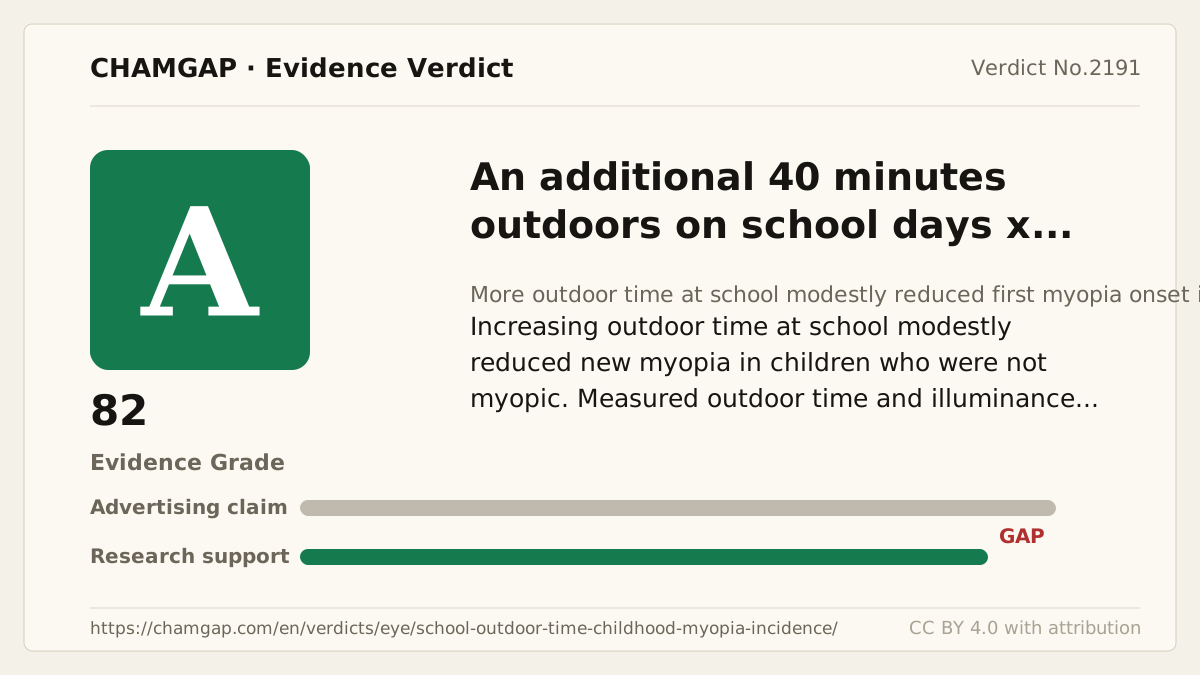
ads claimRandomized human evidence supports increasing outdoor time to delay myopia onset. It does not prove that exactly 40 minutes is optimal or that 80 minutes doubles benefit.
Useful facts when choosing a product
- Wrist-device measurements in Shanghai found about 127 outdoor minutes daily in both intervention arms versus 106 minutes in controls.
- Reported mean illuminance-related values were about 3,557-3,662 lux in intervention groups and 2,984 lux in controls; these are exposure measurements, not efficacy outcomes.
- Verdict 1176 is C with 52 points, verdict 1575 is C with 55 points, verdict 1715 is C with 50 points, and verdict 1765 is C with 55 points for devices that slow established myopia. This verdict concerns a behavior and first onset in nonmyopic children.
Chamgap Semantic Classification Code
Candidate index · review held
UNK.additional-outdoors-on-school-days.UNK.first-onset-of-myopia-without-baseline-myopia.reduce.UNKUnknown > additional outdoors on school days > Unknown > first onset of myopia without baseline myopia > Reduction claim > Unknown
An automated migration candidate, not an issued permanent code; exact claim scope remains under review. This machine-generated migration candidate helps retrieval but is not a permanent assignment. The original verdict ID and URL remain authoritative.
What the research actually shows
Shanghai used generalized estimating equations to account for school clustering, 1% cyclopentolate cycloplegic autorefraction, and optical axial-length measurement. Examiners and statisticians were masked; 19.5% attrition was balanced across groups (P=.140). Guangzhou found 30.4% (259/853) versus 39.5% (287/726), adjusted odds ratio 0.73 (0.57-0.92). All 18 Taiwan authors were distinct from the two Chinese trial teams, and Taiwan Ministry of Health funding and no commercial conflicts were reported; complete-data incidence was 14.47% (34/235) versus 17.40% (67/385). The Cochrane synthesis at two years included three trials and 2,104 children: 22.5% versus 26.7%, risk ratio 0.84 (0.72-0.98), with moderate certainty; the heterogeneity value was not confirmed. Shanghai funding included Brien Holden Vision Institute, and several authors were affiliated with it. The institute states that it invents, prototypes, and licenses contact and spectacle lenses and holds myopia-control lens patents. Both points matter, although the intervention judged here is free outdoor activity, so the interest does not point toward inflating its effect.
Why this is classified as A (86)
A diagnosed event fell in large cluster-randomized trials, and a Taiwan Ministry of Health-funded trial with no overlapping authors replicated the direction, making this the first A among 240 verdicts in this series, with 82 points. Shanghai and Guangzhou shared three authors and are not independent; Taiwan's confidence interval included 1, and no dose response was established.
Counterpoint. Slowing refractive or axial progression after myopia has developed is outside this onset-prevention verdict.
Rejudgment record. Cross-check applied — Shanghai, Guangzhou, and Taiwan school trials and the 2024 Cochrane review were cross-checked for incidence outcomes, cluster adjustment, achieved outdoor time, author overlap, independent funding, confidence intervals, and conflicts
| Endpoint | H | Hard endpoint - actual events such as death |
| Replication | R2 | Independently replicated across trials |
| Independence | I2 | Decisive evidence is publicly or non-profit funded |
| Effect size | E+ | Meets the clinically important threshold |
Stored derived and displayed grades match; this is not a current recalculation or validity check (A).
Sub-claim grades by effect
This ingredient is marketed for several effects. A single overall grade blends strong and weak claims together, so each effect is graded separately here. The overall grade reflects the strongest disconfirming or core claim.
| Effect (sub-claim) | Grade | Basis |
|---|---|---|
| Reduced first onset of myopia in nonmyopic children | A | School-level randomized trials reduced incidence, with same-direction replication by an independent team and funding source. |
| Longer assigned outdoor time produces a linearly larger preventive effect | D | The 80-minute arm was not better, and achieved outdoor time was similar. |
Cross-check — AI research and Codex final gate
Evidence Table
| Study | Design | Sample | Funding | Endpoint | Result | Weight |
|---|---|---|---|---|---|---|
| He X et al., Ophthalmology, 2022 | Three-arm, 24-school cluster-randomized examiner-masked trial | 6,295 assigned; 5,067 in the two-year incidence analysis | Chinese national and Shanghai public programs, National Natural Science Foundation of China, and Brien Holden Vision Institute | Two-year incident myopia by cycloplegic refraction | 20.6% versus 24.9%; cluster-adjusted IRR 0.84 (95% CI 0.72-0.99) | Pivotal direct event evidence |
| He M et al., JAMA, 2015 | 12-school cluster-randomized trial | 1,903 assigned; 1,579 initially nonmyopic children in incidence analysis | Public and academic research support as reported in the article | Three-year cumulative myopia incidence | 30.4% versus 39.5%; difference -9.1 points (95% CI -14.1 to -4.1) | Longer school trial in the same direction |
Receipt — 4 References
All 4 cited sources were verified for existence at the original page (as of 2026-08-04).
Final verification and publication gate: Codex · Evidence date: 2026-08-04 · Corrections: none
Cite this verdict
[Chamgap] Extra school-day outdoor time x prevention of childhood myopia onset — Evidence Grade A·86. 4 cited sources checked. Source: https://chamgap.com/en/verdicts/eye/school-outdoor-time-childhood-myopia-incidence/ · CC BY 4.0CC BY 4.0 — free to use with attribution; do not distort grades, numbers, or verdict meaning.
What this document does and does not do
Chamgap is an information source. It reports what research has and has not confirmed; it does not tell readers what to take or buy. That decision belongs to readers and, when needed, medical or legal professionals. This verdict reflects literature available up to the search date and may change as new research appears. Nothing here is medical advice.