
Saffron extract,
does it really help with Lowering intraocular pressure and inhibiting progression when added to existing eye-drop treatment for primary open-angle glaucoma?
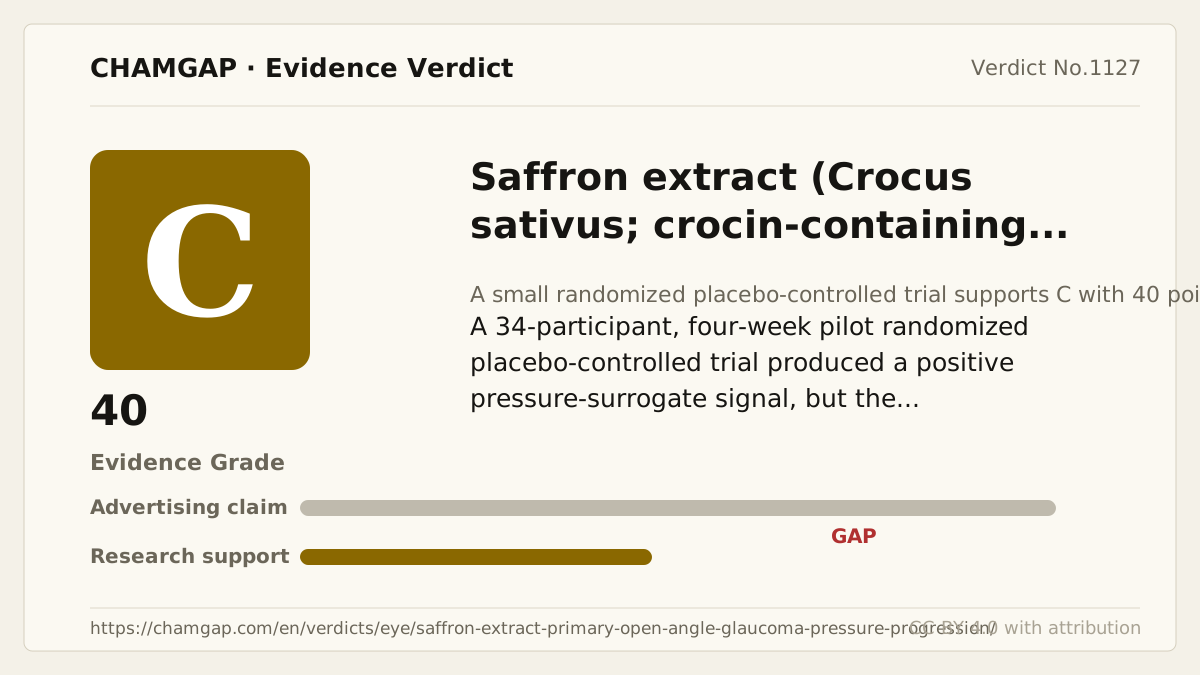
research showsThe overall claim for adding saffron extract to glaucoma eye drops is rated C. A four-week pilot randomized placebo-controlled trial in 34 participants found a small positive signal with 30 mg per day: mean intraocular pressure at week 4 was 10.6 mmHg versus 13.8 mmHg. This supports C for short-term pressure lowering. However, pressure is a surrogate, each arm had only 17 participants, and only one specific aqueous extract was tested. There is no direct human evidence for this extract on visual-field preservation, optic-nerve structure, or inhibition of glaucoma progression, so each of those outcomes remains ?. The overall verdict is therefore C with 40 points, the bottom of the C band. Absence of adverse events in a short trial is not generalized to long-term safety or different products.
ads claimMarketing can expand a brief pressure-care signal into optic-nerve protection, preserved visual fields, or stopped glaucoma progression. The actual trial added one aqueous extract at 30 mg to two established eye drops for four weeks and did not test visual fields or long-term progression.
Useful facts when choosing a product
- The direct trial used a particular aqueous saffron extract at 30 mg per day, while commercial supplements can differ in crocin, crocetin, and safranal content and extraction method.
- Participants continued timolol and dorzolamide, so the study does not support replacing established glaucoma treatment with saffron.
- No adverse events were reported during the four-week trial, but 34 short-term observations cannot establish long-term safety or detect rare events.
- Higher supplemental doses can cause gastrointestinal symptoms, and supplemental use during pregnancy should be avoided or discussed with a clinician. Glaucoma drops should never be stopped without medical guidance.
Chamgap Semantic Classification Code
Candidate index · review held
S.saffron-extract.UNK.intraocular-pressure-and-inhibiting-progression-when-added-to-existing-eye-drop-treatment-for-primary-open-angle-glaucoma.reduce.MULTISupplements and nutraceuticals > Saffron extract > Unknown > intraocular pressure and inhibiting progression when added to existing eye-drop treatment for primary open-angle glaucoma > Reduction claim > Multiple: primary unresolved
An automated migration candidate, not an issued permanent code; exact claim scope remains under review. This machine-generated migration candidate helps retrieval but is not a permanent assignment. The original verdict ID and URL remain authoritative.
What the research actually shows
Jabbarpoor Bonyadi and colleagues randomized 34 stable patients with primary open-angle glaucoma who continued timolol and dorzolamide to aqueous saffron extract 30 mg per day or placebo. Baseline pressure was 12.9 versus 14.0 mmHg and week-four pressure was 10.6 versus 13.8 mmHg; the difference disappeared after a one-month washout. The trial used pressure as its main outcome and was not large or long enough to test progression or visual-field loss. A 2019 review of 33 nutritional-intervention studies found the glaucoma evidence inconclusive, and a 2022 review likewise judged most clinical findings for saffron and other candidate antioxidants inconclusive.
Why this is classified as C (40)
A 34-participant, four-week pilot randomized placebo-controlled trial found a small positive pressure signal versus placebo, providing direct human evidence. Because pressure is a surrogate and the evidence comes from 17 participants per arm, one extract, and very short exposure, the maximum verdict is C with 40 points, the bottom of the C band. Visual-field preservation, optic-nerve structure, and progression inhibition each remain ? because direct human evidence for this extract is absent. Short-term tolerability does not establish long-term safety.
Counterpoint. Anyone choosing a supplement should tell the glaucoma specialist the product and dose while continuing the established eye-drop, laser, or surgical plan. Progression assessment requires repeated visual-field and optic-nerve or retinal nerve-fiber testing, not pressure alone.
Rejudgment record. Cross-check applied — Accepted the lower pressure versus placebo in the 34-participant, four-week pilot randomized trial as a small positive direct human signal. Surrogate-only measurement, 17 participants per arm, and testing of one extract cap the overall verdict at C with 40 points, the bottom of the band; visual-field preservation, optic-nerve structure, and progression inhibition each remain ? because direct human evidence for this extract is absent
Sub-claim grades by effect
This ingredient is marketed for several effects. A single overall grade blends strong and weak claims together, so each effect is graded separately here. The overall grade reflects the strongest disconfirming or core claim.
| Effect (sub-claim) | Grade | Basis |
|---|---|---|
| Short-term intraocular-pressure lowering as an adjunct to existing eye drops | C | A positive 34-participant, four-week pilot signal exists, but it is a surrogate from one small trial of one extract. |
| Long-term inhibition of primary open-angle glaucoma progression | ? | No direct human trial was found evaluating long-term visual-field or optic-nerve progression with saffron. |
| Prevention of glaucomatous visual-field loss | ? | The only direct trial measured pressure only, leaving no efficacy literature on preservation of visual fields. |
Cross-check — AI research and Codex final gate
Evidence Table
| Study | Design | Sample | Funding | Endpoint | Result | Weight |
|---|---|---|---|---|---|---|
| Jabbarpoor Bonyadi MH, Yazdani S, and Saadat S. 2014 | Prospective comparative randomized placebo-controlled pilot intervention | 34 patients with primary open-angle glaucoma; 17 per group | Inadequately reported; academic-center study | Four-week intraocular pressure after add-on to timolol and dorzolamide | Week-four pressure was 10.6±3.0 versus 13.8±2.2 mmHg (p=0.001); the difference disappeared after washout and progression was not measured. | Only direct small surrogate trial |
| Loskutova E et al. 2019 | Systematic review of nutritional interventions for glaucoma | 33 intervention studies, including 21 randomized trials | Academic support from Dublin Institute of Technology; no proprietary interest reported | Intraocular pressure, ocular blood flow, visual-field, and progression-related outcomes | Theoretical rationale and early signals existed, but evidence was inconclusive and higher-quality research was needed. | Confirmation of evidence uncertainty |
| Chaudhry S et al. 2022 | Structured review of nutritional supplementation for glaucoma prevention and treatment | 71 interventional, in vivo, and in vitro studies; 11 randomized trials | Academic review; limited product-specific independent clinical evidence | Oxidative stress, intraocular pressure, and glaucoma-progression outcomes | Saffron and other candidates warranted more research, while most clinical findings remained inconclusive. | Later evidence-gap confirmation |
Receipt — 3 References
All 3 cited sources were verified for existence at the original page (as of 2026-07-22).
Final verification and publication gate: Codex · Evidence date: 2026-07-22 · Corrections: none
Cite this verdict
[Chamgap] Saffron extract x intraocular-pressure reduction and progression inhibition in primary open-angle glaucoma — Evidence Grade C·40. 3 cited sources checked. Source: https://chamgap.com/en/verdicts/eye/saffron-extract-primary-open-angle-glaucoma-pressure-progression/ · CC BY 4.0CC BY 4.0 — free to use with attribution; do not distort grades, numbers, or verdict meaning.
What this document does and does not do
Chamgap is an information source. It reports what research has and has not confirmed; it does not tell readers what to take or buy. That decision belongs to readers and, when needed, medical or legal professionals. This verdict reflects literature available up to the search date and may change as new research appears. Nothing here is medical advice.