
Riboflavin-UVA corneal cross-linking,
does it really help with Prevention of corneal protrusion or K-value progression and visual deterioration in progressive keratoconus?
research showsStandard epithelium-off riboflavin-UVA corneal cross-linking is rated B for slowing progressive keratoconus. In the randomized KERALINK trial, progression at 18 months occurred in 7% with CXL and 43% with standard care, and syntheses of several small randomized trials support keratometric stabilization. K values remain surrogate measures and trials are small and relatively short, so prevention of visual deterioration is separately rated C and reduced need for transplantation is treated only as a long-term observational signal.
ads claimMarketing may expand stabilization into restoration of a normal cornea, freedom from glasses or lenses, or permanent avoidance of transplantation. The established benefit is a greater chance of slowing or stopping progression, not complete reversal of irregular astigmatism and existing visual damage.
Useful facts when choosing a product
- Standard epithelium-off CXL removes the corneal epithelium, saturates the cornea with riboflavin, and applies a specified UVA dose to strengthen collagen bonding.
- Candidates generally have objectively documented progression, and suitability depends on corneal thickness, scarring, age, and protocol, requiring assessment by a corneal specialist.
- Pain, photophobia, blurred vision, and an epithelial defect are common for several days; infectious keratitis, persistent haze, scarring, and vision loss are uncommon but important risks.
- CXL is not refractive surgery, so glasses, contact lenses, or later visual rehabilitation may still be required after progression stabilizes.
Chamgap Semantic Classification Code
Candidate index · review held
P.riboflavin-uva-corneal-collagen-cross-linking.ophthalmic.corneal-protrusion-or-k-value-progression-and-visual-deterioration-in-progressive-keratoconus.prevent.usual-careProcedures, devices and tests > Riboflavin-UVA corneal collagen cross-linking > Ophthalmic > corneal protrusion or K-value progression and visual deterioration in progressive keratoconus > Occurrence-prevention claim > Usual care
An automated migration candidate, not an issued permanent code; exact claim scope remains under review. This machine-generated migration candidate helps retrieval but is not a permanent assignment. The original verdict ID and URL remain authoritative.
What the research actually shows
KERALINK assigned 60 adolescents with progressive keratoconus to epithelium-off CXL or standard care and assessed K2 and progression at 18 months. Progression occurred in 2 of 30 versus 12 of 28 evaluable participants. A 2015 meta-analysis of six randomized trials reported favorable one-year changes in Kmax and corrected visual acuity, while the uncorrected visual acuity difference was not significant, and studies were small and heterogeneous. A five-year multicenter registry provides longer-term stabilization signals, but its nonrandomized design cannot establish reduced transplantation.
Why this is classified as B (68)
Progression events fell from 43% to 7% in a randomized standard-care comparison and randomized-trial syntheses support keratometric stabilization, giving B with 68 points. Keratometric surrogacy, small samples, limited follow-up, and protocol heterogeneity keep prevention of visual loss at C and transplantation reduction observational.
Counterpoint. For a young person with documented progression, delay can permit irreversible protrusion, making timely specialist discussion valuable. The benefit-risk balance differs in stable disease or a very thin cornea.
Rejudgment record. Cross-check applied — Applied boundary rule ③ because the randomized KERALINK standard-care comparison reduced prespecified keratoconus progression at 18 months from 43% to 7% and randomized-trial syntheses support stabilization, with deductions for surrogate-heavy outcomes, small samples, limited follow-up, and protocol heterogeneity. At cross-check the score was lowered to 68 for the 60-participant KERALINK sample and a progression definition based mainly on keratometry change (grade B retained).
Sub-claim grades by effect
This ingredient is marketed for several effects. A single overall grade blends strong and weak claims together, so each effect is graded separately here. The overall grade reflects the strongest disconfirming or core claim.
| Effect (sub-claim) | Grade | Basis |
|---|---|---|
| Prevention of corneal protrusion or K-value progression | B | A randomized standard-care comparison found 18-month progression of 7% versus 43%, with randomized-trial syntheses supporting the direction. |
| Prevention of visual deterioration | C | Visual-acuity measures favor CXL in some randomized trials, but samples are small, follow-up is short, and visual recovery is not guaranteed. |
| Reduced need for corneal transplantation | C | Long-term registry and observational signals exist, but adequate randomized long-term evidence using transplantation itself as an endpoint is absent. |
Cross-check — AI research and Codex final gate
Evidence Table
| Study | Design | Sample | Funding | Endpoint | Result | Weight |
|---|---|---|---|---|---|---|
| Larkin DFP et al. 2021 KERALINK | Multicenter randomized standard-care-controlled trial | 60 participants aged 10 to 16 years; 30 CXL and 28 standard-care participants analyzed at 18 months | Public funding from the United Kingdom NIHR | K2 and prespecified keratoconus progression at 18 months | Progression occurred in 2 CXL participants (7%) and 12 standard-care participants (43%), with K2 also favoring CXL. | Key direct randomized evidence |
| Li J et al. 2015 | Systematic review and meta-analysis of randomized controlled trials | Six randomized controlled trials | Academic research; no reported commercial funding | One-year Kmax, corrected and uncorrected distance visual acuity, and corneal thickness | CXL favored Kmax and visual-acuity measures, but trials were small and lacked long-term follow-up. | Supports replication with limited certainty |
| Ferdi AC et al. 2023 registry report | Prospective multicenter observational registry study | Forty-one centers in five countries with follow-up to five years | Save Sight Registries infrastructure | One-to-five-year changes in visual acuity, Kmax, K2, and thinnest corneal thickness | Long-term stabilization signals were observed in most patients, but the nonrandomized design cannot establish reduced transplantation. | Supporting long-term observational evidence |
Receipt — 3 References
All 3 cited sources were verified for existence at the original page (as of 2026-07-23).
Final verification and publication gate: Codex · Evidence date: 2026-07-23 · Corrections: none
Cite this verdict
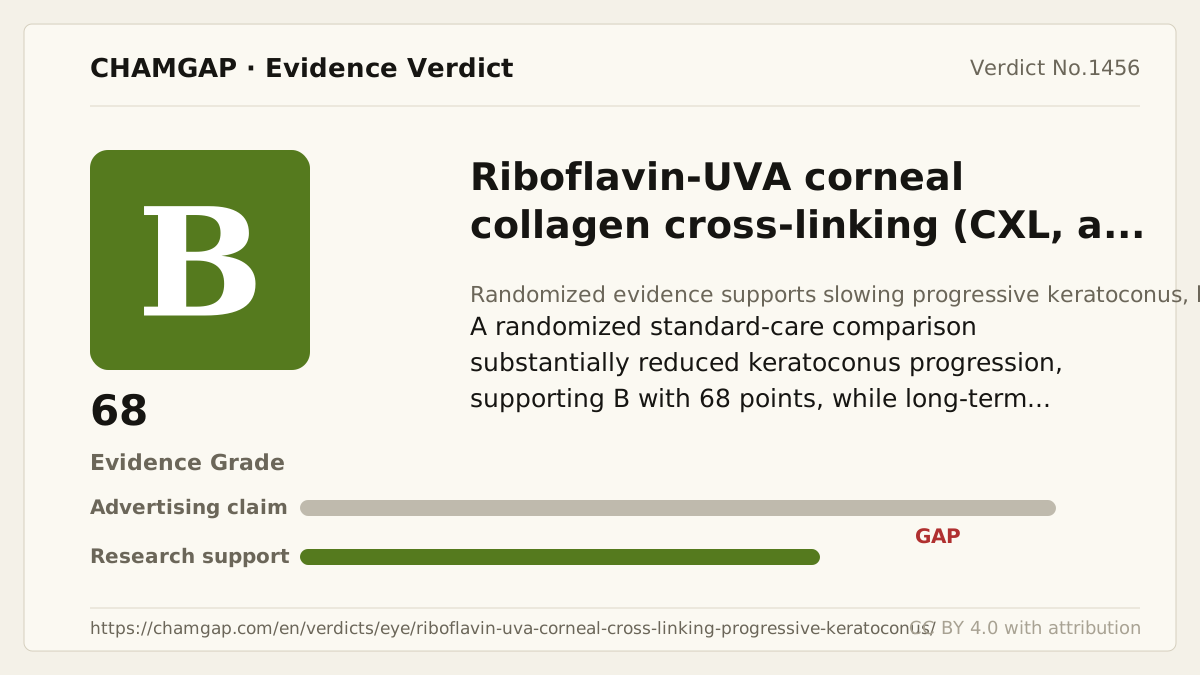
[Chamgap] Riboflavin-UVA corneal cross-linking x slowing progressive keratoconus — Evidence Grade B·68. 3 cited sources checked. Source: https://chamgap.com/en/verdicts/eye/riboflavin-uva-corneal-cross-linking-progressive-keratoconus/ · CC BY 4.0CC BY 4.0 — free to use with attribution; do not distort grades, numbers, or verdict meaning.
What this document does and does not do
Chamgap is an information source. It reports what research has and has not confirmed; it does not tell readers what to take or buy. That decision belongs to readers and, when needed, medical or legal professionals. This verdict reflects literature available up to the search date and may change as new research appears. Nothing here is medical advice.