
Reusable contact lenses,
does it really help with Higher incidence of Acanthamoeba keratitis, a form of microbial keratitis, than with daily disposable lenses?
research showsThe grade is B with 72 points. A case-control study compared 83 cases with 122 contact-lens-wearing emergency-eye controls and found 3.84-fold higher odds of Acanthamoeba keratitis with daily-wear reusable soft lenses than with daily disposables (95% CI 1.75-8.43). This supports the harm claim, but it was not a cohort capable of measuring incidence directly and remains vulnerable to control selection and recall of past lens behavior.
ads claimReplacement schedule, water exposure, overnight wear, solution reuse, and case hygiene should be stated separately rather than collapsed into the word reusable.
Useful facts when choosing a product
- The outcome was Acanthamoeba keratitis, not a pooled endpoint covering all bacterial and fungal keratitis.
- Reusable soft lenses require storage and disinfection steps that daily disposables avoid.
- Verdict 2288 is B with 70 points for sleeping in contact lenses; this verdict compares daytime reusable with daily disposable wear.
Chamgap Semantic Classification Code
Candidate index · review held
UNK.wear-reusable-soft-contact-lenses-that-are-cleaned-and-stored.UNK.higher-incidence-of-acanthamoeba-keratitis-a-form-of-microbial-keratitis-than-with-daily-disposable-lenses.increase.UNKUnknown > wear reusable soft contact lenses that are cleaned and stored > Unknown > Higher incidence of Acanthamoeba keratitis, a form of microbial keratitis, than with daily disposable lenses > Increase claim > Unknown
An automated migration candidate, not an issued permanent code; exact claim scope remains under review. This machine-generated migration candidate helps retrieval but is not a permanent assignment. The original verdict ID and URL remain authoritative.
What the research actually shows
Carnt and colleagues conducted a case-control study, not a registry cohort. They recruited 83 Acanthamoeba keratitis cases, 21 retrospectively and 62 prospectively from 2011-2014, and 122 contact lens users presenting to the same emergency department with disorders other than Acanthamoeba keratitis in 2014-2015. Daily disposables were reported by 20/83 cases and 66/122 controls. Versus daily disposables, adjusted ORs were 3.84 (1.75-8.43) for daily-wear reusable soft lenses and 4.56 (1.03-20.19) for rigid lenses. Within daily-disposable users, reuse, showering, and overnight wear were separate exposures. Lens type, wear, and hygiene exposures were collected after disease onset by self-completed questionnaire. Moorfields diagnoses combined clinical records with culture, PCR, or in-vivo confocal evidence as available. A case-control design does not observe the person-time denominator and cannot provide an absolute incidence rate. Verdict 2288 is B with 70 points for sleeping in contact lenses and occurrence of microbial keratitis of any organism. This verdict instead concerns daily-wear reusable lenses and the odds of Acanthamoeba keratitis, so both exposure and pathogen scope differ.
Why this is classified as B (72)
A statistically significant association of at least medium size supports the harm claim, but one hospital-based case-control study with a control-selection limitation gives B with 72 points.
Counterpoint. An OR of 3.84 is neither a risk ratio nor an individual's absolute probability. Water exposure and overnight wear may be more actionable than lens category alone.
Rejudgment record. Cross-check applied — A significant association of at least medium size in one hospital-based case-control study, limited by control selection; post-disease self-reported exposure was retained as an inherent case-control information-bias limitation but not double-counted
| Endpoint | H | Hard endpoint - actual events such as death |
| Replication | R1 | Single confirmatory trial |
| Independence | I2 | Decisive evidence is publicly or non-profit funded |
| Effect size | E+ | Meets the clinically important threshold |
Stored derived and displayed grades match; this is not a current recalculation or validity check (B).
Sub-claim grades by effect
This ingredient is marketed for several effects. A single overall grade blends strong and weak claims together, so each effect is graded separately here. The overall grade reflects the strongest disconfirming or core claim.
| Effect (sub-claim) | Grade | Basis |
|---|---|---|
| Reusable soft lenses and Acanthamoeba keratitis | B | OR 3.84 (1.75-8.43), but based on case-control evidence. |
| Reusable lenses and all microbial keratitis | ? | The organism-specific finding was not generalized to all pathogens. |
Cross-check — AI research and Codex final gate
Evidence Table
| Study | Design | Sample | Funding | Endpoint | Result | Weight |
|---|---|---|---|---|---|---|
| Carnt N et al. 2023 | Hospital-based case-control study | 83 Acanthamoeba keratitis cases and 122 contact-lens-wearing controls with other eye disorders | Fight for Sight, Moorfields Eye Hospital Special Trustees, anonymous donors, NIHR BRC salary support, and an NHMRC fellowship; no proprietary interest | Clinically and laboratory supported Acanthamoeba keratitis | Reusable soft versus daily disposable OR 3.84 (95% CI 1.75-8.43) | Pivotal evidence for the harm association |
Receipt — 2 References
All 2 cited sources were verified for existence at the original page (as of 2026-08-07).
Final verification and publication gate: Codex · Evidence date: 2026-08-07 · Corrections: none
Cite this verdict
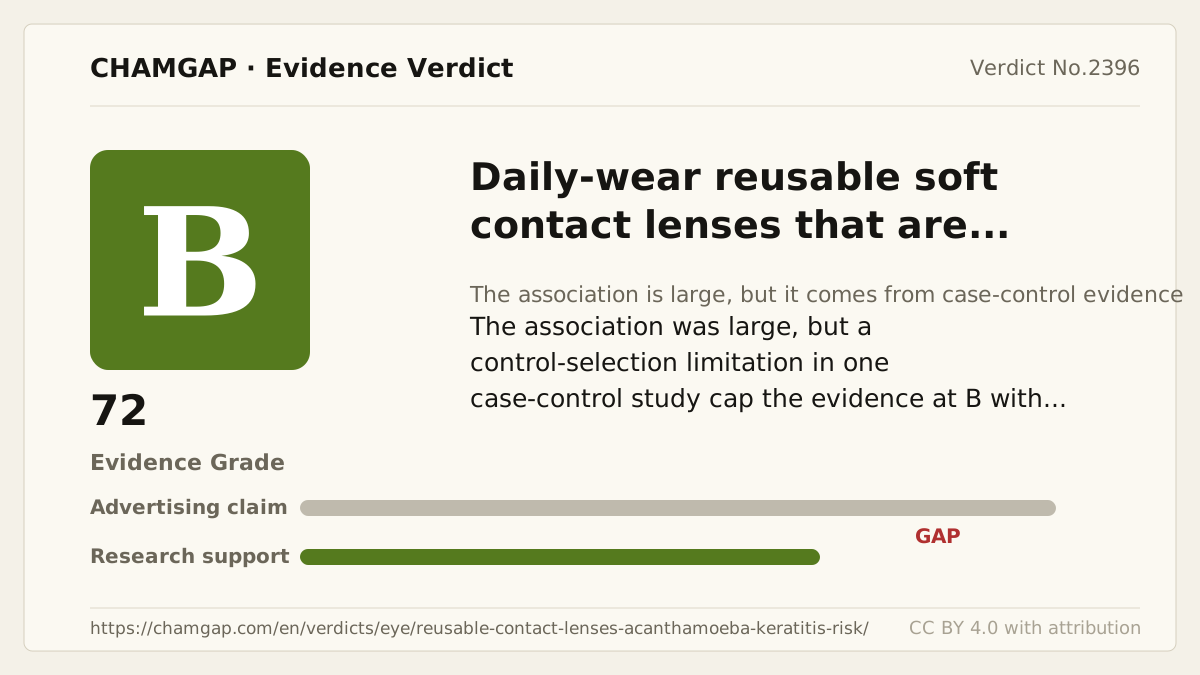
[Chamgap] Reusable contact lenses x increased microbial keratitis risk (Acanthamoeba keratitis) — Evidence Grade B·72. 2 cited sources checked. Source: https://chamgap.com/en/verdicts/eye/reusable-contact-lenses-acanthamoeba-keratitis-risk/ · CC BY 4.0CC BY 4.0 — free to use with attribution; do not distort grades, numbers, or verdict meaning.
What this document does and does not do
Chamgap is an information source. It reports what research has and has not confirmed; it does not tell readers what to take or buy. That decision belongs to readers and, when needed, medical or legal professionals. This verdict reflects literature available up to the search date and may change as new research appears. Nothing here is medical advice.