
Omega-3 fatty acids,
does it really help with Suppression of age-related macular degeneration progression and vision loss when added to an AREDS formulation?
research showsThe claim that adding EPA and DHA to an AREDS formulation further reduces age-related macular degeneration progression or vision loss is rated D. AREDS2 was a multicenter double-masked randomized trial of 4,203 adults aged 50 to 85 years at high risk of progression and followed them for about five years. Adding DHA 350 mg plus EPA 650 mg did not lower advanced AMD risk versus placebo: HR 0.97 (98.7% CI 0.82 to 1.16; P=.70). Long-term follow-up in 2022 also found no difference in late AMD by original omega-3 assignment: HR 1.01 (95% CI 0.93 to 1.09). A Cochrane review of two trials and 2,343 participants found no reduction in either advanced AMD or loss of at least 15 visual-acuity letters. This AREDS add-on axis is distinct from dry-eye verdict 164 and other retinal claims in verdict 381. Evidence for AREDS antioxidants and zinc or lutein and zeaxanthin must not be attributed to omega-3 add-on therapy.
ads claimMarketing combines the fact that DHA is a retinal component, observational associations with fish intake, and the AREDS2 name to imply that omega-3 prevents AMD progression. The omega-3 arm of AREDS2 directly tested and failed that claim.
Useful facts when choosing a product
- The AREDS2 omega-3 intervention added DHA 350 mg and EPA 650 mg daily to a base AREDS antioxidant and zinc formulation; an ordinary fish oil with a similar total amount is not automatically the same preparation.
- The commonly used AREDS2 formulation centers on vitamins C and E, zinc, copper, lutein, and zeaxanthin. EPA and DHA are not included as AMD-progression ingredients.
- Omega-3 supplements do not replace an indicated AREDS formulation, regular ophthalmic follow-up, smoking cessation, or anti-VEGF treatment for neovascular AMD.
- Usual doses are generally tolerated, but fishy eructation and gastrointestinal discomfort can occur. High doses warrant attention to bleeding tendency and atrial fibrillation, especially with anticoagulants, antiplatelet drugs, or planned surgery.
Chamgap Semantic Classification Code
Candidate index · review held
S.omega-3-fatty-acids.UNK.suppression-of-age-related-macular-degeneration-progression-and-vision-loss-when-added-to-an-areds-formulation.assess.MULTISupplements and nutraceuticals > Omega-3 fatty acids > Unknown > Suppression of age-related macular degeneration progression and vision loss when added to an AREDS formulation > Association or change assessment > Multiple: primary unresolved
An automated migration candidate, not an issued permanent code; exact claim scope remains under review. This machine-generated migration candidate helps retrieval but is not a permanent assignment. The original verdict ID and URL remain authoritative.
What the research actually shows
AREDS2 enrolled 4,203 participants with bilateral large drusen or large drusen in one eye and advanced AMD in the fellow eye. They were assigned to DHA 350 mg plus EPA 650 mg, lutein plus zeaxanthin, both, or placebo, while all were asked to take a base AREDS formulation. During five years, 1,608 participants progressed to advanced AMD, but the omega-3 group did not outperform placebo. AREDS2 Report 28 in 2022 confirmed no prevention of late AMD by original omega-3 assignment during longer follow-up. The Cochrane review by Lawrenson and Evans combined the US AREDS2 and French NAT2 trials, totaling 2,343 participants, and found no effect on advanced AMD or moderate-to-severe visual loss. The original AREDS antioxidants and zinc and the lutein-zeaxanthin substitution have separate evidence that cannot be credited to omega-3.
Why this is classified as D (22)
AREDS2 in 4,203 participants found advanced AMD precisely null at HR 0.97 (98.7% CI 0.82 to 1.16), and ten-year follow-up was also null at HR 1.01 (0.93 to 1.09), with no reduction in visual loss. Large direct clinical-outcome effects near 1.0 yield low D with 22 points.
Counterpoint. People with intermediate AMD or late AMD in one eye should ask an eye-care professional whether they meet indications for an AREDS2 formulation. Eating fish may be a separate dietary choice, but it does not establish an AMD treatment effect for omega-3 capsules.
Rejudgment record. New verdict — Applied rule ② for null large human evidence because the 4,203-participant multicenter double-masked trial of EPA and DHA added to an AREDS formulation and its long-term follow-up found no effect on advanced or late AMD, while Cochrane also found no effect on visual loss
Sub-claim grades by effect
This ingredient is marketed for several effects. A single overall grade blends strong and weak claims together, so each effect is graded separately here. The overall grade reflects the strongest disconfirming or core claim.
| Effect (sub-claim) | Grade | Basis |
|---|---|---|
| Suppression of advanced AMD by adding EPA and DHA to an AREDS formulation | D | AREDS2 in 4,203 participants found no add-on benefit at HR 0.97, with a five-year progression probability of 31% in both groups. |
| Suppression of AMD-related visual loss by omega-3 supplements | D | In Cochrane, loss of at least 15 letters was not reduced: HR 0.96 in the US trial and RR 1.25 in the French trial. |
| Additional clinical benefit of omega-3 on top of an AREDS antioxidant and zinc formulation | D | Separate effects of AREDS nutrients or lutein and zeaxanthin cannot be attributed to omega-3, and long-term follow-up was null at HR 1.01. |
Cross-check — AI research and Codex final gate
Evidence Table
| Study | Design | Sample | Funding | Endpoint | Result | Weight |
|---|---|---|---|---|---|---|
| Age-Related Eye Disease Study 2 Research Group. 2013 | Multicenter 2-by-2 factorial randomized double-masked placebo-controlled phase 3 trial | 4,203 participants at high risk of AMD progression; median follow-up of five years | Public NIH support including the US National Eye Institute; some study products supplied by industry | Development of advanced AMD and moderate visual loss | Adding DHA and EPA did not reduce advanced AMD (HR 0.97, 98.7% CI 0.82 to 1.16; P=.70). | Decisive large direct null randomized trial |
| Bhandari S et al. 2022 AREDS2 Report 28 | Long-term follow-up of the original randomized cohort | Original AREDS2 cohort of 4,203 participants | Public funding from the US National Eye Institute and NIH | Progression to late AMD by original randomized assignment | Late-AMD progression did not differ for omega-3 versus no omega-3: HR 1.01 (95% CI 0.93 to 1.09; P=.91). | Long-term null confirmation |
| Lawrenson JG and Evans JR. 2015 Cochrane review | Systematic review and meta-analysis of omega-3 randomized trials in AMD | Two randomized trials with 2,343 participants | Cochrane Eyes and Vision; one trial publicly funded and one manufacturer funded | Advanced AMD and loss of at least 15 visual-acuity letters | Advanced AMD was null at HR 0.96 (95% CI 0.84 to 1.10), and significant visual loss was not reduced. | High-certainty null synthesis |
Receipt — 3 References
All 3 cited sources were verified for existence at the original page (as of 2026-07-20).
Final verification and publication gate: Codex · Evidence date: 2026-07-20 · Corrections: none
Cite this verdict
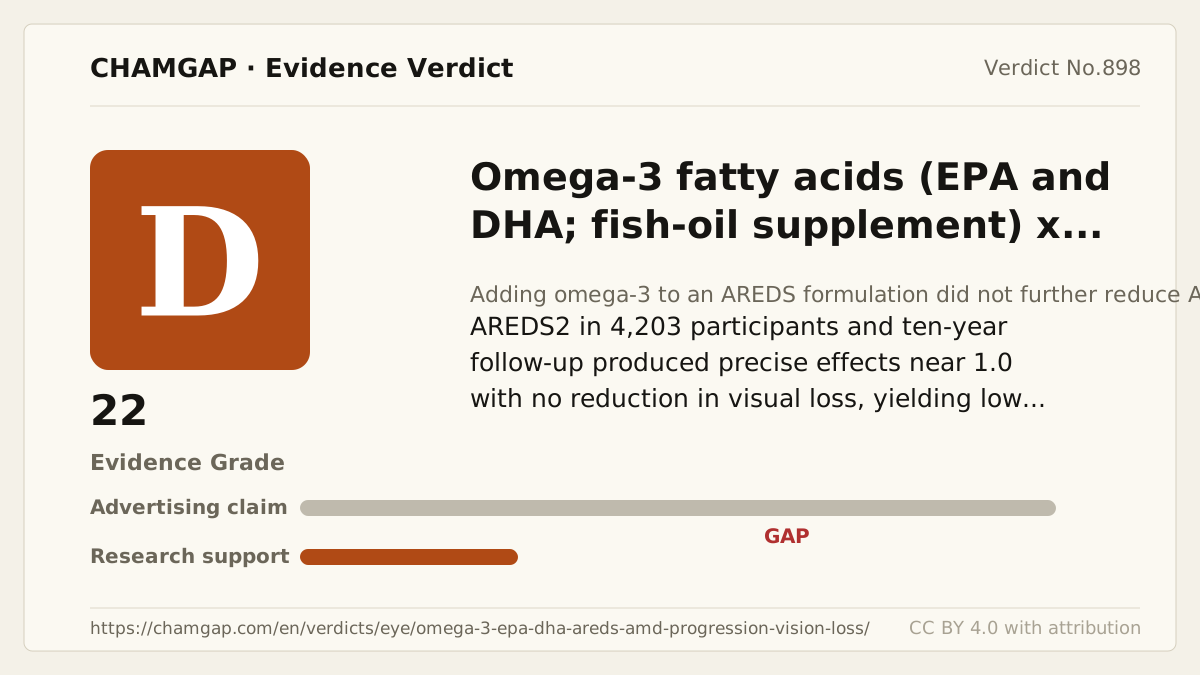
[Chamgap] Omega-3 fatty acids x suppression of age-related macular degeneration progression and vision loss when added to an AREDS formulation — Evidence Grade D·22. 3 cited sources checked. Source: https://chamgap.com/en/verdicts/eye/omega-3-epa-dha-areds-amd-progression-vision-loss/ · CC BY 4.0CC BY 4.0 — free to use with attribution; do not distort grades, numbers, or verdict meaning.
What this document does and does not do
Chamgap is an information source. It reports what research has and has not confirmed; it does not tell readers what to take or buy. That decision belongs to readers and, when needed, medical or legal professionals. This verdict reflects literature available up to the search date and may change as new research appears. Nothing here is medical advice.