
Olopatadine eye drops,
does it really help with Relief of ocular itching and redness in seasonal allergic conjunctivitis?
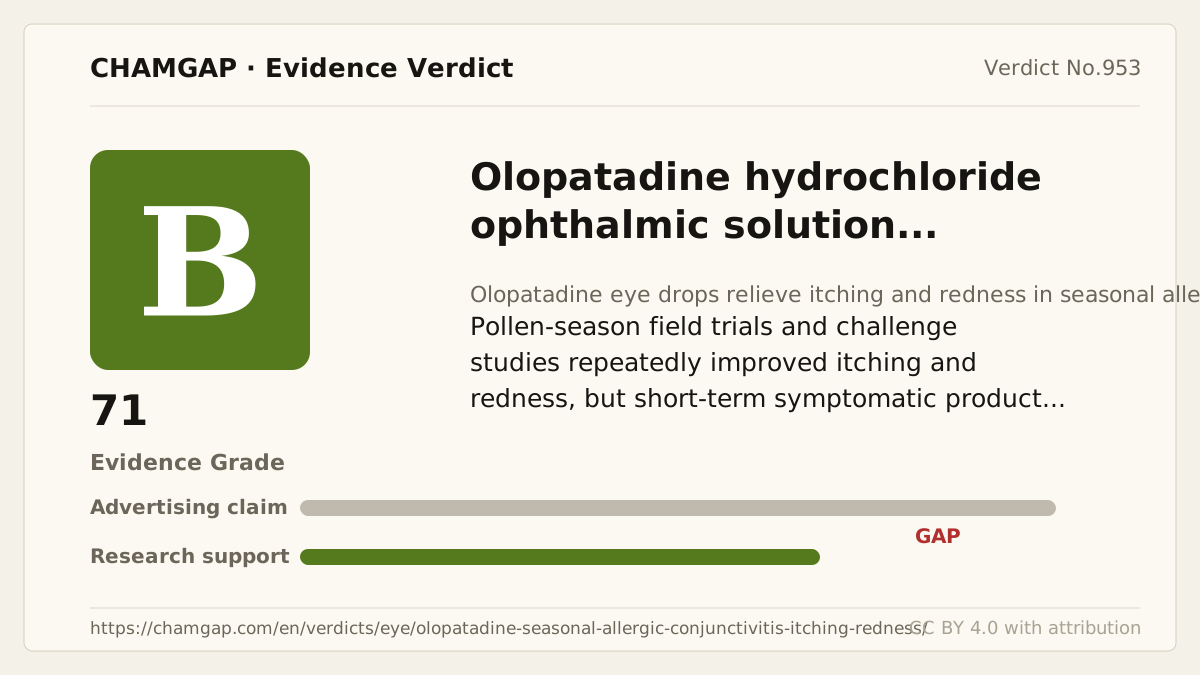
research showsOlopatadine eye drops are rated B for short-term relief of ocular itching and redness in seasonal allergic conjunctivitis. In a 260-participant, 10-week pollen-season trial, itching above moderate severity during high pollen occurred in 21% versus 47%, and redness in 14% versus 31%. A 131-participant field trial of 0.1% solution and multiple conjunctival allergen-challenge trials also found fewer symptoms and signs than placebo. A Cochrane review concluded that topical antihistamines and mast-cell stabilizers reduce short-term signs and symptoms. Endpoints remain symptom scores and challenge models, trials are short, and product-development funding is concentrated, yielding B with 71 points.
ads claimPromotion may turn symptomatic relief into blocking the cause of allergy or complete 24-hour control for everyone. The evidence supports local short-term reduction of itching and redness during allergen exposure, not modification or cure of the allergic disease.
Useful facts when choosing a product
- Olopatadine eye drops are sold in concentrations such as 0.1% and 0.2% with different authorized dosing frequencies, so the prescription and product-specific instructions should be followed.
- Brief stinging, burning, blurred vision, dry eye, or headache can occur after instillation, although clinical trials generally found the drops well tolerated.
- The bottle tip should not touch the eye or skin, and product-directed spacing from other eye drops helps avoid contamination and washout.
- Preservatives in some multidose products can be absorbed by soft contact lenses; removal and reinsertion timing should follow the specific product information.
Chamgap Semantic Classification Code
Candidate index · review held
M.olopatadine-hydrochloride-ophthalmic-solution.ophthalmic.ocular-itching-and-redness-in-seasonal-allergic-conjunctivitis.relieve.placeboMedicinal interventions > Olopatadine hydrochloride ophthalmic solution > Ophthalmic > ocular itching and redness in seasonal allergic conjunctivitis > Symptom-relief claim > Placebo
An automated migration candidate, not an issued permanent code; exact claim scope remains under review. This machine-generated migration candidate helps retrieval but is not a permanent assignment. The original verdict ID and URL remain authoritative.
What the research actually shows
Abelson 2004 randomized 260 patients with seasonal allergic conjunctivitis or rhinoconjunctivitis to once-daily olopatadine 0.2% or placebo for ten weeks during pollen season and found significantly lower itching and redness frequency and severity during high pollen. Abelson 2003 compared twice-daily 0.1% solution with artificial tears in a 10-week, seven-center field trial involving 131 evaluable participants. The 2015 Castillo Cochrane review included 30 randomized trials and 4,344 participants and supported short-term benefit from topical antihistamines and mast-cell stabilizers, while noting highly variable outcome reporting and no long-term data.
Why this is classified as B (71)
B. Natural pollen-season placebo trials involving 260 and 131 participants, repeated conjunctival challenge studies, and a 30-trial Cochrane review support direct short-term relief of itching and redness. Short symptom-score follow-up, challenge-model emphasis, reporting heterogeneity, concentrated product-development funding, and no disease-modification evidence yield B with 71 points. Instillation discomfort and lens and contamination precautions remain separate safety issues.
Counterpoint. Olopatadine can be a rapid local symptomatic option when itching is the main feature of seasonal allergic conjunctivitis. Pain, reduced vision, marked photophobia, purulent discharge, or severe unilateral redness should not be assumed to be simple allergy and warrants clinical assessment.
Rejudgment record. New verdict — Accepted direct short-term improvement of itching and redness in natural pollen-season placebo trials of 0.1% and 0.2% olopatadine and repeated conjunctival allergen-challenge trials, while applying B for short follow-up, emphasis on symptom scores and challenge models, heterogeneous reporting, and concentrated product-development funding
Sub-claim grades by effect
This ingredient is marketed for several effects. A single overall grade blends strong and weak claims together, so each effect is graded separately here. The overall grade reflects the strongest disconfirming or core claim.
| Effect (sub-claim) | Grade | Basis |
|---|---|---|
| Relief of ocular itching in seasonal allergic conjunctivitis | B | Natural pollen-season and conjunctival allergen-challenge trials repeatedly improved itching versus placebo. |
| Relief of conjunctival redness in seasonal allergic conjunctivitis | B | Observer-rated redness generally improved in both field and challenge trials. |
| Short-term control of ocular symptoms during pollen season | B | Natural-exposure trials lasting up to ten weeks support control but do not establish post-season persistence or disease modification. |
Cross-check — AI research and Codex final gate
Evidence Table
| Study | Design | Sample | Funding | Endpoint | Result | Weight |
|---|---|---|---|---|---|---|
| Abelson MB et al. 2004 | Ten-week randomized double-masked placebo-controlled natural pollen-season field trial | 260 patients with seasonal allergic conjunctivitis or rhinoconjunctivitis | Funding not stated in the PubMed abstract; product-development context | Frequency and severity of ocular itching and redness by pollen level | During high pollen, itching above moderate severity occurred in 21% versus 47% and redness in 14% versus 31%, favoring olopatadine 0.2%. | Key direct natural-exposure symptom trial |
| Abelson MB and Turner D. 2003 | Seven-center, ten-week randomized double-blind placebo-controlled pollen-season field trial | 131 participants evaluated for efficacy | Funding not stated in the PubMed abstract; product-evaluation trial | Ocular and nasal symptoms of seasonal allergic conjunctivitis | Twice-daily olopatadine 0.1% provided better control of ocular symptoms than artificial-tear placebo during natural pollen exposure. | Second natural-exposure placebo-controlled source |
| Castillo M et al. 2015 Cochrane review | Systematic review of randomized topical antihistamine and mast-cell-stabilizer trials | 30 randomized trials, 4,344 participants, and 17 drugs or comparisons | Academic Cochrane review | Short-term changes in itching, irritation, tearing, photophobia, and ocular signs | Topical antihistamines and mast-cell stabilizers reduced short-term symptoms and signs versus placebo, but long-term data and consistent reporting were lacking. | Independent synthesis and confirmation of long-term limitations |
Receipt — 3 References
All 3 cited sources were verified for existence at the original page (as of 2026-07-21).
Final verification and publication gate: Codex · Evidence date: 2026-07-21 · Corrections: none
Cite this verdict
[Chamgap] Olopatadine eye drops x relief of ocular itching and redness in seasonal allergic conjunctivitis — Evidence Grade B·71. 3 cited sources checked. Source: https://chamgap.com/en/verdicts/eye/olopatadine-seasonal-allergic-conjunctivitis-itching-redness/ · CC BY 4.0CC BY 4.0 — free to use with attribution; do not distort grades, numbers, or verdict meaning.
What this document does and does not do
Chamgap is an information source. It reports what research has and has not confirmed; it does not tell readers what to take or buy. That decision belongs to readers and, when needed, medical or legal professionals. This verdict reflects literature available up to the search date and may change as new research appears. Nothing here is medical advice.