
Occlusion patch,
does it really help with Visual-acuity improvement and treatment success in residual childhood amblyopia after refractive correction?
research showsAn adhesive patch over the better-seeing eye is rated B because it improves visual acuity and treatment success in childhood amblyopia remaining after refractive correction. In the 334-participant multicenter EuPatch trial, success after 12 weeks of patching was 67% with early patching versus 54% after a longer period of optical treatment before patching. A separate Pediatric Eye Disease Investigator Group trial also found that two hours of daily patching improved acuity more than continued spectacles alone after optical adaptation.
ads claimClaims that a patch alone guarantees normal vision or that more hours are always better are unsupported. Accurate refractive correction, a prescribed schedule, adherence support, and repeated acuity testing are integral to treatment.
Useful facts when choosing a product
- An adhesive amblyopia patch occludes the better-seeing eye to encourage use of the amblyopic eye and is a standard non-drug treatment product.
- Daily prescriptions range from two hours to more intensive regimens according to severity and response and should not be increased without clinical guidance.
- Skin irritation, adhesive allergy, peeking around the patch, and social or emotional burden can reduce adherence.
- Excessive occlusion can produce reverse amblyopia in the better eye, and recurrence can follow discontinuation, so acuity in both eyes requires follow-up.
Chamgap Semantic Classification Code
Candidate index · review held
UNK.adhesive-occlusion-patch.ophthalmic.visual-acuity-improvement-and-treatment-success-in-residual-childhood-amblyopia-after-refractive-correction.improve.MULTIUnknown > Adhesive occlusion patch > Ophthalmic > Visual-acuity improvement and treatment success in residual childhood amblyopia after refractive correction > Improvement claim > Multiple: primary unresolved
An automated migration candidate, not an issued permanent code; exact claim scope remains under review. This machine-generated migration candidate helps retrieval but is not a permanent assignment. The original verdict ID and URL remain authoritative.
What the research actually shows
Proudlock and colleagues randomized untreated children aged three to eight years to patching after three weeks or after 18 weeks of extended optical treatment. Both groups received intensive patching, but success at 12 weeks was higher with earlier treatment. Wallace and the Pediatric Eye Disease Investigator Group separately showed that two hours of daily patching added acuity benefit after spectacle adaptation compared with spectacles alone.
Why this is classified as B (74)
EuPatch found 67% versus 54% treatment success in 334 participants, and a separate trial replicated added acuity benefit after spectacle adaptation. Lack of masking and dependence on adherence, age, and intensity yield B with 74 points.
Counterpoint. Spectacles alone improve some children, so residual amblyopia is usually assessed after optical adaptation before patching is added. The timing should remain individualized.
Rejudgment record. New verdict — Accepted improved treatment success in the multicenter EuPatch trial and independent added acuity improvement after refractive correction in a Pediatric Eye Disease Investigator Group trial, but assigned B because of nonmasking and dependence on adherence, age, and regimen intensity
Sub-claim grades by effect
This ingredient is marketed for several effects. A single overall grade blends strong and weak claims together, so each effect is graded separately here. The overall grade reflects the strongest disconfirming or core claim.
| Effect (sub-claim) | Grade | Basis |
|---|---|---|
| Visual-acuity improvement in residual amblyopia after refractive correction | B | A Pediatric Eye Disease Investigator Group randomized trial found added improvement over continued spectacles alone. |
| Higher amblyopia treatment success | B | EuPatch found 12-week success rates of 67% versus 54%. |
| Guaranteed equal success from intensive patching across all ages and severities | D | Response varies by age, cause, severity, and adherence, so universal success is not established. |
Cross-check — AI research and Codex final gate
Evidence Table
| Study | Design | Sample | Funding | Endpoint | Result | Weight |
|---|---|---|---|---|---|---|
| Proudlock FA et al.; EUPatch study group. 2024 | Open-label randomized controlled trial at 30 hospitals | 334 children aged three to eight years with amblyopia | Action Medical Research, NIHR Clinical Research Network, and Ulverscroft Foundation | Treatment success after 12 weeks of patching, defined as an interocular best-corrected acuity difference of 0.20 logMAR or less | Success was 67% with early patching versus 54% with extended optical treatment, a 13-point difference, p=0.019. | Pivotal contemporary multicenter randomized trial |
| Wallace DK; Pediatric Eye Disease Investigator Group. 2006 | Multicenter randomized controlled trial | 180 children aged three to seven years with residual amblyopia after refractive correction | United States National Eye Institute | Change in amblyopic-eye visual acuity | Two hours of daily patching produced additional improvement over spectacles alone in moderate to severe amblyopia. | Independent replication of standard treatment |
Receipt — 2 References
All 2 cited sources were verified for existence at the original page (as of 2026-07-23).
Final verification and publication gate: Codex · Evidence date: 2026-07-23 · Corrections: none
Cite this verdict
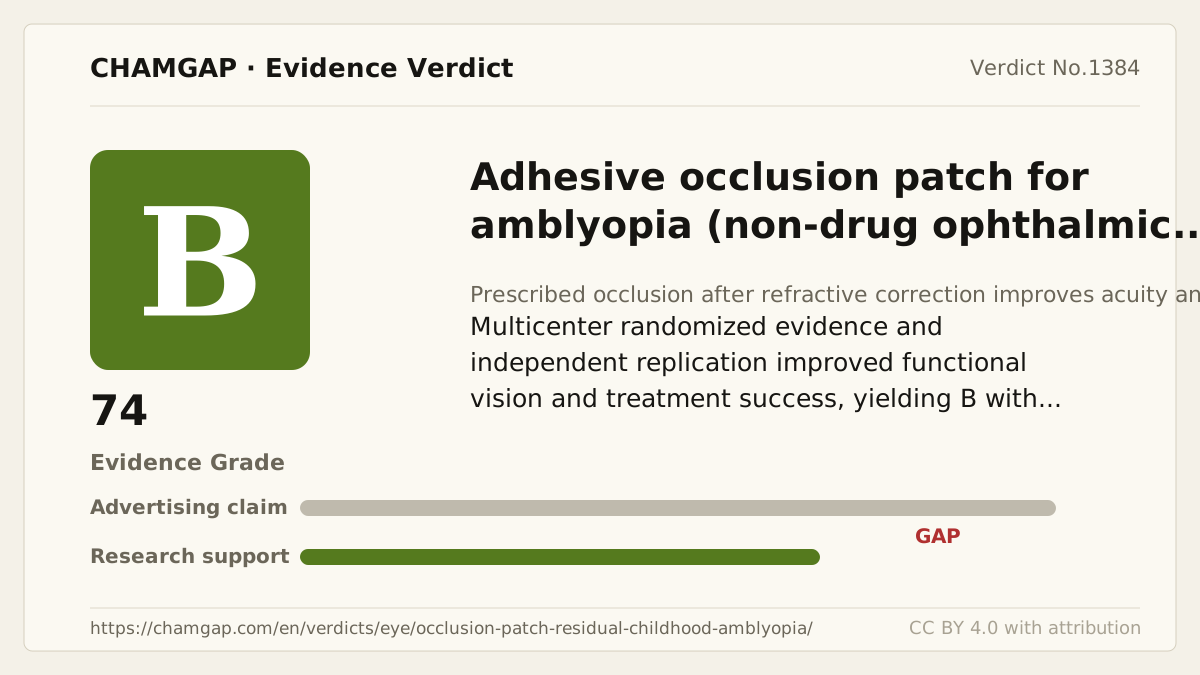
[Chamgap] Occlusion patch x improved residual childhood amblyopia after refractive correction — Evidence Grade B·74. 2 cited sources checked. Source: https://chamgap.com/en/verdicts/eye/occlusion-patch-residual-childhood-amblyopia/ · CC BY 4.0CC BY 4.0 — free to use with attribution; do not distort grades, numbers, or verdict meaning.
What this document does and does not do
Chamgap is an information source. It reports what research has and has not confirmed; it does not tell readers what to take or buy. That decision belongs to readers and, when needed, medical or legal professionals. This verdict reflects literature available up to the search date and may change as new research appears. Nothing here is medical advice.