
Nepafenac,
does it really help with Prevention of macular edema and visual loss after cataract surgery in patients with diabetic retinopathy?
research showsNepafenac eye drops are rated B because they reduce newly developing macular edema and protect some short-term visual outcomes after cataract surgery in patients with diabetic retinopathy. In a 263-participant trial of 0.1% nepafenac, macular edema occurred in 3.2% versus 16.7%; pooled results from two phase 3 trials involving 1,220 participants were 4.1% versus 15.9% with 0.3% nepafenac. All pivotal nepafenac studies, however, belonged to Alcon registration programs, and the 15-letter visual-acuity result was positive in one 0.3% trial but null in the other. The preventive adjunctive benefit is therefore accepted at B with 68 points and kept distinct from treatment of established diabetic macular edema with agents such as ranibizumab. Ocular irritation and rare corneal injury remain separate safety issues.
ads claimMarketing can expand this evidence into treatment of diabetic macular edema or a guarantee of vision after surgery. The evidence instead concerns a prescription preventive adjunct around cataract surgery in patients with diabetic retinopathy and does not replace anti-VEGF treatment for established center-involving diabetic macular edema.
Useful facts when choosing a product
- Nepafenac is a prescription topical nonsteroidal anti-inflammatory eye drop, and Nevanac 0.1% and other concentrations can differ in approved indication, dosing frequency, and duration; the operating ophthalmologist's prescription and the specific label take priority.
- The pivotal prevention trials used 0.1% three times daily or 0.3% once daily from one day before surgery through 90 postoperative days, but a study schedule should not be transferred casually to another patient or formulation.
- This evidence concerns prevention and adjunctive management of macular edema associated with cataract surgery; it does not guarantee treatment of pre-existing center-involving diabetic macular edema or lifelong preservation of vision.
- Transient burning, pain, or foreign-body sensation can occur. Topical NSAIDs can rarely cause keratitis, epithelial breakdown, delayed healing, corneal thinning, ulceration, or perforation, so worsening pain or vision requires prompt ophthalmic evaluation.
Chamgap Semantic Classification Code
Candidate index · review held
M.nepafenac.ophthalmic.macular-edema-and-visual-loss-after-cataract-surgery-with-diabetic-retinopathy.prevent.UNKMedicinal interventions > Nepafenac > Ophthalmic > macular edema and visual loss after cataract surgery with diabetic retinopathy > Occurrence-prevention claim > Unknown
An automated migration candidate, not an issued permanent code; exact claim scope remains under review. This machine-generated migration candidate helps retrieval but is not a permanent assignment. The original verdict ID and URL remain authoritative.
What the research actually shows
Singh and colleagues in 2012 randomized 263 patients with nonproliferative diabetic retinopathy to nepafenac 0.1% or vehicle from one day before surgery through day 90. Macular edema occurred in 3.2% versus 16.7%, and loss of more than five visual-acuity letters was less frequent at days 30, 60, and 90. Singh and colleagues in 2017 randomized 615 and 605 patients with diabetic retinopathy in two separate trials to once-daily nepafenac 0.3% or vehicle. Prevention of macular edema was positive in both studies. Sustained 15-letter improvement was positive in study 1 at 61.7% versus 43.0%, null in study 2 at 48.8% versus 50.5%, and positive when pooled at 55.4% versus 46.7%. A meta-analysis of randomized prophylaxis trials in patients with diabetes also supported adding a topical NSAID to a steroid, but it does not remove the commercial concentration of nepafenac-specific evidence.
Why this is classified as B (68)
Macular edema repeatedly declined, from 16.7% to 3.2% in the 0.1% trial and from 15.9% to 4.1% in the pooled 0.3% program. Macular edema was nevertheless an OCT-centered surrogate outcome, the sustained 15-letter endpoint was null at 48.8% versus 50.5% in one of the two 0.3% trials, and pivotal evidence is concentrated in Alcon registration programs. Consistency with the B verdict for bromfenac after cataract surgery is maintained, while the claim differs from the A-rated treatment of established diabetic macular edema with ranibizumab. The result is B with 68 points; rare corneal harm is recorded separately under safety.
Counterpoint. Patients with diabetic retinopathy have elevated postoperative macular-edema risk and may obtain a meaningful absolute short-term benefit. Duration and combination with steroids or other drops require individualized ophthalmic supervision.
Rejudgment record. Cross-check reflected — Accepted replicated macular-edema reduction in large randomized vehicle-controlled trials of nepafenac 0.1% and 0.3%, while reflecting the OCT-centered surrogate outcome, a null 15-letter visual-acuity result of 48.8% versus 50.5% in one 0.3% trial, and concentration of evidence in Alcon registration programs, resulting in B with 68 points
Sub-claim grades by effect
This ingredient is marketed for several effects. A single overall grade blends strong and weak claims together, so each effect is graded separately here. The overall grade reflects the strongest disconfirming or core claim.
| Effect (sub-claim) | Grade | Basis |
|---|---|---|
| Prevention of macular edema after cataract surgery in patients with diabetic retinopathy | B | Macular edema through 90 days repeatedly declined versus vehicle in the 0.1% trial and both 0.3% phase 3 trials. |
| Prevention of visual loss after cataract surgery in patients with diabetic retinopathy | B | Visual loss declined in the 0.1% trial and pooled 0.3% visual results favored nepafenac, although one of the two 0.3% trials was null. |
| Perioperative macular protection as a preventive adjunct to cataract surgery | B | Evidence is limited to perioperative prevention and adjunctive use and does not establish treatment of existing center-involving diabetic macular edema. |
Cross-check — AI research and Codex final gate
Evidence Table
| Study | Design | Sample | Funding | Endpoint | Result | Weight |
|---|---|---|---|---|---|---|
| Singh R et al. 2012 | Multicenter randomized double-masked vehicle-controlled trial | 263 patients with nonproliferative diabetic retinopathy | Alcon Research product-development trial with a company-affiliated coauthor | Macular edema through 90 days and loss of more than five best-corrected visual-acuity letters after day 7 | Macular edema occurred in 3.2% versus 16.7%, and loss of more than five letters was significantly less frequent with nepafenac at days 30, 60, and 90. | Pivotal direct prevention and visual-outcome trial |
| Singh RP et al. 2017 | Two multicenter phase 3 randomized double-masked vehicle-controlled trials | 615 and 605 patients with diabetic retinopathy; 1,220 total | Funded and managed by Alcon Research, which participated in design, analysis, and manuscript preparation | Macular edema through day 90 and a 15-letter visual-acuity gain maintained through day 90 | Macular edema declined in both trials, but sustained 15-letter improvement was positive in study 1, null in study 2, and positive in the pooled analysis. | Large replicated prevention evidence with limited visual consistency |
| Laursen SB et al. 2019 | Systematic review and meta-analysis of randomized prophylaxis trials after cataract surgery in patients with diabetes | Synthesis of eligible randomized trials published after 1990 | Danish academic investigators; no industry funding stated in the PubMed abstract | Postoperative cystoid macular edema, visual acuity, macular thickness, and adverse events | Adding a topical NSAID to a steroid prevented 75.8% of postoperative cystoid macular-edema events versus steroid alone in patients without preoperative diabetic macular edema. | Independent synthesis supporting the drug class and prophylactic strategy |
Receipt — 3 References
All 3 cited sources were verified for existence at the original page (as of 2026-07-21).
Final verification and publication gate: Codex · Evidence date: 2026-07-21 · Corrections: none
Cite this verdict
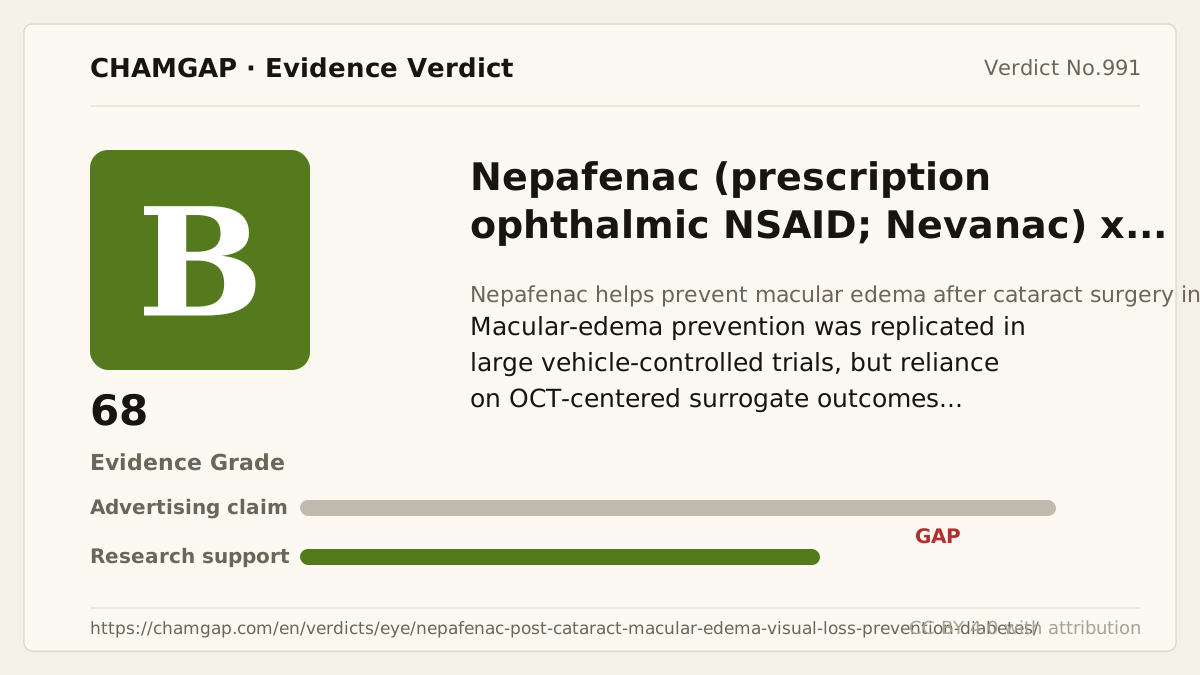
[Chamgap] Nepafenac x prevention of macular edema and visual loss after cataract surgery in diabetic retinopathy — Evidence Grade B·68. 3 cited sources checked. Source: https://chamgap.com/en/verdicts/eye/nepafenac-post-cataract-macular-edema-visual-loss-prevention-diabetes/ · CC BY 4.0CC BY 4.0 — free to use with attribution; do not distort grades, numbers, or verdict meaning.
What this document does and does not do
Chamgap is an information source. It reports what research has and has not confirmed; it does not tell readers what to take or buy. That decision belongs to readers and, when needed, medical or legal professionals. This verdict reflects literature available up to the search date and may change as new research appears. Nothing here is medical advice.