
Mirtogenol combination,
does it really help with Lower intraocular pressure and slowed glaucoma progression?
research showsMirtogenol is rated C because small human studies provide a signal of improved intraocular pressure and ocular blood flow. The central evidence consists of a 38-person untreated-control product evaluation and a three-arm study of 79 people with ocular hypertension but no glaucoma, both involving authors affiliated with proprietary-ingredient companies. An 18-person glaucoma study was also an uncontrolled before-and-after comparison. No long-term trial directly tested visual-field progression or prevention of blindness, so the pressure surrogate cannot be converted into a claim of slowed glaucoma progression.
ads claimMarketing places pressure normalization beside glaucoma protection, while the verified evidence concerns short-term pressure and blood-flow changes with a specific proprietary combination. This is a distinct pressure claim, not the broad bilberry eye claim in verdict 088 or the vascular Pycnogenol claim in verdict 112.
Useful facts when choosing a product
- Mirtogenol is a proprietary combination of Mirtoselect bilberry extract and Pycnogenol French maritime pine-bark extract. Korean consumers mainly encounter imported or direct-import supplements, and it is not an approved glaucoma medicine.
- The 2008 study used 40 mg Pycnogenol plus 80 mg Mirtoselect per capsule twice daily, totaling 80 mg plus 160 mg/day.
- The 2010 study and some commercial capsules used 40 mg Pycnogenol plus 80 mg Mirtoselect daily, while the 2021 Japanese product used 40 mg plus 90 mg/day. Products and trial doses are not interchangeable.
- Replacing or stopping standard glaucoma drops can allow irreversible visual-field loss. People using antiplatelet, anticoagulant, or glucose-lowering drugs or preparing for surgery should discuss use with a clinician.
Chamgap Semantic Classification Code
Candidate index · review held
UNK.mirtogenol-combination.UNK.intraocular-pressure-and-slowed-glaucoma-progression.reduce.MULTIUnknown > Mirtogenol combination > Unknown > intraocular pressure and slowed glaucoma progression > Reduction claim > Multiple: primary unresolved
An automated migration candidate, not an issued permanent code; exact claim scope remains under review. This machine-generated migration candidate helps retrieval but is not a permanent assignment. The original verdict ID and URL remain authoritative.
What the research actually shows
The 2008 product evaluation followed 38 people with ocular hypertension but no glaucoma, assigning 20 to Mirtogenol and 18 to no treatment for six months, and reported improved pressure and ocular blood flow. The 2010 study assigned 79 people with pressure of 35 to 40 mmHg but no visual-field defect to Mirtogenol, latanoprost, or both. Mirtogenol alone lowered pressure, but latanoprost was stronger at every measured time point. Coauthors of both papers included personnel from Horphag Research, the Pycnogenol company, and Indena, the Mirtoselect company. A 2021 Japanese study added Pycnogenol 40 mg plus Mirtoselect 90 mg for four weeks in 18 treated patients with primary open-angle glaucoma and 29 eyes, reporting a decrease from 17.2 to 15.7 mmHg, but it was a single-arm before-and-after study without placebo. None directly tested long-term visual-field loss, optic-nerve structural progression, blindness, or quality of life.
Why this is classified as C (46)
Repeated human observations prevent D, but samples are small, placebo control is weak, company personnel participated, and outcomes stop at pressure and blood flow. Applying the surrogate ceiling in rule ① and the proprietary manufacturer-concentration ceiling in rule ②-b yields C with 46 points. Product differences and combination precautions are separated from efficacy.
Counterpoint. A small additional pressure reduction alongside standard treatment remains possible. That possibility does not establish slower glaucoma progression or identify the contribution of either ingredient.
Rejudgment record. New verdict — Small manufacturer-connected studies of the proprietary combination were positive for intraocular pressure and ocular blood-flow surrogates, but no large independent placebo replication or direct visual-field or blindness outcome exists, so rules ① and ②-b apply
Sub-claim grades by effect
This ingredient is marketed for several effects. A single overall grade blends strong and weak claims together, so each effect is graded separately here. The overall grade reflects the strongest disconfirming or core claim.
| Effect (sub-claim) | Grade | Basis |
|---|---|---|
| Lower intraocular pressure | C | Small proprietary-combination studies show repeated signals, but robust placebo control and large independent replication are lacking. |
| Slower glaucomatous visual-field loss or prevention of blindness | ? | No Mirtogenol human efficacy trial directly assessing long-term visual-field progression, blindness, or quality of life was identified. |
| Attribution of the effect to bilberry or Pycnogenol alone | ? | The core clinical evidence concerns the two-ingredient proprietary combination, with no reliable factorial trial isolating each ingredient's contribution. |
Cross-check — AI research and Codex final gate
Evidence Table
| Study | Design | Sample | Funding | Endpoint | Result | Weight |
|---|---|---|---|---|---|---|
| Steigerwalt RD Jr et al. 2008 | Prospective unmasked untreated-control product evaluation | 38 people with ocular hypertension; 20 received Mirtogenol and 18 received no treatment; six months | Coauthors affiliated with Horphag Research and Indena; proprietary-ingredient product evaluation | Intraocular pressure, ocular arterial flow velocity, and visual acuity | Pressure decreased from 25.2 to 22.0 mmHg at three months; the untreated group did not change and visual acuity did not improve. | Key small surrogate study |
| Steigerwalt RD Jr et al. 2010 | Randomized three-arm active-comparator trial | 79 people with severe ocular hypertension but no glaucoma; 24 weeks | Coauthors affiliated with Horphag Research and Indena | Intraocular pressure and ocular blood flow; Mirtogenol, latanoprost, and combination comparison | Reported lower pressure with Mirtogenol alone, but it was weaker than latanoprost at all time points and patients with visual-field defects were excluded. | Supportive active-comparator surrogate study |
| Manabe K et al. 2021 | Multicenter open-label single-arm before-and-after study | 18 patients and 29 eyes with primary open-angle glaucoma; four weeks | Santen Pharmaceutical employees were coauthors and a Santen product was used | Goldmann intraocular pressure, home morning pressure, and oxidative-stress markers | After adding the extracts to standard eye drops, pressure decreased from 17.2 to 15.7 mmHg, but there was no placebo group. | Exploratory supportive evidence |
Receipt — 4 References
All 4 cited sources were verified for existence at the original page (as of 2026-07-18).
Final verification and publication gate: Codex · Evidence date: 2026-07-18 · Corrections: none
Cite this verdict
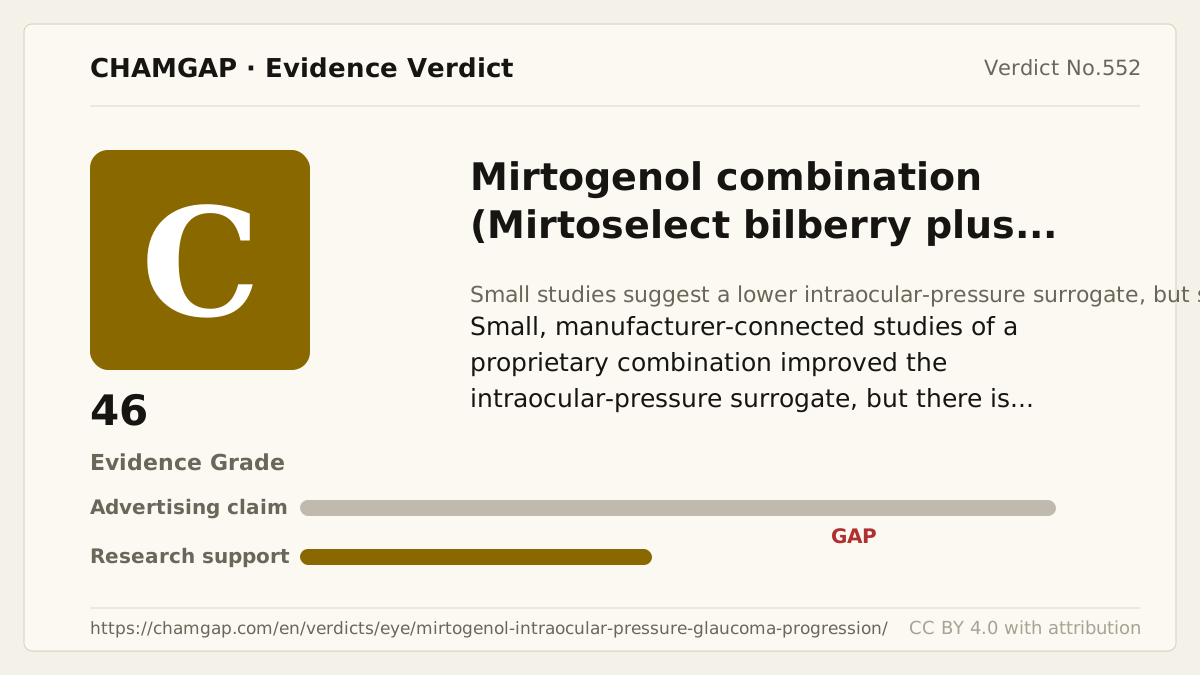
[Chamgap] Mirtogenol combination x lower intraocular pressure and slowed glaucoma progression — Evidence Grade C·46. 4 cited sources checked. Source: https://chamgap.com/en/verdicts/eye/mirtogenol-intraocular-pressure-glaucoma-progression/ · CC BY 4.0CC BY 4.0 — free to use with attribution; do not distort grades, numbers, or verdict meaning.
What this document does and does not do
Chamgap is an information source. It reports what research has and has not confirmed; it does not tell readers what to take or buy. That decision belongs to readers and, when needed, medical or legal professionals. This verdict reflects literature available up to the search date and may change as new research appears. Nothing here is medical advice.