
Zinc,
does it really help with Reduced risk of intermediate age-related macular degeneration progressing to advanced disease and central vision loss?
research showsIn patients with intermediate age-related macular degeneration or advanced disease in one eye, the AREDS combination of antioxidants, zinc, and copper reduces progression and vision loss. This direct clinical result from a large randomized trial supports B. The isolated contribution of zinc is less certain, this is not prevention of disease onset, and an ordinary zinc supplement is not equivalent to an AREDS2 formulation.
ads claimMarketing simplifies the evidence into prevention or restoration of vision. The actual evidence concerns delayed progression in people who already have intermediate disease or advanced disease in the fellow eye. It does not establish prevention of onset, restoration of lost sight, or efficacy of an ordinary zinc-only product.
Useful facts when choosing a product
- Imported and domestically distributed products marketed as AREDS2 are available in Korea, and zinc content may be 25 mg or 80 mg.
- The original formula contained vitamin C 500 mg, vitamin E 400 IU, beta-carotene 15 mg, zinc 80 mg, and copper 2 mg.
- Lutein and zeaxanthin replace beta-carotene for smokers because of lung-cancer risk, and use belongs in an ophthalmic context after diagnosis.
- A dose of 80 mg/day exceeds the general adult upper intake level of 40 mg/day and requires attention to copper deficiency, gastrointestinal effects, and interactions.
Chamgap Semantic Classification Code
Candidate index · review held
UNK.zinc-in-the-areds-and-areds2-context.UNK.risk-of-intermediate-age-related-macular-degeneration-progressing-to-advanced-disease-and-central-vision-loss.reduce.MULTIUnknown > Zinc in the AREDS and AREDS2 context > Unknown > risk of intermediate age-related macular degeneration progressing to advanced disease and central vision loss > Reduction claim > Multiple: primary unresolved
An automated migration candidate, not an issued permanent code; exact claim scope remains under review. This machine-generated migration candidate helps retrieval but is not a permanent assignment. The original verdict ID and URL remain authoritative.
What the research actually shows
AREDS Report 8 randomized 3,640 participants aged 55 to 80 years to antioxidants, 80 mg of zinc with 2 mg of copper, the combination, or placebo. The odds ratio for advanced disease was 0.72 for the combination overall. In high-risk categories 3 and 4, the odds ratios were 0.66 for the combination and 0.71 for zinc alone. Moderate vision loss was significantly reduced by the combination, while zinc alone was not significant. AREDS2 found no difference between 80 mg and 25 mg of zinc but lacked a zinc-free placebo.
Why this is classified as B (70)
A large multicenter randomized trial supports direct outcomes of advanced disease and vision loss, yielding B with 70 points. The strongest result belongs to a combination, zinc alone was null for vision loss, and the population was restricted to high-risk patients.
Counterpoint. Use of a standard AREDS2 formulation is evidence-based when an eye-care professional has confirmed intermediate disease. This verdict does not extend to prevention in healthy people or restoration of vision already lost.
Rejudgment record. New verdict — Accepted the large AREDS reductions in advanced disease and vision loss but withheld A because the strongest result belongs to a combination, zinc alone was null for vision loss, and benefit is restricted to high-risk disease
Sub-claim grades by effect
This ingredient is marketed for several effects. A single overall grade blends strong and weak claims together, so each effect is graded separately here. The overall grade reflects the strongest disconfirming or core claim.
| Effect (sub-claim) | Grade | Basis |
|---|---|---|
| Delayed progression with the AREDS combination in high-risk patients with at least intermediate disease | B | The large AREDS trial reduced advanced disease and moderate vision loss. |
| The isolated contribution of zinc to reducing progression and central vision loss | C | There was a signal for advanced disease, but the zinc-only vision-loss result was not significant. |
| Prevention of age-related macular degeneration onset in people without the disease | D | Benefit was not established in low-risk or early-disease groups, and this is not the indicated population. |
Cross-check — AI research and Codex final gate
Evidence Table
| Study | Design | Sample | Funding | Endpoint | Result | Weight |
|---|---|---|---|---|---|---|
| Age-Related Eye Disease Study Research Group 2001, Report 8 | Multicenter randomized double-masked placebo-controlled factorial trial | 3,640 | Primarily public funding from the National Eye Institute; study tablets supplied by industry | Advanced disease and loss of at least 15 letters of visual acuity | In the high-risk group, the odds ratio for advanced disease was 0.66 with the combination and 0.71 with zinc alone; moderate vision loss was significant only for the combination. | Key |
| AREDS2 Research Group 2013 | Multicenter randomized double-masked trial with secondary formulation randomization | 4,203 | Public support led by the National Eye Institute with some ingredients supplied by industry | Advanced disease; 80 mg versus 25 mg of zinc | Lowering zinc did not change progression, but there was no zinc-free placebo group. | Supportive |
| Evans JR, Lawrenson JG. 2023 | Cochrane systematic review | 26 | National Institute for Health and Care Research | Late disease and vision loss | The AREDS-type combination probably slows progression, but the evidence is dominated by AREDS. | Synthesis |
Receipt — 4 References
All 4 cited sources were verified for existence at the original page (as of 2026-07-18).
Final verification and publication gate: Codex · Evidence date: 2026-07-18 · Corrections: none
Cite this verdict
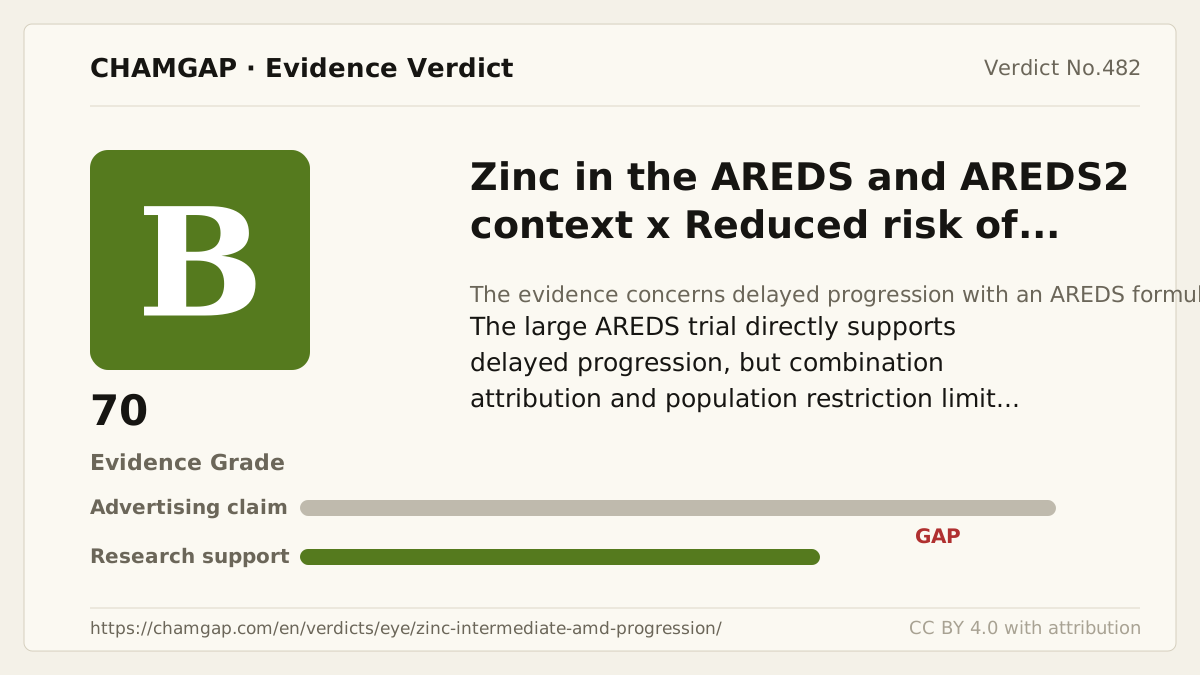
[Chamgap] Zinc x progression of intermediate age-related macular degeneration and central vision loss — Evidence Grade B·70. 4 cited sources checked. Source: https://chamgap.com/en/verdicts/eye/zinc-intermediate-amd-progression/ · CC BY 4.0CC BY 4.0 — free to use with attribution; do not distort grades, numbers, or verdict meaning.
What this document does and does not do
Chamgap is an information source. It reports what research has and has not confirmed; it does not tell readers what to take or buy. That decision belongs to readers and, when needed, medical or legal professionals. This verdict reflects literature available up to the search date and may change as new research appears. Nothing here is medical advice.