
Medical-grade 16% manuka-honey drops or 98% gel added to existing lid care,
does it really help with Improved symptoms and selected signs of evaporative dry eye from meibomian gland dysfunction?
research showsGrade C with 46 points. An open three-arm trial of 114 added 16% drops or 98% gel to common warm compresses, lid massage, and preservative-free lubricant and found differences in selected staining and meibomian outcomes. In a 59-person assessor-masked trial, SPEED improvement was mainly presented as separate within-group P values, leaving the direct symptom effect uncertain.
ads claimThe claim that putting honey in the eye cures dry eye converts a sterile medical formulation into food honey and within-group improvement into direct product efficacy.
Useful facts when choosing a product
- This is not evidence for food-grade manuka honey or homemade dilution.
- The 16% drop and 98% gel are different formulations.
- Temporary stinging and redness were reported.
Chamgap Semantic Classification Code
Permanent code issued
M.medical-manuka-honey-ophthalmic.ophthalmic.dry-eye-symptoms.improve.standard-eyelid-careMedicinal interventions > Medical-grade 16% manuka-honey drops or 98% gel added to existing lid care > Ophthalmic > Improved symptoms and selected signs of evaporative dry eye from meibomian gland dysfunction > Improvement claim > Standard eyelid care
Codex retrospectively verified the principal intervention, delivery, population, endpoint, and comparator from the existing reviewed verdict and issued a permanent semantic code. Secondary outcomes on the page are not transferred as separate claims. The code identifies the intervention and claim; it never contains the evidence grade, score, or safety result.
Exact Claim Classification
These independent facets prevent evidence from different forms, routes, populations, effects, and comparators from being mixed.
| Intervention class | M · Medicine |
|---|---|
| Canonical ingredient or intervention | Medical-grade 16% manuka-honey drops or 98% gel added to existing lid care |
| Source or part used | Medicinal or medical-grade preparation specified in the verdict; unreported manufacturing details remain unverified |
| Formulation or processing | Medical-grade 16% manuka-honey drops or 98% gel added to existing lid care |
| Route | Ophthalmic |
| Dose | Medical-grade 16% manuka-honey drops or 98% gel added to existing lid care |
| Duration | Eight weeks in the principal direct trial |
| Population | 114 participants |
| Effect or condition | Improved symptoms and selected signs of evaporative dry eye from meibomian gland dysfunction |
| Primary endpoint | Symptoms, staining, tear film, meibum, colonization, and lubricant use |
| Comparator | Standard eyelid care |
| Duplicate-detection key | medical-manuka-honey-ophthalmic|ophthalmic|114 participants|dry-eye-symptoms|Eight weeks in the principal direct trial |
What the research actually shows
Ophthalmic medical-grade 16% drops or 98% gel were added to warm compresses, lid massage, and preservative-free lubricant, or compared with ordinary lubricant. The two formulations were kept separate.
Why this is classified as C (46)
Selected objective signs and assessor masking are useful, but missing direct symptom effects and precision, product involvement, open treatment, and multiple outcomes give C with 46 points.
Counterpoint. P=.006 in the honey group and P=.183 in control do not test whether the two changes differ and therefore do not establish superiority.
Rejudgment record. Cross-check applied — Separated 16% drops, 98% gel, and common lid care; did not convert within-group P values to between-group effects; distinguished symptoms, signs, and product involvement
| Endpoint | P | Symptom or function itself is the target - including patient reports and performance tests |
| Replication | R1 | Single confirmatory trial |
| Independence | I1 | Mixed funding sources |
| Effect size | EX | The clinical size of the effect could not be judged |
| Precision | CX | No pooled confidence interval could be confirmed |
Stored derived and displayed grades match; this is not a current recalculation or validity check (C).
Sub-claim grades by effect
This ingredient is marketed for several effects. A single overall grade blends strong and weak claims together, so each effect is graded separately here. The overall grade reflects the strongest disconfirming or core claim.
| Effect (sub-claim) | Grade | Basis |
|---|---|---|
| Improved dry-eye symptoms over existing care | C | Different within-group P values do not establish direct superiority. |
| Improved selected staining or meibomian signs | C | These are formulation-specific signals from a small open multiple-outcome trial. |
| Self-instillation of food-grade manuka honey | F | There is no clinical evidence, and nonsterile ocular use can cause harm. |
Cross-check — AI research and Codex final gate
Evidence Table
| Study | Design | Sample | Funding | Endpoint | Result | Weight |
|---|---|---|---|---|---|---|
| Albietz JM and Lenton LM. 2017 | Open three-arm randomized trial | 114 participants | Optimel product provision or related involvement reported | Symptoms, staining, tear film, meibum, colonization, and lubricant use | All groups improved; selected signals included staining with drops P=.035 and gel meibum quality P=.005 and expressibility P=.042 | Key adjunctive composite-treatment trial |
| Wong D et al. 2021 | Randomized assessor-masked trial | 59 randomized and 55 completed | Specific Optimel product study and provision; author conflicts disclosed | Three-week SPEED, tear film, inflammation, and staining | Within-group SPEED changes 2.53 (P=.006) versus 1.087 (P=.183); direct symptom contrast not presented in abstract | Supporting symptom trial |
Receipt — 2 References
All 2 cited sources were verified for existence at the original page (as of 2026-09-07).
Final verification and publication gate: Codex · Evidence date: 2026-09-07 · Corrections: none
Cite this verdict
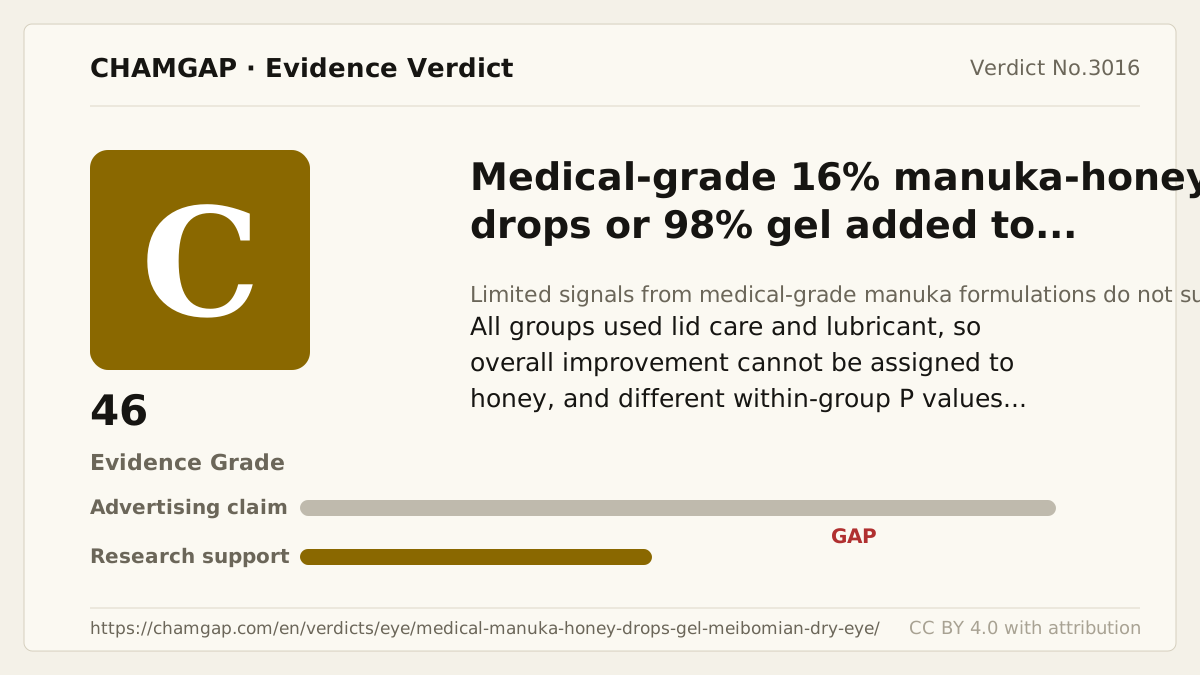
[Chamgap] Medical Manuka-Honey Drops and Gel for MGD Dry Eye—Within-Group Improvement Is Not the Product's Added Effect — Evidence Grade C·46. 2 cited sources checked. Source: https://chamgap.com/en/verdicts/eye/medical-manuka-honey-drops-gel-meibomian-dry-eye/ · CC BY 4.0CC BY 4.0 — free to use with attribution; do not distort grades, numbers, or verdict meaning.
What this document does and does not do
Chamgap is an information source. It reports what research has and has not confirmed; it does not tell readers what to take or buy. That decision belongs to readers and, when needed, medical or legal professionals. This verdict reflects literature available up to the search date and may change as new research appears. Nothing here is medical advice.