
LipiFlow thermal pulsation,
does it really help with Improvement of symptoms and tear-film measures in meibomian-gland-dysfunction dry eye?
research showsLipiFlow is rated C because it improved physiologic co-primary endpoints but comparative patient-reported symptoms were inconsistent. Lane 2012, Cornea 31(4):396-404, was an open randomized crossover trial of 139 participants. Its co-primary endpoints were meibomian gland secretion score and tear breakup time; SPEED and OSDI were secondary, and improvement was short term. TearScience funded the trial in full. Pucker 2024, Cochrane 2024(2):CD015448, found conflicting symptom results, OSDI 4.59 points worse with LipiFlow than with other automated heating devices, and very-low-certainty evidence.
ads claimMarketing turns a device mechanism and improved test values into a claim of durable relief from dry-eye symptoms. Comparative evidence does not show clear superiority over other heating treatments for patient-experienced symptoms.
Useful facts when choosing a product
- LipiFlow uses a disposable ocular applicator to deliver heat from the inner eyelid and pulsatile pressure for about 12 minutes in a clinic.
- It is mainly intended for evaporative dry eye with confirmed meibomian gland dysfunction, not every cause of dry eye.
- Temporary discomfort, redness, or irritation can occur, and cost and retreatment intervals vary by clinic.
Chamgap Semantic Classification Code
Candidate index · review held
P.lipiflow-thermal-pulsation.ophthalmic.symptoms-and-tear-film-measures-in-meibomian-gland-dysfunction-dry-eye.improve.activeProcedures, devices and tests > LipiFlow thermal pulsation > Ophthalmic > symptoms and tear-film measures in meibomian-gland-dysfunction dry eye > Improvement claim > Active comparator
An automated migration candidate, not an issued permanent code; exact claim scope remains under review. This machine-generated migration candidate helps retrieval but is not a permanent assignment. The original verdict ID and URL remain authoritative.
What the research actually shows
Lane 2012, Cornea 31(4):396-404, was an open randomized crossover trial of 139 participants, with efficacy analyzed in 133 (65/68). The co-primary endpoints were meibomian gland secretion score and tear breakup time and succeeded with P<.0001 and P=.0017. SPEED and OSDI were secondary endpoints, improvement was short term, and TearScience funded the trial in full. Pucker 2024, Cochrane 2024(2):CD015448, synthesized 13 randomized trials and 1,155 participants. Symptom results conflicted, OSDI was 4.59 points worse with LipiFlow than with other automated heating devices, and certainty was very low. For comparison, verdict 1704, which is D with 35 points, had a completely null symptom endpoint, OSDI, whereas this verdict had at least short-term symptom improvement. Both nevertheless relied on surrogate primary endpoints, secretion score and tear breakup time.
Why this is classified as C (40)
The trial randomized 139 people and analyzed 133 for efficacy, succeeding on physiologic co-primary endpoints, but symptoms were secondary and a 13-trial synthesis did not show consistent comparative symptom benefit or clinically important improvement. Surrogate, manufacturer-led, and conflicting evidence warrants C with 40 points.
Counterpoint. Patients with confirmed gland obstruction that remains symptomatic despite basic warm compresses and lid hygiene may consider the procedure after understanding its cost and uncertainty.
Rejudgment record. Cross-check applied — Accepted success on physiologic co-primary endpoints but applied the C ceiling under rules ①-ⓐ and ①-ⓒ because comparative patient-reported symptom benefit and clinically important improvement were inconsistent
Sub-claim grades by effect
This ingredient is marketed for several effects. A single overall grade blends strong and weak claims together, so each effect is graded separately here. The overall grade reflects the strongest disconfirming or core claim.
| Effect (sub-claim) | Grade | Basis |
|---|---|---|
| Improvement in patient-reported dry-eye symptoms | D | Later synthesis did not show consistent comparative benefit or achievement of a clinically important difference for OSDI or SPEED. |
| Improvement in meibomian gland secretion | C | The manufacturer-led pivotal trial succeeded on this co-primary endpoint, but it is a physiologic surrogate. |
| Improvement in tear-film stability | C | The tear-breakup-time co-primary endpoint was positive short term but did not consistently translate into symptom benefit. |
Cross-check — AI research and Codex final gate
Evidence Table
| Study | Design | Sample | Funding | Endpoint | Result | Weight |
|---|---|---|---|---|---|---|
| Lane SS et al. 2012 | Multicenter randomized open-label active-controlled trial | 139 randomized (69/70); 133 included in the efficacy analysis (65/68) | Funded in full by manufacturer TearScience; company employees were among the authors | Co-primary meibomian gland secretion score and tear breakup time; secondary SPEED symptoms | Both co-primary endpoints succeeded with P<.0001 and P=.0017. SPEED was also positive but was secondary. | Manufacturer-led pivotal short-term trial with physiologic primary endpoints |
| Pucker AD et al. 2024 | Cochrane systematic review | 13 randomized trials, 1,155 participants, and 1,720 eyes | Public and academic support from the US National Eye Institute, the UK Public Health Agency, and Queen's University Belfast | Patient-reported OSDI and SPEED symptoms plus meibomian gland function and tear breakup time | Symptom results conflicted, and LipiFlow OSDI was 4.59 points worse than with other automated heating devices. Certainty was very low. | Independent synthesis centered on comparative symptoms |
Receipt — 2 References
All 2 cited sources were verified for existence at the original page (as of 2026-07-24).
Final verification and publication gate: Codex · Evidence date: 2026-07-24 · Corrections: none
Cite this verdict
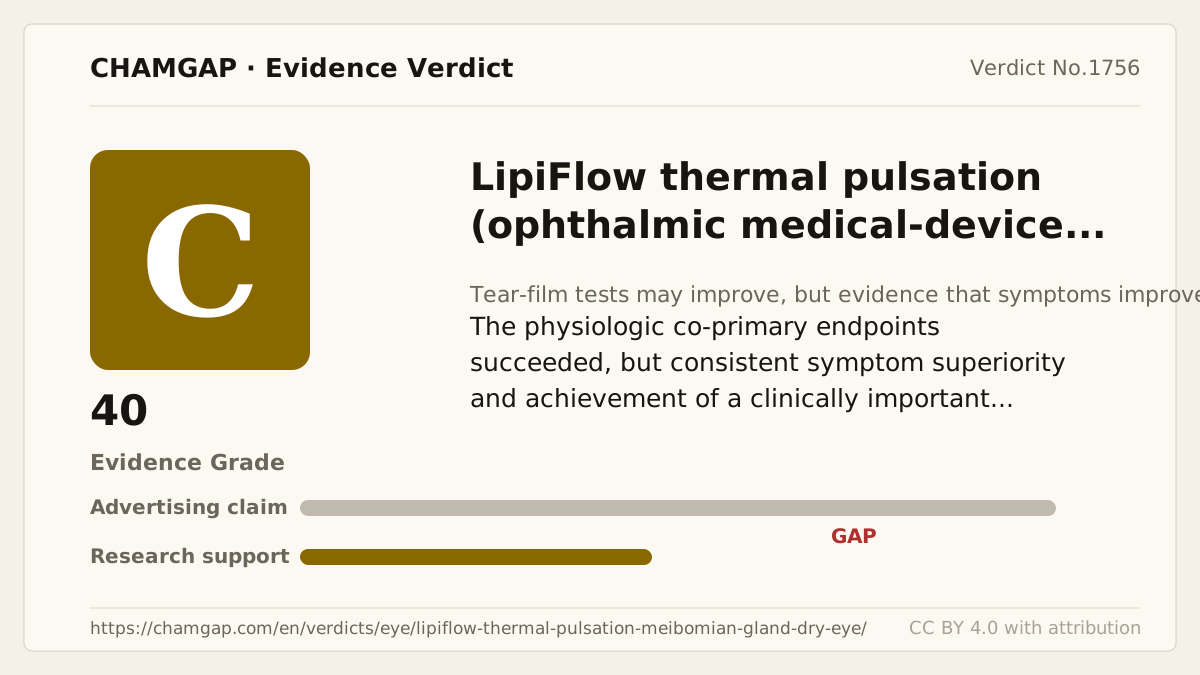
[Chamgap] LipiFlow thermal pulsation x improvement of meibomian-gland-dysfunction dry eye — Evidence Grade C·40. 2 cited sources checked. Source: https://chamgap.com/en/verdicts/eye/lipiflow-thermal-pulsation-meibomian-gland-dry-eye/ · CC BY 4.0CC BY 4.0 — free to use with attribution; do not distort grades, numbers, or verdict meaning.
What this document does and does not do
Chamgap is an information source. It reports what research has and has not confirmed; it does not tell readers what to take or buy. That decision belongs to readers and, when needed, medical or legal professionals. This verdict reflects literature available up to the search date and may change as new research appears. Nothing here is medical advice.