
Intracameral cefuroxime,
does it really help with Prevention of postoperative endophthalmitis when injected into the anterior chamber at the end of cataract surgery?
research showsIntracameral cefuroxime sodium 1 mg/0.1 mL at the end of cataract surgery is rated A because it markedly reduces rare but potentially blinding postoperative endophthalmitis. In the 16,603-participant randomized 2-by-2 factorial ESCRS multicenter trial, omitting intracameral cefuroxime was associated with 4.92-fold higher total endophthalmitis risk (95% CI 1.87 to 12.9), and a Cochrane review rated cefuroxime alone, RR 0.21 (95% CI 0.06 to 0.74), as high-certainty evidence. The large reduction in a direct hard clinical endpoint is reproduced in large routine-practice evidence, including Swedish registry and Indian multicenter data, supporting A with 82 points. Approval status varies by country, and off-label compounding or dilution errors, toxic anterior segment syndrome, and retinal toxicity are separate safety and implementation issues rather than efficacy limitations.
ads claimPromotion can emphasize a fivefold relative difference while omitting the rare baseline event rate, country-specific approval, and the need for a dedicated preservative-free formulation and exact dilution. Efficacy applies to correctly prepared cefuroxime delivered into the anterior chamber at the end of surgery; it does not establish the safety of every improvised compounded product.
Useful facts when choosing a product
- The ESCRS dose was cefuroxime 1 mg/0.1 mL injected into the anterior chamber at the end of cataract surgery. A properly manufactured or compounded preservative-free preparation and strict aseptic technique are required.
- Approval status and access to a dedicated intracameral cefuroxime product vary by country. A licensed product is available in parts of Europe, but where use is off label, a validated institutional pharmacy protocol and independent double checks are especially important.
- Using a noninjectable formulation such as cefuroxime axetil or making a concentration or dilution error can cause toxic anterior segment syndrome, macular edema, retinal toxicity, and permanent visual loss. An arbitrary powder or oral product must never be substituted in the operating room.
- Cephalosporin allergy and any history of severe beta-lactam hypersensitivity require review, and antibiotic prophylaxis does not replace preoperative povidone-iodine antisepsis or sound surgical technique. Local organisms and resistance also inform antibiotic selection.
Chamgap Semantic Classification Code
Candidate index · review held
UNK.cefuroxime-sodium-intracamerally.UNK.postoperative-endophthalmitis-when-injected-into-the-anterior-chamber-at-the-end-of-cataract-surgery.prevent.MULTIUnknown > Cefuroxime sodium / intracamerally > Unknown > postoperative endophthalmitis when injected into the anterior chamber at the end of cataract surgery > Occurrence-prevention claim > Multiple: primary unresolved
An automated migration candidate, not an issued permanent code; exact claim scope remains under review. This machine-generated migration candidate helps retrieval but is not a permanent assignment. The original verdict ID and URL remain authoritative.
What the research actually shows
The Endophthalmitis Study Group randomized 16,603 cataract-surgery patients at 24 centers in Austria, Belgium, Germany, Italy, Poland, Portugal, Spain, Turkey, and the United Kingdom among four groups defined by intracameral cefuroxime sodium 1 mg/0.1 mL and perioperative topical levofloxacin. Twenty-nine endophthalmitis cases occurred, including 20 proven infective cases, and absence of cefuroxime carried an OR of 4.92 for total endophthalmitis. Gower and colleagues' 2017 Cochrane review estimated RR 0.21 for cefuroxime alone versus no intracameral cefuroxime and RR 0.14 for cefuroxime plus topical levofloxacin. Swedish registry and Indian multicenter evidence also reproduced the direction of lower endophthalmitis risk with intracameral antibiotic prophylaxis. Gardner and colleagues showed why efficacy must be distinguished from formulation safety: use of noninjectable cefuroxime axetil or improper extemporaneous compounding can cause toxic anterior segment syndrome.
Why this is classified as A (82)
In the 16,603-participant ESCRS randomized trial, omission of intracameral cefuroxime carried an OR of 4.92 for total endophthalmitis, and Cochrane rated cefuroxime alone, RR 0.21, as high-certainty evidence. The large reduction in potentially blinding endophthalmitis, a direct hard clinical endpoint, is directionally reproduced in large routine-practice evidence including Swedish registry and Indian multicenter data, giving A with 82 points. Country-specific approval, off-label compounding or dilution errors, hypersensitivity, TASS, overdose-related retinal toxicity, and resistance remain separate safety and implementation concerns.
Counterpoint. Endophthalmitis is rare but can be devastating, so even a small absolute benefit from accurately prepared intracameral cefuroxime can be valuable. The center's baseline rate, availability of a dedicated product, pharmacy quality assurance, and patient allergy should guide implementation.
Rejudgment record. Cross-check applied — Applied the marked reduction in the direct hard clinical endpoint of postoperative endophthalmitis in the 16,603-participant ESCRS randomized trial and Cochrane review, together with directional replication in large routine-practice evidence including Swedish registry and Indian multicenter data, while separating country-specific approval and off-label compounding, dilution, and TASS concerns as safety and implementation issues rather than efficacy limitations
Sub-claim grades by effect
This ingredient is marketed for several effects. A single overall grade blends strong and weak claims together, so each effect is graded separately here. The overall grade reflects the strongest disconfirming or core claim.
| Effect (sub-claim) | Grade | Basis |
|---|---|---|
| Prevention of total clinical endophthalmitis after cataract surgery | A | In ESCRS, omission of cefuroxime carried OR 4.92, and the large reduction in a direct clinical endpoint was directionally reproduced in large routine-practice data. |
| Prevention of proven infective endophthalmitis after cataract surgery | A | The analysis of proven infective endophthalmitis also favored cefuroxime, supporting prevention of a potentially blinding hard infection endpoint. |
| Large relative risk reduction with intracameral cefuroxime | A | Cochrane estimated RR 0.21 for cefuroxime alone and rated the evidence high certainty. |
Cross-check — AI research and Codex final gate
Evidence Table
| Study | Design | Sample | Funding | Endpoint | Result | Weight |
|---|---|---|---|---|---|---|
| Endophthalmitis Study Group, European Society of Cataract & Refractive Surgeons. 2007 | Multinational prospective randomized partially masked 2-by-2 factorial trial | 16,603 cataract-surgery patients at 24 units in nine countries | Led by the European Society of Cataract & Refractive Surgeons with some supplied drugs and support | Total clinical endophthalmitis and proven infective endophthalmitis | Twenty-nine total cases; omission of intracameral cefuroxime gave OR 4.92 (95% CI 1.87 to 12.9) for total endophthalmitis. | Pivotal large rare-event randomized trial |
| Gower EW et al. 2017 Cochrane review | Systematic review of randomized trials of perioperative antibiotics in cataract surgery | Five trials; direct cefuroxime estimates came from approximately 8,100-patient ESCRS comparisons | Supported through Cochrane Eyes and Vision and NIHR infrastructure | Acute endophthalmitis within six weeks of surgery | Cefuroxime alone RR 0.21 (95% CI 0.06 to 0.74) and cefuroxime plus levofloxacin RR 0.14 (95% CI 0.03 to 0.63), rated high-certainty evidence. | Efficacy synthesis and certainty assessment |
| Gardner S, Barry P, and Cordovés L. 2015 | Scholarly letter examining formulation- and compounding-related toxicity cases | Context of 17 reported TASS cases after use of cefuroxime axetil | No funding reported | Toxic anterior segment syndrome and inappropriate formulation or compounding | Identified the noninjectable axetil formulation and inappropriate compounding as likely central safety problems. | Evidence separating efficacy from formulation and compounding safety |
Receipt — 3 References
All 3 cited sources were verified for existence at the original page (as of 2026-07-22).
Final verification and publication gate: Codex · Evidence date: 2026-07-22 · Corrections: none
Cite this verdict
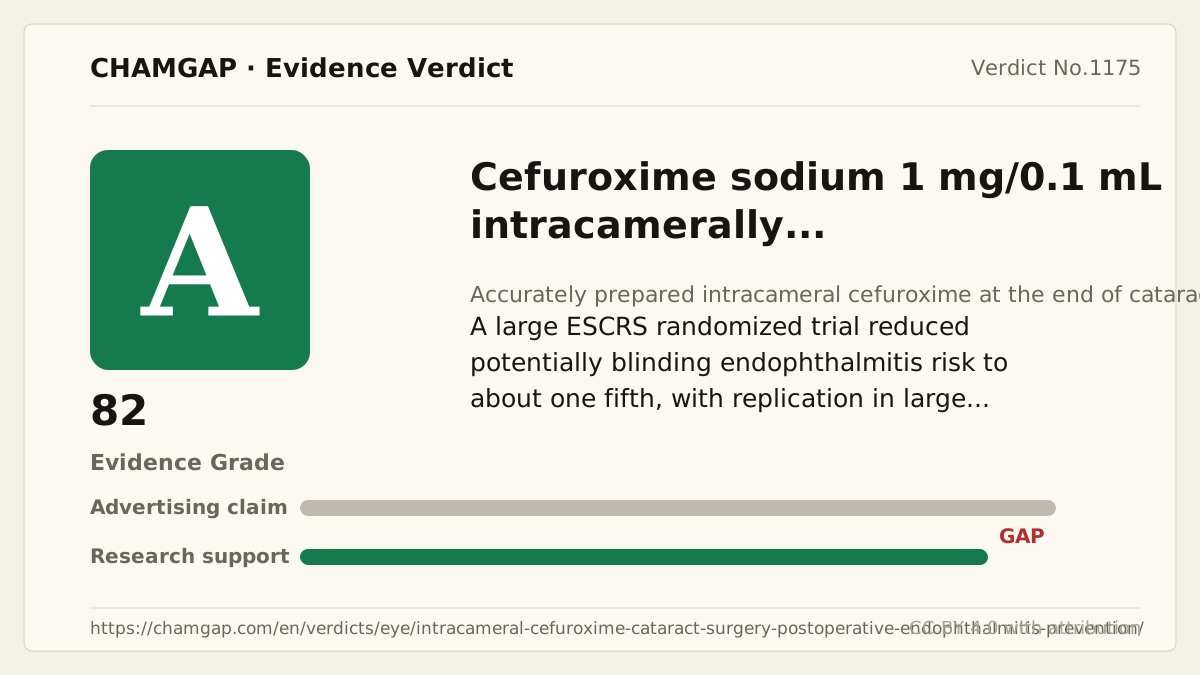
[Chamgap] Intracameral cefuroxime x prevention of endophthalmitis after cataract surgery — Evidence Grade A·82. 3 cited sources checked. Source: https://chamgap.com/en/verdicts/eye/intracameral-cefuroxime-cataract-surgery-postoperative-endophthalmitis-prevention/ · CC BY 4.0CC BY 4.0 — free to use with attribution; do not distort grades, numbers, or verdict meaning.
What this document does and does not do
Chamgap is an information source. It reports what research has and has not confirmed; it does not tell readers what to take or buy. That decision belongs to readers and, when needed, medical or legal professionals. This verdict reflects literature available up to the search date and may change as new research appears. Nothing here is medical advice.