
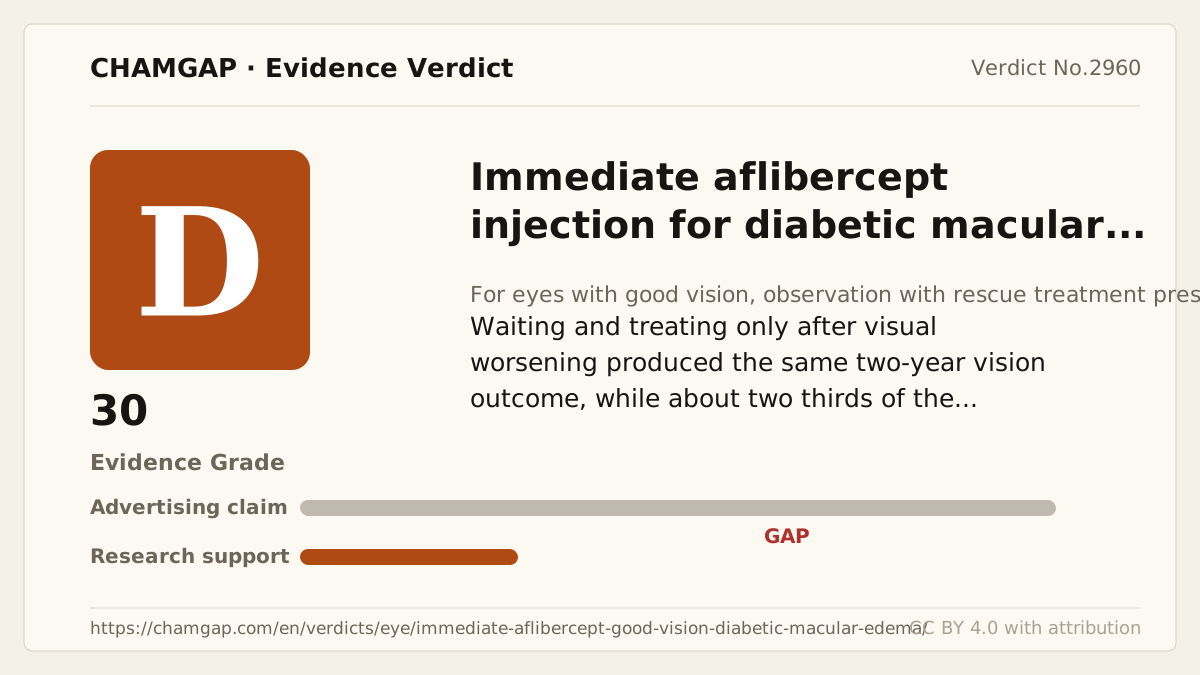
Immediate aflibercept injection for diabetic macular edema with visual acuity of 20/25 or better,
does it really help with Reduced two-year vision loss versus observation with treatment only after worsening?
research showsGrade D. At two years, loss of at least five letters occurred in 33/205 (16%) with immediate aflibercept, 36/212 (17%) with laser, and 39/208 (19%) with observation. Immediate aflibercept versus observation had RR 0.83 (95% CI 0.55 to 1.27), risk difference -3 points (-11 to 4), P=.79.
ads claimThe slogan that earlier injection is always better erases baseline vision. Treating already impaired vision and preemptively treating an eye that still sees 20/25 are different questions.
Useful facts when choosing a product
- Observation was an active rescue strategy with prespecified visual-worsening criteria, not abandonment of care.
- The primary event was loss of at least five letters at two years.
- Regeneron provided drug and some site payments, while the DRCR Network controlled data and publication.
Chamgap Semantic Classification Code
Candidate index · review held
UNK.immediate-aflibercept-injection.UNK.vision-loss.reduce.UNKUnknown > Immediate aflibercept injection > Unknown > vision loss > Reduction claim > Unknown
An automated migration candidate, not an issued permanent code; exact claim scope remains under review. This machine-generated migration candidate helps retrieval but is not a permanent assignment. The original verdict ID and URL remain authoritative.
What the research actually shows
DRCR Retina Network Protocol V randomized 702 participants and 702 eyes at 91 US and Canadian sites: 226 to immediate aflibercept, 240 to laser, and 236 to observation. Laser and observation eyes started rescue aflibercept after a one-time loss of at least 10 letters or a 5-to-9-letter loss at two consecutive visits. Only 34% of observation eyes and 25% of laser eyes started injections. The National Eye Institute and NIDDK funded the trial. Regeneron supplied aflibercept and paid part of clinical-site costs. It commented on the protocol and manuscript but did not conduct or control collection, management, analysis, interpretation, or submission; the DRCR Network retained data and editorial control.
Axis 6 B0 evidence ① Allocation concealment: "Randomization was performed on the study website using a permuted block design (random block sizes of 3 and 6) stratified by site and recent or planned CI-DME treatment in the nonstudy eye using computer-generated random numbers." ② Masking: "Technicians were masked to treatment assignment at annual visits. Investigators and participants were not masked." Objective visual-acuity assessors were masked at the annual primary visit. ③ Analysis population and missing data: "The primary analysis will be an intention-to-treat analysis that includes all randomized eyes according to the treatment group assignment at randomization." Also, "For eyes not completing the 2-year visit, multiple imputation was used to impute missing data in the primary analysis." ④ Prespecified primary endpoint: "The primary objective of the protocol is to determine if there are differences between the three treatment groups in the proportion of eyes that lose 5 or more letters of visual acuity from baseline at the 2-year (104-week) visit." — matches registration NCT01909791
Why this is classified as D (30)
A large, long, patient-centered randomized trial had no counted design flaw, but immediate-treatment benefit was null and no minimum-benefit threshold allowed exclusion, giving D with 30 points.
Counterpoint. The null observation strategy does not imply that anti-VEGF lacks benefit once vision is already impaired.
Rejudgment record. Cross-check applied — Null two-year vision-loss result in Protocol V with equivalent observation-plus-rescue outcomes and no separate minimum-effect threshold
| Endpoint | P | Symptom or function itself is the target - including patient reports and performance tests |
| Replication | R1 | Single confirmatory trial |
| Independence | I1 | Mixed funding sources |
| Effect size | E0 | Null |
| Precision | C0 | The confidence interval leaves room for benefit |
Stored derived and displayed grades match; this is not a current recalculation or validity check (D).
Sub-claim grades by effect
This ingredient is marketed for several effects. A single overall grade blends strong and weak claims together, so each effect is graded separately here. The overall grade reflects the strongest disconfirming or core claim.
| Effect (sub-claim) | Grade | Basis |
|---|---|---|
| Reduced two-year vision loss with immediate injection in eyes seeing 20/25 or better | D | Rates were 16% versus 19% with observation, P=.79. |
| Anti-VEGF treatment after vision is already impaired | B | Outside this verdict; benefit is established in separate trials. |
Cross-check — AI research and Codex final gate
Evidence Table
| Study | Design | Sample | Funding | Endpoint | Result | Weight |
|---|---|---|---|---|---|---|
| Baker CW et al. 2019 DRCR Protocol V | Three-arm multicenter randomized clinical trial | 702 participants/eyes randomized, 226/240/236; two-year result denominators 205/212/208 | Public NEI and NIDDK funding; Regeneron donated study drug and paid part of site costs | Loss of at least five visual-acuity letters at two years | 16%, 17%, and 19%; immediate injection vs observation RR 0.83 (95% CI 0.55-1.27), risk difference -3 points (-11 to 4), P=.79 | Pivotal two-year visual-outcome evidence |
Receipt — 1 References
All 1 cited sources were verified for existence at the original page (as of 2026-08-26).
Final verification and publication gate: Codex · Evidence date: 2026-08-26 · Corrections: none
Cite this verdict
[Chamgap] No Benefit of Immediate Aflibercept for Two-Year Vision Loss in Diabetic Macular Edema With Good Vision — Evidence Grade D·30. 1 cited sources checked. Source: https://chamgap.com/en/verdicts/eye/immediate-aflibercept-good-vision-diabetic-macular-edema/ · CC BY 4.0CC BY 4.0 — free to use with attribution; do not distort grades, numbers, or verdict meaning.
What this document does and does not do
Chamgap is an information source. It reports what research has and has not confirmed; it does not tell readers what to take or buy. That decision belongs to readers and, when needed, medical or legal professionals. This verdict reflects literature available up to the search date and may change as new research appears. Nothing here is medical advice.