
High-dose vitamin E,
does it really help with Reduced incidence and progression of age-related cataract and lower risk of cataract surgery?
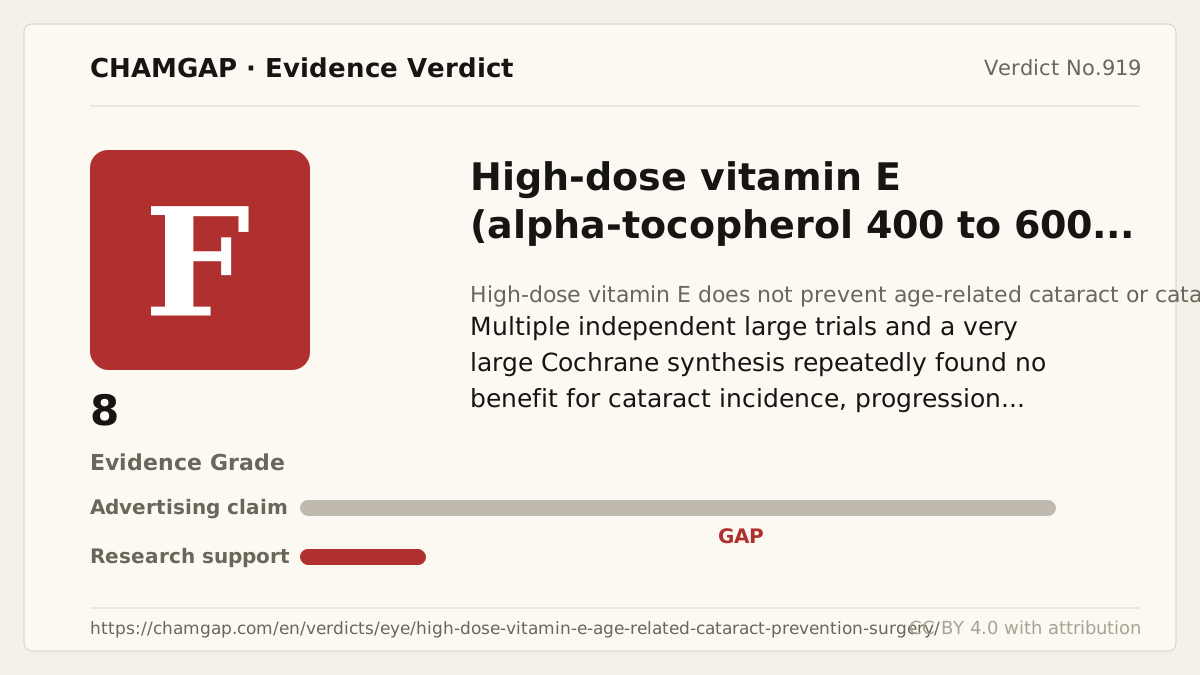
research showsThe claim that high-dose vitamin E reduces the incidence or progression of age-related cataract or the risk of cataract surgery is rated F. Cochrane reviewed nine randomized trials with 117,272 participants; vitamin E was null for cataract incidence, RR 0.97 across three trials and 50,059 participants, and for cataract surgery, RR 0.98 across five trials and 83,956 participants. A 9.7-year trial of 600 IU every other day in 39,876 women, a long-term male-physician trial, and a detailed ophthalmic-imaging trial of 500 IU/day in 1,193 participants all failed to reproduce benefits for incidence, progression, or surgery. The antioxidant mechanism did not translate into clinical prevention, and repeated independent large trials support F with 8 points rather than D. Bleeding tendency, hemorrhagic stroke, and high-dose all-cause mortality signals remain separate under safety.
ads claimMarketing uses oxidative stress in the lens to claim that an antioxidant vitamin prevents eye aging and delays surgery. A biochemical antioxidant role is not a clinical cataract-prevention outcome, and trials of 400 to 600 IU repeatedly disproved that link.
Useful facts when choosing a product
- High doses in cataract trials commonly used alpha-tocopherol 400 IU every other day, 500 IU daily, or 600 IU every other day, which differs from usual dietary exposure.
- Vitamin E is fat soluble, and natural versus synthetic forms and conversion between international units and milligrams differ, so the exact form and dose on the label matter.
- High-dose vitamin E can affect platelet and vitamin-K-related coagulation and may increase bleeding risk with anticoagulants, antiplatelet medicines, or around surgery.
- Some meta-analyses report increased hemorrhagic stroke and an all-cause mortality signal at high doses; without cataract-prevention benefit, unnecessary high-dose use should be avoided.
Chamgap Semantic Classification Code
Candidate index · review held
UNK.vitamin-e.UNK.incidence-and-progression-of-age-related-cataract-and-lower-risk-of-cataract-surgery.reduce.MULTIUnknown > Vitamin E > Unknown > incidence and progression of age-related cataract and lower risk of cataract surgery > Reduction claim > Multiple: primary unresolved
An automated migration candidate, not an issued permanent code; exact claim scope remains under review. This machine-generated migration candidate helps retrieval but is not a permanent assignment. The original verdict ID and URL remain authoritative.
What the research actually shows
The Cochrane review by Mathew and colleagues included nine high-quality trials and 117,272 adults aged at least 35 years, separately pooling cataract incidence and surgery outcomes for vitamin E and finding both null. The women's trial by Christen and colleagues assigned 39,876 participants to 600 IU of natural vitamin E every other day or placebo for an average of 9.7 years, with no benefit for total, nuclear, cortical, or posterior subcapsular cataract. The male-physician trial also found cataract HR 0.99 after long-term 400-IU alternate-day supplementation. The VECAT trial by McNeil and colleagues assessed 1,193 participants with standardized photography and image analysis for four years and found no difference in incidence, progression, or surgery. Results converge across dose schedules, sex, and measurement methods.
Why this is classified as F (8)
Vitamin-E-specific pooled estimates were null for cataract incidence across three trials and 50,059 participants, RR 0.97, and surgery across five trials and 83,956 participants, RR 0.98. A 39,876-woman long-term trial, a male-physician trial, and detailed-imaging VECAT repeatedly found no benefit for incidence, progression, or surgery. Repeated independent large randomized refutation gives F with 8 points; bleeding and mortality signals remain separate safety concerns.
Counterpoint. Smoking cessation, ultraviolet protection, diabetes management, and regular eye assessment are more defensible approaches to cataract risk. Cataract that already affects vision is managed with ophthalmic follow-up and surgery when indicated, not with a supplement.
Rejudgment record. New verdict — Applied F for repeated refutation because vitamin E was null for cataract incidence across three trials and 50,059 participants with RR 0.97 and for surgery across five trials and 83,956 participants with RR 0.98, while a 39,876-woman long-term trial, a male-physician trial, and detailed-imaging VECAT independently found no benefit for incidence, progression, or surgery
Sub-claim grades by effect
This ingredient is marketed for several effects. A single overall grade blends strong and weak claims together, so each effect is graded separately here. The overall grade reflects the strongest disconfirming or core claim.
| Effect (sub-claim) | Grade | Basis |
|---|---|---|
| Reduced incidence of age-related cataract | F | Three vitamin-E trials with 50,059 participants gave RR 0.97, and independent large trials in women and men were repeatedly null. |
| Slowed progression of age-related cataract | F | Detailed photographic and imaging assessment in VECAT found no reduction in progression of nuclear, cortical, or posterior subcapsular cataract. |
| Reduced risk of cataract surgery | F | Five trials with 83,956 participants gave RR 0.98, and individual large trials were concordantly null. |
Cross-check — AI research and Codex final gate
Evidence Table
| Study | Design | Sample | Funding | Endpoint | Result | Weight |
|---|---|---|---|---|---|---|
| Mathew MC et al. 2012 Cochrane review | Cochrane systematic review of randomized antioxidant-vitamin trials | Nine trials and 117,272 participants; 50,059 for vitamin E incidence and 83,956 for surgery | Cochrane Eyes and Vision review | Cataract incidence, progression, visual-acuity loss, and cataract surgery | Vitamin E was null for cataract, RR 0.97, and surgery, RR 0.98. | Decisive very large null synthesis |
| Christen WG et al. 2008 Women's Health Study | Long-term randomized double-masked placebo-controlled trial | 39,876 healthy women followed for a mean of 9.7 years | Public research support from the United States NIH | Overall and subtype-specific age-related cataract and surgery | Vitamin E 600 IU every other day produced cataract RR 0.96 and no benefit for overall, subtype, or surgery outcomes. | Independent very large long-term null trial |
| Christen WG et al. 2010 Physicians' Health Study II | Randomized double-masked placebo-controlled factorial trial | 11,545 male physicians without baseline cataract followed for eight years | Public research support from the United States NIH | Age-related cataract causing reduced visual acuity | Vitamin E 400 IU every other day was null for cataract with HR 0.99. | Independent large long-term null trial |
| McNeil JJ et al. 2004 VECAT | Four-year randomized double-masked placebo-controlled trial | 1,193 adults aged 55 to 80 years | Funding was not reported in the PubMed abstract | Standardized photographic and imaging outcomes for cataract incidence, progression, and surgery | Vitamin E 500 IU/day did not reduce nuclear, cortical, or posterior subcapsular cataract incidence, progression, or surgery. | Repeated null result with detailed objective measurement |
Receipt — 5 References
All 5 cited sources were verified for existence at the original page (as of 2026-07-21).
Final verification and publication gate: Codex · Evidence date: 2026-07-21 · Corrections: none
Cite this verdict
[Chamgap] High-dose vitamin E x prevention and slowed progression of age-related cataract — Evidence Grade F·8. 5 cited sources checked. Source: https://chamgap.com/en/verdicts/eye/high-dose-vitamin-e-age-related-cataract-prevention-surgery/ · CC BY 4.0CC BY 4.0 — free to use with attribution; do not distort grades, numbers, or verdict meaning.
What this document does and does not do
Chamgap is an information source. It reports what research has and has not confirmed; it does not tell readers what to take or buy. That decision belongs to readers and, when needed, medical or legal professionals. This verdict reflects literature available up to the search date and may change as new research appears. Nothing here is medical advice.