
High-add multifocal soft contact lenses,
does it really help with Slowed refractive progression and axial elongation in childhood myopia?
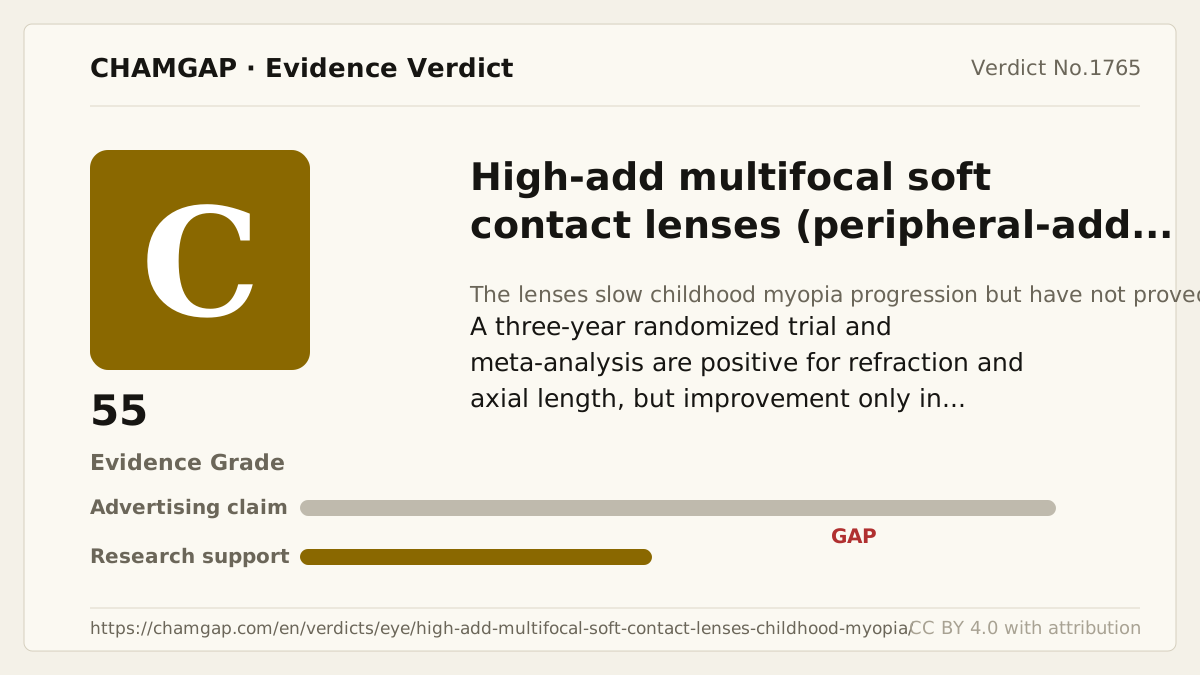
research showsHigh-add multifocal soft contact lenses are rated C because they slow refractive progression and axial elongation in children, but both are surrogate outcomes. BLINK (Walline 2020, JAMA 324(6):571-580) randomized 294 children and analyzed 292; the three-year refractive difference was +0.46 D (95% CI 0.29 to 0.63) and the axial-length difference was -0.23 mm. Public NIH and NEI grants were the main funding, CooperVision manufactured and supplied lenses, and Bausch + Lomb supplied consumables; no role in design or analysis was reported, so this was not a manufacturer-led trial. No long-term clinical outcome directly proves prevention of visual loss or pathologic myopia, giving C with 55 points.
ads claimMarketing may claim that the lenses cure myopia or prevent blinding complications in adulthood. Slowing progression is different from eliminating existing myopia or proving lifelong vision protection, and lens design, add power, wearing time, care, and adherence influence both efficacy and risk.
Useful facts when choosing a product
- BLINK tested a commercially available center-distance Biofinity multifocal lens with +2.50 D high add; not every multifocal lens has equivalent myopia-control evidence.
- Prescription requires assessment of cycloplegic refraction, corneal and tear-film health, handling ability, and hygiene by an eye-care professional.
- Soft contact-lens wear can cause conjunctivitis, corneal infiltrates, and rare microbial keratitis. Avoid sleeping or water exposure while wearing lenses, and stop wear promptly for pain, redness, or reduced vision.
Chamgap Semantic Classification Code
Candidate index · review held
UNK.high-add-multifocal-soft-contact-lenses.UNK.slowed-refractive-progression-and-axial-elongation-in-childhood-myopia.assess.UNKUnknown > High-add multifocal soft contact lenses > Unknown > Slowed refractive progression and axial elongation in childhood myopia > Association or change assessment > Unknown
An automated migration candidate, not an issued permanent code; exact claim scope remains under review. This machine-generated migration candidate helps retrieval but is not a permanent assignment. The original verdict ID and URL remain authoritative.
What the research actually shows
Walline 2020 BLINK (JAMA 324(6):571-580) randomized 294 children aged 7 to 11 years and analyzed 292. The three-year high-add versus single-vision refractive difference was +0.46 D (95% CI 0.29 to 0.63), and the axial-length difference was -0.23 mm. Public NIH and NEI grants were the main funding; CooperVision manufactured and supplied lenses, while Bausch + Lomb supplied consumables, with no reported design or analysis role. Better funding independence and three-year follow-up place it above verdict 1176, which is C with 52 points, and verdict 1715, which is C with 50 points, within grade C, but all three remain capped by surrogate outcomes.
Why this is classified as C (55)
BLINK randomized 294 participants and analyzed 292; the three-year refractive difference was +0.46 D (95% CI 0.29 to 0.63) and axial-length difference was -0.23 mm. NIH and NEI public grants were the main funding, CooperVision manufactured and supplied lenses, and Bausch + Lomb supplied consumables, with no reported design or analysis role. No long-term clinical outcome proves prevention of visual loss or pathologic myopia, so rule ①-ⓐ gives C with 55 points.
Counterpoint. Slowing progression may still have practical value for a child with rapidly advancing myopia. Long-term goals, infection risk, and regular monitoring of refraction, axial length, and corneal health should be discussed together.
Rejudgment record. Cross-check applied — Accepted success on the BLINK primary endpoint of cycloplegic spherical-equivalent refraction and meta-analytic replication, but applied the rule ①-ⓐ ceiling of C because refraction and axial length are surrogates for long-term visual loss
Sub-claim grades by effect
This ingredient is marketed for several effects. A single overall grade blends strong and weak claims together, so each effect is graded separately here. The overall grade reflects the strongest disconfirming or core claim.
| Effect (sub-claim) | Grade | Basis |
|---|---|---|
| Reduced three-year progression of cycloplegic spherical-equivalent refraction | C | The BLINK primary endpoint succeeded, but it is a surrogate for long-term visual loss. |
| Reduced axial elongation | C | The pivotal trial and meta-analysis were positive, but axial length is also a surrogate. |
| Improved high-contrast distance visual acuity | D | The 2024 meta-analysis found no between-group difference, P=0.19. |
Cross-check — AI research and Codex final gate
Evidence Table
| Study | Design | Sample | Funding | Endpoint | Result | Weight |
|---|---|---|---|---|---|---|
| Walline JJ et al. 2020 BLINK | Double-masked three-group randomized clinical trial | 294 randomized (98 per group); 292 in the actual primary analysis; 287 attended the three-year visit | Public NIH and National Eye Institute grants were the main funding; CooperVision manufactured and supplied lenses, Bausch + Lomb supplied consumables, and no role in design or analysis was reported | Primary endpoint: three-year change in cycloplegic spherical-equivalent autorefraction | High add -0.60 D versus single vision -1.05 D, difference +0.46 D (95% CI 0.29 to 0.63); the primary endpoint succeeded. | Pivotal long-term surrogate-endpoint trial |
| Song D et al. 2024 | Systematic review and meta-analysis | 11 articles and 787 participants | National Natural Science Foundation of China Youth Science Foundation grant 82100778; no manufacturer funding reported | Refractive progression, axial elongation, visual acuity, and adverse events | The lenses favored refraction by MD +0.20 D and axial length by MD -0.08 mm; high-contrast distance acuity was not different. | Replication synthesis for surrogate outcomes |
Receipt — 2 References
All 2 cited sources were verified for existence at the original page (as of 2026-07-24).
Final verification and publication gate: Codex · Evidence date: 2026-07-24 · Corrections: none
Cite this verdict
[Chamgap] High-add multifocal soft contact lenses x slowed childhood myopia progression — Evidence Grade C·55. 2 cited sources checked. Source: https://chamgap.com/en/verdicts/eye/high-add-multifocal-soft-contact-lenses-childhood-myopia/ · CC BY 4.0CC BY 4.0 — free to use with attribution; do not distort grades, numbers, or verdict meaning.
What this document does and does not do
Chamgap is an information source. It reports what research has and has not confirmed; it does not tell readers what to take or buy. That decision belongs to readers and, when needed, medical or legal professionals. This verdict reflects literature available up to the search date and may change as new research appears. Nothing here is medical advice.