
Eye patching for simple corneal abrasion,
does it really help with Faster healing and less pain?
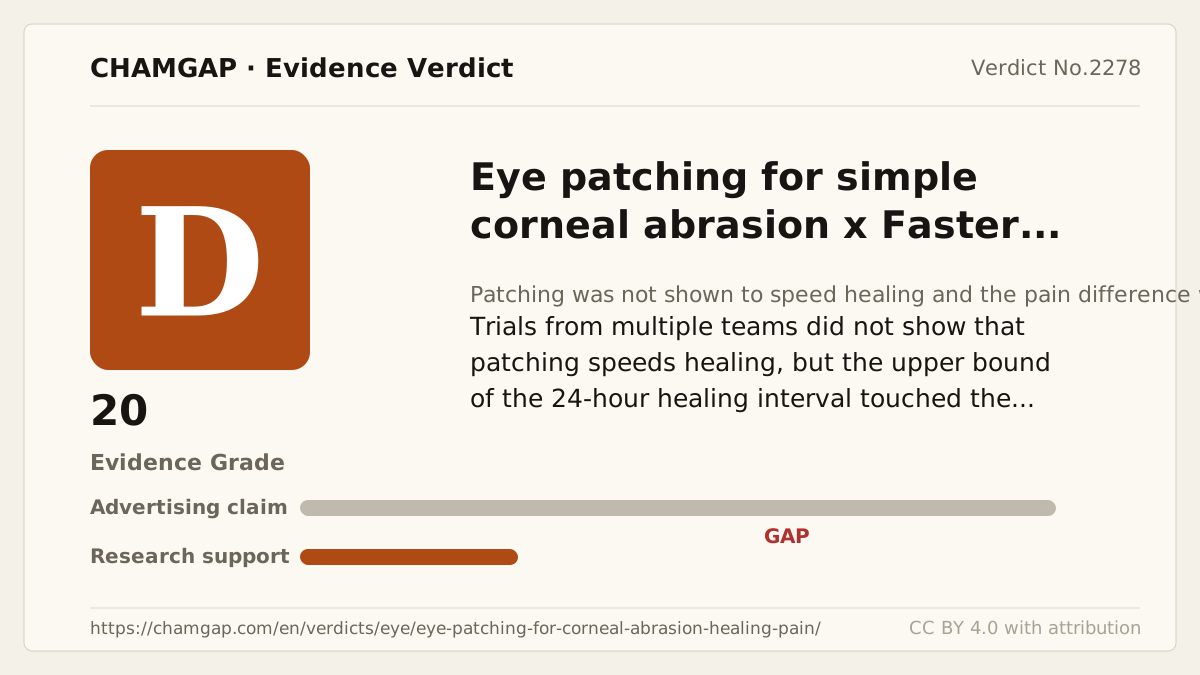
research showsGrade D, 20 points. Twelve randomized or quasi-randomized trials in a Cochrane review reported a 24-hour healing risk ratio of 0.89 (95% CI 0.79 to 1.00). Modeled absolute values were 620 per 1,000 without patching and 552 per 1,000 with patching (490 to 620). Because the interval included no effect, absence of benefit cannot be asserted; however, there is no evidence that patching speeds healing. The 24-hour pain risk ratio of 1.51 (0.86 to 2.65) was not significant.
ads claimClaims that a patch rests the eye, speeds wound closure, and reduces pain merge two distinct outcomes. There was no evidence of faster healing, and the pain difference was not significant.
Useful facts when choosing a product
- The modeled 24-hour healing estimates were 620 per 1,000 without a patch and 552 per 1,000 with a patch, with a range of 490 to 620.
- The modeled 24-hour pain estimates were 157 per 1,000 without a patch and 237 per 1,000 with a patch, with a range of 135 to 416; the difference was not significant.
- Included injuries mixed trauma and abrasions after foreign-body removal and were mainly recent, simple abrasions.
Chamgap Semantic Classification Code
Candidate index · review held
UNK.eye-patching.UNK.faster-healing-and-less-pain.improve.UNKUnknown > Eye patching > Unknown > Faster healing and less pain > Improvement claim > Unknown
An automated migration candidate, not an issued permanent code; exact claim scope remains under review. This machine-generated migration candidate helps retrieval but is not a permanent assignment. The original verdict ID and URL remain authoritative.
What the research actually shows
The Cochrane review by Lim, Turner, and Lim included 12 randomized or quasi-randomized trials and 1,080 participants, with 183 excluded after randomization. Trials mixed traumatic abrasions with abrasions after foreign-body removal: five included post-removal injuries and three excluded them. Antibiotics or cycloplegics were commonly given to both groups. The 24-hour healing analysis included seven trials and 531 participants; the 48-hour analysis included six trials and 497. Multiple independent teams generally found no faster healing, but allocation, masking, and attrition were often unclear or problematic.
Why this is classified as D (28)
Trials did not establish faster healing, but the upper bound of the 24-hour healing interval was exactly 1.00 and touched the null. This means benefit was not established, not that benefit was excluded; pain was also not significant. The result remains D with 28 points.
Counterpoint. Infectious keratitis, penetrating injury, contact-lens-related injury, or reduced vision requires urgent eye assessment and is outside this verdict.
Rejudgment record. Cross-check applied — Absolute 24-hour healing and pain estimates and their intervals were verified separately, and repeated null findings were distinguished from exclusion of clinically important benefit.
| Endpoint | P | Symptom or function itself is the target - including patient reports and performance tests |
| Replication | RX | Repeatedly refuted in the same indication |
| Independence | I1 | Mixed funding sources |
| Effect size | E0 | Null |
| Precision | C0 | The confidence interval leaves room for benefit |
Stored derived and displayed grades match; this is not a current recalculation or validity check (D).
Sub-claim grades by effect
This ingredient is marketed for several effects. A single overall grade blends strong and weak claims together, so each effect is graded separately here. The overall grade reflects the strongest disconfirming or core claim.
| Effect (sub-claim) | Grade | Basis |
|---|---|---|
| Patching speeds healing of corneal abrasion | D | Twenty-four-hour healing was 55.2% with patching and 62.0% without. |
| Patching reduces corneal-abrasion pain | D | The 24-hour pain difference was not statistically significant. |
Cross-check — AI research and Codex final gate
Evidence Table
| Study | Design | Sample | Funding | Endpoint | Result | Weight |
|---|---|---|---|---|---|---|
| Lim, Turner, and Lim, 2016 Cochrane review | Meta-analysis of 12 randomized or quasi-randomized trials | 1,080 randomized; 183 excluded after randomization | Cochrane review support; funding was unreported for most included trials | Complete healing at 24, 48 and 72 hours, healing time, and pain at 24 hours | Twenty-four-hour healing RR 0.89 (0.79 to 1.00); pain RR 1.51 (0.86 to 2.65) | Repeated evidence from multiple teams, limited by trial flaws and a wide pain interval |
Receipt — 1 References
All 1 cited sources were verified for existence at the original page (as of 2026-08-05).
Final verification and publication gate: Codex · Evidence date: 2026-08-05 · Corrections: none
Cite this verdict
[Chamgap] Eye patching for corneal abrasion × healing speed and pain — Evidence Grade D·28. 1 cited sources checked. Source: https://chamgap.com/en/verdicts/eye/eye-patching-for-corneal-abrasion-healing-pain/ · CC BY 4.0CC BY 4.0 — free to use with attribution; do not distort grades, numbers, or verdict meaning.
What this document does and does not do
Chamgap is an information source. It reports what research has and has not confirmed; it does not tell readers what to take or buy. That decision belongs to readers and, when needed, medical or legal professionals. This verdict reflects literature available up to the search date and may change as new research appears. Nothing here is medical advice.