
Digital screen time,
does it really help with Higher myopia risk in children and adolescents?
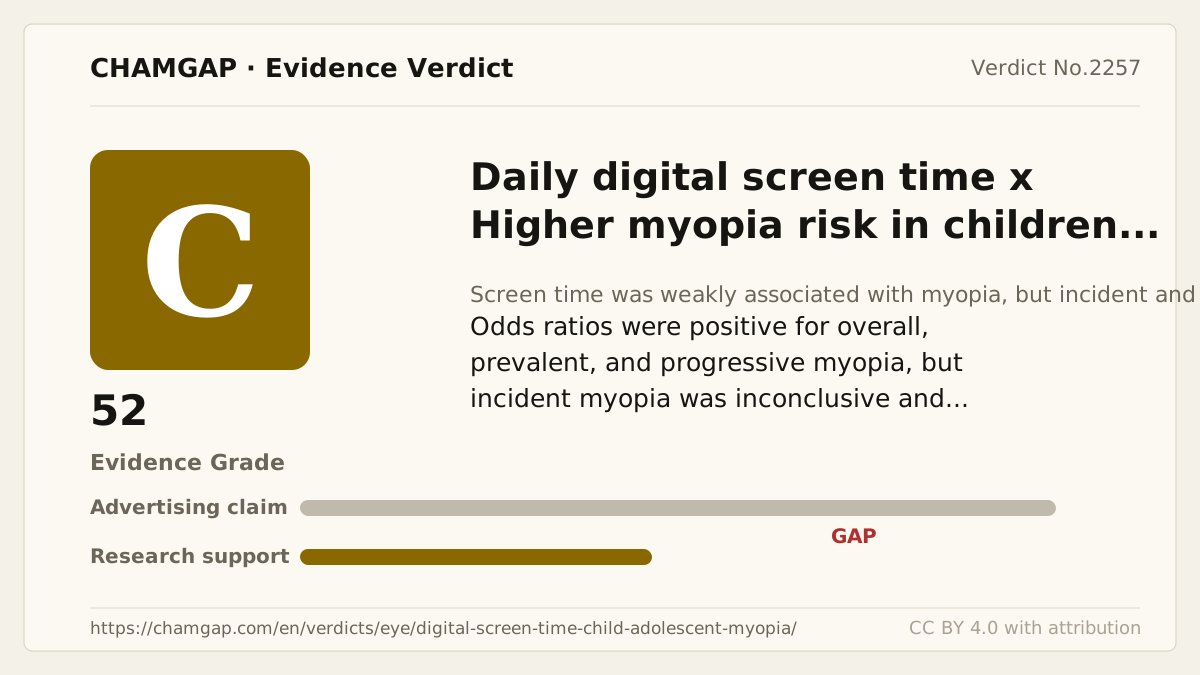
research showsThe grade is C. Across 45 observational studies and 335,524 participants, each extra daily hour was associated with myopia OR 1.21, 95% CI 1.13-1.30, but heterogeneity was 99%. Prevalence was positive, whereas incident myopia was not established, OR 1.40, 0.84-2.33. Screen time was mainly self- or parent-reported, so the estimate is not a clean causal effect.
ads claimThis association does not fully separate screen exposure from less outdoor time or other near work. Verdict 2191 is A with 86 points for an outdoor-time intervention; this verdict concerns a different exposure and observational question.
Useful facts when choosing a product
- Screen exposure was mainly self- or parent-reported; continuous objective device logs were uncommon.
- Myopia definitions ranged from cycloplegic refraction to other examination methods or self-report.
- Verdict 2191 is A with 86 points for outdoor-time intervention, not screen exposure.
Chamgap Semantic Classification Code
Candidate index · review held
UNK.digital-screen-time.UNK.higher-myopia-risk-and-adolescents.increase.UNKUnknown > digital screen time > Unknown > Higher myopia risk and adolescents > Increase claim > Unknown
An automated migration candidate, not an issued permanent code; exact claim scope remains under review. This machine-generated migration candidate helps retrieval but is not a permanent assignment. The original verdict ID and URL remain authoritative.
What the research actually shows
The prospectively registered review, PROSPERO CRD42024514134, pooled 45 studies and 335,524 participants. Per additional daily hour, overall OR was 1.21, 95% CI 1.13-1.30; prevalence was 1.19, 1.10-1.28; progression was 1.54, 1.01-2.36; and incidence was 1.40, 0.84-2.33. Incidence came from two studies with 7,578 participants; the exact event count was not reported in the original meta-analysis and could not be verified. I-squared was 99.0%. The funnel plot was slightly asymmetric, but Egger intercept was 2.53 with P=.11. Prevalence data were cross-sectional, and studies varied in screen questionnaires, device type, myopia definition, and adjustment for near work and outdoor time.
Why this is classified as C (54)
Positive overall, prevalence, and progression odds ratios are offset by inconclusive incidence, 99% heterogeneity, exposure misclassification, and residual confounding, giving C with 54 points.
Counterpoint. C describes limited certainty for the harm claim, not medium harm. Whether reducing screens prevents incident myopia has not been established in a randomized intervention.
Rejudgment record. Cross-check applied — Separated overall, prevalence, progression, and incidence odds ratios as binary event endpoints and incorporated self-reported exposure, cross-sectional prevalence data, confounding, and 99% heterogeneity
| Endpoint | H | Hard endpoint - actual events such as death |
| Replication | R1 | Single confirmatory trial |
| Independence | I1 | Mixed funding sources |
| Effect size | E+ | Meets the clinically important threshold |
Stored derived and displayed grades match; this is not a current recalculation or validity check (C).
Sub-claim grades by effect
This ingredient is marketed for several effects. A single overall grade blends strong and weak claims together, so each effect is graded separately here. The overall grade reflects the strongest disconfirming or core claim.
| Effect (sub-claim) | Grade | Basis |
|---|---|---|
| Higher odds of prevalent myopia | C | The per-hour OR was 1.19 (1.10-1.28). |
| Higher incidence of new myopia | D | OR 1.40 (0.84-2.33) included the null. |
| Prevention of myopia by reducing screens | ? | This review did not test a randomized screen-reduction intervention. |
Cross-check — AI research and Codex final gate
Evidence Table
| Study | Design | Sample | Funding | Endpoint | Result | Weight |
|---|---|---|---|---|---|---|
| Ha et al. 2025 | Dose-response meta-analysis of observational studies | 45 studies and 335,524 participants | 2024 scientific promotion program of Jeju National University | Myopia prevalence, incidence, and progression | Overall per-hour OR 1.21 (1.13-1.30), I-squared 99%; incidence OR 1.40 (0.84-2.33) | Small observational association in a large sample |
Receipt — 1 References
All 1 cited sources were verified for existence at the original page (as of 2026-08-05).
Final verification and publication gate: Codex · Evidence date: 2026-08-05 · Corrections: none
Cite this verdict
[Chamgap] Digital screen time x child and adolescent myopia — Evidence Grade C·54. 1 cited sources checked. Source: https://chamgap.com/en/verdicts/eye/digital-screen-time-child-adolescent-myopia/ · CC BY 4.0CC BY 4.0 — free to use with attribution; do not distort grades, numbers, or verdict meaning.
What this document does and does not do
Chamgap is an information source. It reports what research has and has not confirmed; it does not tell readers what to take or buy. That decision belongs to readers and, when needed, medical or legal professionals. This verdict reflects literature available up to the search date and may change as new research appears. Nothing here is medical advice.