
Tap-water rinsing or storage of contact lenses,
does it really help with Safe use without increased Acanthamoeba or fungal keratitis?
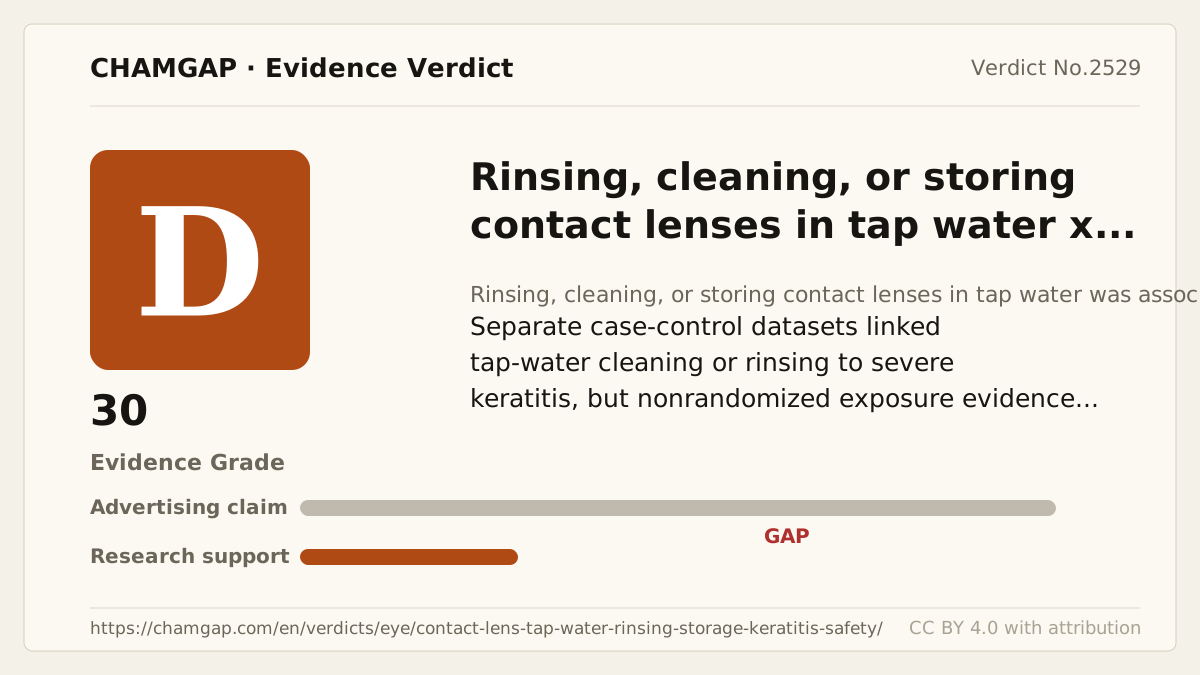
research showsThe grade is D. In a US matched case-control study, rinsing lenses in tap water was associated with Acanthamoeba keratitis at mOR 6.3 (95% CI 1.3-29.9), and storing them in tap water at 3.9 (1.2-12.3), although both were unadjusted estimates. A Dutch study of 220 cases and 1,020 controls found adjusted OR 3.3 (1.7-6.4) for cleaning or rinsing lenses with tap water. The direction toward severe infection is clear, but recall and selection bias in case-control data give D with 30 points.
ads claimTap water is used for routine household cleaning, but that does not establish safety as a contact-lens disinfectant or storage fluid. The available case-control evidence identifies tap-water cleaning or rinsing as a risk behavior for severe microbial keratitis.
Useful facts when choosing a product
- Brown's odds ratios for tap-water rinsing and storage were unadjusted and were absent from the final significant multivariable list.
- Peckeu-Abboud's OR 3.3 for tap-water cleaning or rinsing was adjusted for other risk factors.
- An odds ratio is a relative exposure measure in case-control data; exposure-specific absolute counts were unavailable, so absolute infection probability could not be calculated.
- No duplicate contact-lens tap-water safety verdict or reuse of PMIDs 28099282 and 42393849 or either DOI was found in the existing list.
Chamgap Semantic Classification Code
Candidate index · review held
X.rinsing.behavioral.safe-use-without-increased-acanthamoeba-or-fungal-keratitis.increase.UNKBehaviors, exposures and policies > Rinsing > Behavioral delivery > Safe use without increased Acanthamoeba or fungal keratitis > Increase claim > Unknown
An automated migration candidate, not an issued permanent code; exact claim scope remains under review. This machine-generated migration candidate helps retrieval but is not a permanent assignment. The original verdict ID and URL remain authoritative.
What the research actually shows
Brown recruited 88 soft-lens users with laboratory-confirmed Acanthamoeba keratitis from 14 US ophthalmology referral centers and a laboratory in 2008-2011, matching 151 controls by state and primary eye-care-provider type. Standardized interviews and conditional logistic regression were used. Peckeu-Abboud retrospectively compared 220 cases from 16 Dutch cornea referral centers in 2009-2019 with 1,020 lens-wearing controls recruited through social media in 2020 and used multivariable regression. Neither observational study had a clinical-trial registration number. PubMed lists NEI grant K23 EY015689 for Brown, but the primary-paper funding sentence was not verified; the 2026 paper's funding section was also not verified in the accessible record.
Why this is classified as D (30)
Statistically significant adverse associations appeared for severe Acanthamoeba and fungal keratitis. However, one set of estimates was unadjusted and both studies were vulnerable to recall and selection bias, so the evidence was not elevated to causal confirmation or repeated refutation and receives D with 30 points.
Counterpoint. This verdict concerns direct rinsing, cleaning, or storage of contact lenses with tap water, not contact-lens safety overall or drinking-water safety. Showering or swimming in lenses, rinsing the case, and sleeping in lenses are related but distinct exposures.
Rejudgment record. Cross-check applied — We separated the 2018 unadjusted water variables from its final multivariable model and checked the 2026 adjusted estimate and recruitment structure without converting relative associations into absolute or causal risks.
| Endpoint | H | Hard endpoint - actual events such as death |
| Replication | R1 | Single confirmatory trial |
| Independence | I1 | Mixed funding sources |
| Effect size | E- | Harm increased in the trials |
| Precision | C0 | The confidence interval leaves room for benefit |
The stored derived grade is C while the verdict assigns D. Large adverse associations in case-control studies do not support the safety claim, but recall and selection confounding remain and tap-water exposure was not randomized, so the grade was lowered below causal refutation.
Sub-claim grades by effect
This ingredient is marketed for several effects. A single overall grade blends strong and weak claims together, so each effect is graded separately here. The overall grade reflects the strongest disconfirming or core claim.
| Effect (sub-claim) | Grade | Basis |
|---|---|---|
| Rinsing contact lenses in tap water is safe without increased Acanthamoeba keratitis risk. | D | The US unadjusted mOR of 6.3 and Dutch adjusted OR of 3.3 both ran against the safety claim. |
| Storing contact lenses in tap water is safe. | D | The US unadjusted mOR was 3.9, but an independent adjusted effect and absolute risk were not established. |
Cross-check — AI research and Codex final gate
Evidence Table
| Study | Design | Sample | Funding | Endpoint | Result | Weight |
|---|---|---|---|---|---|---|
| Brown et al., Eye & Contact Lens 2018 | US multistate matched case-control study | 88 laboratory-confirmed Acanthamoeba keratitis cases and 151 controls | PubMed grant metadata K23 EY015689/NEI/NIH; the primary-paper funding sentence was not verified | Acanthamoeba keratitis | Unadjusted mOR 6.3 (95% CI 1.3-29.9) for tap-water rinsing and 3.9 (1.2-12.3) for storage; neither remained in the final significant multivariable list | Direct behavior-specific evidence, but unadjusted and imprecise |
| Peckeu-Abboud et al., Acta Ophthalmologica 2026 | Retrospective case-control study across 16 Dutch referral centers | 181 Acanthamoeba and 39 fungal keratitis cases, with 1,020 controls | The primary-paper funding section was not verified in the accessible record | Acanthamoeba or fungal keratitis | Adjusted OR 3.3 (95% CI 1.7-6.4) for tap-water cleaning or rinsing; exposure-specific absolute counts were not verified | Recent larger adjusted analysis, but cases and controls differed in recruitment period and route |
Receipt — 2 References
Of 2 cited sources, 1 had limited original-page access (blocked or summary-only) and were verified via index/summary, marked partial; the rest were verified at the original page. As of 2026-08-14.
Final verification and publication gate: Codex · Evidence date: 2026-08-14 · Corrections: none
Cite this verdict
[Chamgap] Tap-water rinsing or storage of contact lenses x infection safety — Evidence Grade D·30. 2 cited sources checked. Source: https://chamgap.com/en/verdicts/eye/contact-lens-tap-water-rinsing-storage-keratitis-safety/ · CC BY 4.0CC BY 4.0 — free to use with attribution; do not distort grades, numbers, or verdict meaning.
What this document does and does not do
Chamgap is an information source. It reports what research has and has not confirmed; it does not tell readers what to take or buy. That decision belongs to readers and, when needed, medical or legal professionals. This verdict reflects literature available up to the search date and may change as new research appears. Nothing here is medical advice.