
Self-instilled 100% castor oil,
does it really help with Dissolution or reversal of age-related cataract with restored vision after ocular instillation?
research showsThe grade is ? because no human efficacy trial matching the claim that self-instilled, nonsterile 100% castor oil dissolves or reverses age-related cataract and restores vision was found. Human castor-oil eye-drop studies do exist, but a small trial examined a formulated ophthalmic product containing 2% castor oil plus an emulsifier for meibomian gland dysfunction and dry eye. It did not test lens opacity, cataract reversal, vision restoration, or avoidance of surgery, so it cannot support self-instillation of 100% general-purpose oil. Contemporary reviews and Cochrane cataract literature confirm that established treatment removes the cloudy lens and replaces it with an intraocular lens. Nonsterile oil risks infection, inflammation, and corneal injury, and delaying indicated surgery for an unproven remedy can allow avoidable visual disability to worsen. It should not be used in the eye.
ads claimOnline testimonials may say that oil dissolves the lens, clears cloudy vision within days, or cures cataract without surgery. Temporary lubrication or a tear-film change is not reversal of lens opacity, and subjective impressions, lighting changes, or relief of dry eye must not be mistaken for cataract treatment.
Useful facts when choosing a product
- Food-grade or cosmetic-grade 100% castor oil is not an ophthalmic medicine and does not guarantee sterility, particle control, pH, osmolality, or the quality of an eye-drop container. It should not be put into the eye.
- The studied castor-oil eye drops were low-concentration, emulsified preparations manufactured for ophthalmic use. Their findings do not support self-instillation of undiluted general-purpose oil or treatment of cataract.
- Age-related cataract is clouding of the crystalline lens. When it causes meaningful functional impairment, the established treatment is surgical removal of the cloudy lens and implantation of an artificial intraocular lens.
- Pain, redness, photophobia, discharge, or sudden loss of vision after nonsterile oil instillation requires immediate discontinuation and urgent ophthalmic assessment. An unproven remedy should not delay cataract evaluation or indicated surgery.
Chamgap Semantic Classification Code
Candidate index · review held
UNK.self-instillation-of-100-percent-castor-oil.ophthalmic.dissolution-or-reversal-of-age-related-cataract-with-restored-vision-after-ocular-instillation.assess.placeboUnknown > Self-instillation of 100% castor oil > Ophthalmic > Dissolution or reversal of age-related cataract with restored vision after ocular instillation > Association or change assessment > Placebo
An automated migration candidate, not an issued permanent code; exact claim scope remains under review. This machine-generated migration candidate helps retrieval but is not a permanent assignment. The original verdict ID and URL remain authoritative.
What the research actually shows
Goto and colleagues in 2002 studied a homogenized ophthalmic formulation containing 2% castor oil and 5% emulsifier in 20 patients and 40 eyes with meibomian gland dysfunction. Tear-film and symptom measures improved, but the trial did not concern cataract or the lens. The Cochrane review by Riaz and colleagues evaluated 17 randomized trials and 9,627 participants comparing surgical methods for age-related cataract and documented visual outcomes after surgery; it included no castor-oil drug-reversal trial. A 2021 review by Chen and colleagues stated that surgery is currently the only treatment for cataract and that drug reversal remains preclinical. A study of 110 hospital-compounded eye drops found tip or cap contamination in 36 bottles, while residual content contamination occurred in only one bottle. This does not show widespread contamination of marketed eye-drop contents, but general-purpose oil that was never manufactured as a sterile ophthalmic preparation is still not a safe substitute.
Why this is classified as ?
The grade is ? with a null score because matching human efficacy literature does not exist. A randomized trial of a low-concentration sterile ophthalmic castor-oil emulsion for meibomian gland dysfunction differs in disease, formulation, and endpoint and was not transferred. This is also distinct from N-acetylcarnosine and pirenoxine, rated D because at least some cataract-specific human literature exists. Infection, corneal injury, and treatment delay support a separate do-not-use safety judgment, not an efficacy grade of F.
Counterpoint. Suspected cataract requires ophthalmic assessment of visual acuity, refraction, slit-lamp findings, retina, and optic nerve. Glasses and lighting can reduce early functional difficulty but do not reverse lens opacity, and the timing of surgery should be decided with an ophthalmologist according to vision and daily function.
Rejudgment record. New verdict — A randomized trial exists for a low-concentration homogenized ophthalmic castor-oil formulation in meibomian gland dysfunction, but no human efficacy literature evaluates self-instilled nonsterile 100% general-purpose oil for dissolution or reversal of age-related cataract or restored vision, so transfer across disease, formulation, and endpoints was prohibited and ? applied
Sub-claim grades by effect
This ingredient is marketed for several effects. A single overall grade blends strong and weak claims together, so each effect is graded separately here. The overall grade reflects the strongest disconfirming or core claim.
| Effect (sub-claim) | Grade | Basis |
|---|---|---|
| Dissolution or reversal of age-related cataract by self-instilled 100% castor oil | ? | No published human efficacy trial evaluating this disease, formulation, and endpoint was found. |
| Restoration of cataract-impaired vision by self-instilled 100% castor oil | ? | No matching human trial measured restoration of cataract-impaired vision. |
| Avoidance or delay of cataract surgery with self-instilled 100% castor oil | ? | No human efficacy literature evaluated need for surgery or time to surgery. |
Cross-check — AI research and Codex final gate
Evidence Table
| Study | Design | Sample | Funding | Endpoint | Result | Weight |
|---|---|---|---|---|---|---|
| Goto E et al. 2002 | Randomized double-masked placebo-controlled crossover trial | 20 patients and 40 eyes with noninflamed meibomian gland dysfunction | Indexed by PubMed as non-United States government research support | Tear film, symptoms, tear evaporation, and meibomian orifice obstruction | A homogenized ophthalmic formulation of 2% castor oil and 5% emulsifier improved ocular-surface outcomes but did not assess cataract, lens opacity, or restored vision. | Confirms mismatch in formulation, disease, and endpoint |
| Riaz Y et al. 2006 Cochrane review | Systematic review of randomized surgical trials for age-related cataract | 17 randomized trials and 9,627 participants | Academic Cochrane review; some authors disclosed involvement in included trials | Visual outcomes and complications across surgical techniques | The evidence compared visual outcomes after surgery and included no trial reversing lens opacity with castor oil or another drug. | Context for established treatment |
| Chen X et al. 2021 | Review of cataract surgery and prospects for drug treatment | Not applicable; narrative review | The article reported no competing interests | Current standard of treatment and development stage of nonsurgical drugs | It concluded that surgery is currently the only treatment and drug reversal remains at animal or preclinical stages. | Current clinical-treatment context |
Receipt — 4 References
All 4 cited sources were verified for existence at the original page (as of 2026-07-21).
Final verification and publication gate: Codex · Evidence date: 2026-07-21 · Corrections: none
Cite this verdict
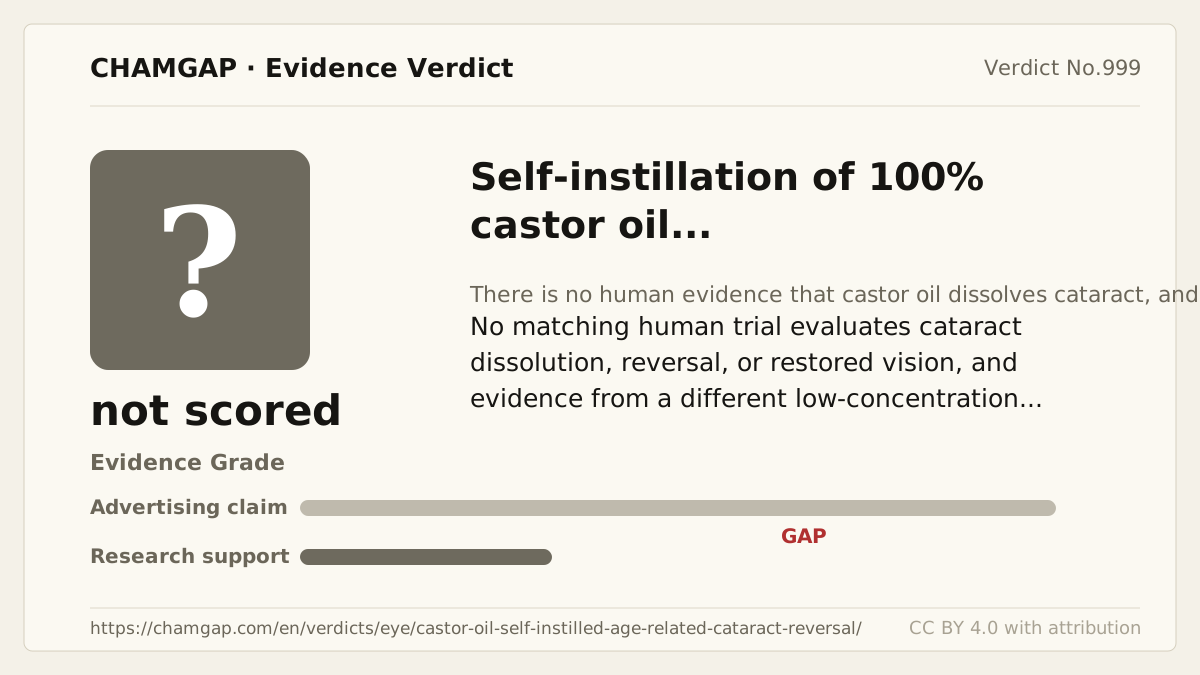
[Chamgap] Self-instilled 100% castor oil x dissolution or reversal of age-related cataract and restored vision — Evidence Grade ?. 4 cited sources checked. Source: https://chamgap.com/en/verdicts/eye/castor-oil-self-instilled-age-related-cataract-reversal/ · CC BY 4.0CC BY 4.0 — free to use with attribution; do not distort grades, numbers, or verdict meaning.
What this document does and does not do
Chamgap is an information source. It reports what research has and has not confirmed; it does not tell readers what to take or buy. That decision belongs to readers and, when needed, medical or legal professionals. This verdict reflects literature available up to the search date and may change as new research appears. Nothing here is medical advice.