
Bromfenac ophthalmic solution,
does it really help with Reduced anterior-segment inflammation and ocular pain after cataract surgery?
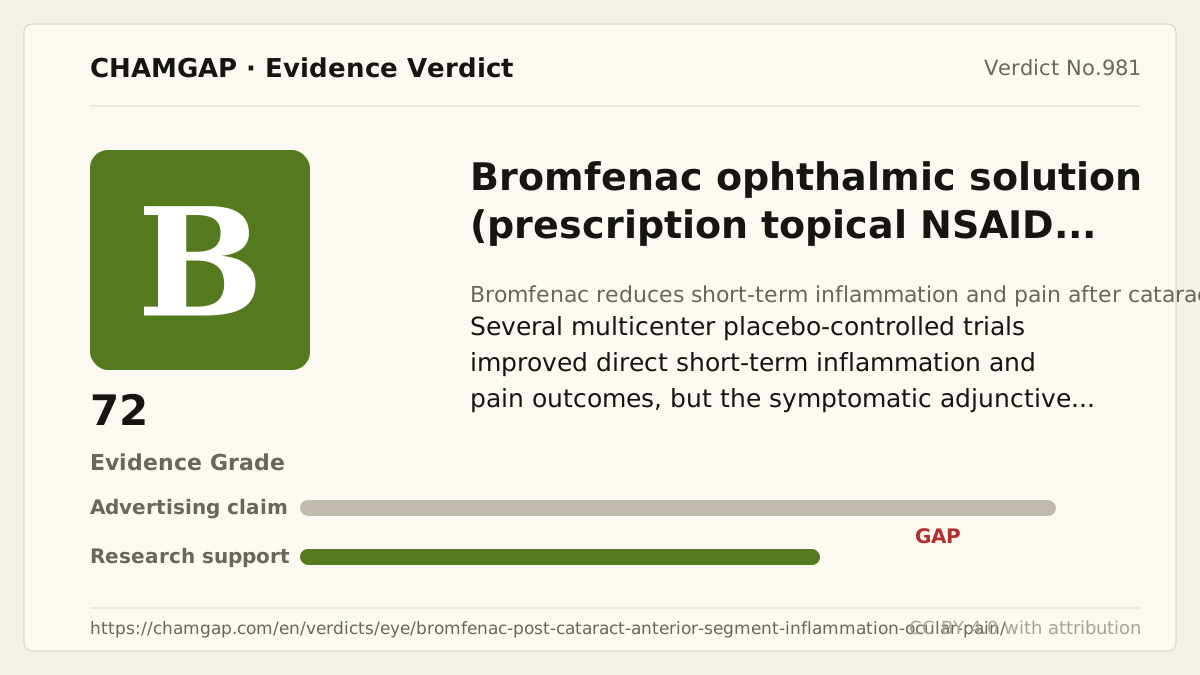
research showsBromfenac ophthalmic solution is rated B because multicenter randomized double-masked placebo-controlled trials repeatedly reduced anterior-segment inflammation and ocular pain after cataract surgery. In the integrated 527-participant trials, complete clearance of inflammation at day 15 was 64.0% versus 43.3%, and median time to pain resolution was 2 versus 5 days. Subsequent registration programs involving 455 and 440 participants also favored bromfenac for inflammation scores and pain-free status. The evidence nevertheless concerns short-term symptomatic adjunctive treatment and is concentrated in commercial formulation programs; it does not establish long-term visual outcomes or prevention of complications. Instillation-site irritation and rare corneal inflammation, erosion, thinning, ulceration, or perforation remain separate safety concerns.
ads claimMarketing can expand reduced short-term inflammation and pain into claims of complete recovery or prevention of surgical complications. The established scope is symptomatic and adjunctive reduction of anterior-segment inflammation and pain during the first roughly two postoperative weeks.
Useful facts when choosing a product
- Bromfenac is a prescription topical NSAID, and products including Bronuck differ in concentration, indication, dosing frequency, and starting time; the operating ophthalmologist's prescription and the specific label take priority.
- Representative registration schedules used 0.07% or 0.09% formulations once or twice daily from one day before surgery through 14 postoperative days, but a schedule for one formulation cannot be transferred automatically to another.
- Other ophthalmic medicines are generally separated in time, contact lenses should not be worn during instillation, and the bottle tip should not touch the eye or skin.
- Burning, foreign-body sensation, and irritation can occur. Topical NSAIDs can rarely cause keratitis, epithelial breakdown, corneal thinning, ulceration, perforation, or delayed healing, so worsening pain or vision requires prompt ophthalmic assessment.
Chamgap Semantic Classification Code
Candidate index · review held
M.bromfenac-ophthalmic-solution.MULTI.anterior-segment-inflammation-and-ocular-pain-after-cataract-surgery.reduce.placeboMedicinal interventions > Bromfenac ophthalmic solution > Multiple: primary unresolved > anterior-segment inflammation and ocular pain after cataract surgery > Reduction claim > Placebo
An automated migration candidate, not an issued permanent code; exact claim scope remains under review. This machine-generated migration candidate helps retrieval but is not a permanent assignment. The original verdict ID and URL remain authoritative.
What the research actually shows
Donnenfeld and colleagues assigned 527 participants with a postoperative summed ocular inflammation score of at least 3 in a 2:1 ratio to bromfenac 0.09% twice daily or placebo. Complete clearance after 14 days was 64.0% versus 43.3%, and median time to pain resolution was 2 versus 5 days. Two Silverstein trials evaluated once-daily 0.09% bromfenac in 455 participants from the day before surgery through 14 postoperative days and favored bromfenac for day-15 clearance and day-1 pain-free status. Two Walters phase 3 trials similarly confirmed clearance and pain-free benefits with once-daily 0.07% bromfenac in 440 participants. Concentrations and schedules differ among products, so the specific label must be followed; regulatory authorization confirms a trial program but does not itself justify a higher evidence grade.
Why this is classified as B (72)
Multicenter randomized double-masked placebo-controlled registration programs involving 527, 455, and 440 participants consistently favored bromfenac for anterior-segment inflammation scores and ocular pain, which directly match the claim. The evidence concerns roughly two weeks of symptomatic adjunctive care, is concentrated in commercial formulation programs, and lacks long-term visual or complication outcomes, yielding B with 72 points rather than A. Irritation and rare serious corneal complications remain independent safety issues.
Counterpoint. If postoperative pain, redness, or vision worsens, the patient should not increase dosing independently and should contact the operating ophthalmologist promptly.
Rejudgment record. New verdict — Repeated direct improvement in anterior-chamber cell and flare and ocular pain in multicenter randomized double-masked placebo-controlled trials, balanced against the symptomatic adjunctive scope, concentration in commercial formulation registration programs, and absence of long-term visual or complication outcomes
Sub-claim grades by effect
This ingredient is marketed for several effects. A single overall grade blends strong and weak claims together, so each effect is graded separately here. The overall grade reflects the strongest disconfirming or core claim.
| Effect (sub-claim) | Grade | Basis |
|---|---|---|
| Reduced anterior-segment inflammation after cataract surgery | B | Several multicenter placebo-controlled trials repeatedly improved complete clearance based on anterior-chamber cells and flare. |
| Reduced ocular pain after cataract surgery | B | Time to pain resolution and pain-free proportions consistently favored bromfenac, but the benefit is short-term and symptomatic. |
Cross-check — AI research and Codex final gate
Evidence Table
| Study | Design | Sample | Funding | Endpoint | Result | Weight |
|---|---|---|---|---|---|---|
| Donnenfeld ED et al. 2007 | Integrated analysis of two multicenter phase 3 randomized double-masked placebo-controlled trials | 527 participants after cataract surgery; 356 bromfenac and 171 placebo | Commercial formulation registration program with company-affiliated coauthors | Complete anterior-segment inflammation clearance at day 15 and time to pain resolution | Complete clearance was 64.0% versus 43.3%, and median time to pain resolution was 2 versus 5 days, favoring bromfenac. | Key direct short-term efficacy trial |
| Silverstein SM et al. 2011 | Integrated analysis of two multicenter randomized double-masked placebo-controlled trials | 455 participants; 230 bromfenac and 225 placebo | Commercial once-daily 0.09% formulation program with company-affiliated coauthors | Inflammation clearance at day 15 and pain-free status at day 1 | Both endpoints significantly favored bromfenac, with consistent inflammation scores and pain-free proportions across follow-up visits. | Replicating direct evidence |
| Walters TR et al. 2014 | Integrated analysis of two phase 3 multicenter randomized double-masked placebo-controlled trials | 440 participants; 222 bromfenac and 218 placebo | Bausch & Lomb 0.07% formulation registration program with a company-affiliated coauthor | Complete inflammation clearance by day 15 and pain-free status at day 1 | Once-daily 0.07% bromfenac significantly outperformed placebo for clearance and pain-free status. | Replicating registration evidence for another concentration |
Receipt — 3 References
All 3 cited sources were verified for existence at the original page (as of 2026-07-21).
Final verification and publication gate: Codex · Evidence date: 2026-07-21 · Corrections: none
Cite this verdict
[Chamgap] Bromfenac ophthalmic solution x reduced inflammation and ocular pain after cataract surgery — Evidence Grade B·72. 3 cited sources checked. Source: https://chamgap.com/en/verdicts/eye/bromfenac-post-cataract-anterior-segment-inflammation-ocular-pain/ · CC BY 4.0CC BY 4.0 — free to use with attribution; do not distort grades, numbers, or verdict meaning.
What this document does and does not do
Chamgap is an information source. It reports what research has and has not confirmed; it does not tell readers what to take or buy. That decision belongs to readers and, when needed, medical or legal professionals. This verdict reflects literature available up to the search date and may change as new research appears. Nothing here is medical advice.