
Bates-type eye exercises,
does it really help with Reduced myopic refractive power and permanently restored unaided vision through repeated training?
research showsFor refractive error, two studies and 321 eyes produced SMD -1.74 (95% CI -6.27 to 2.79), while visual acuity was -0.50 (-1.16 to 0.16), with substantial heterogeneity. The prevention or relief category was positive, RR 0.40 (0.23 to 0.71). Because clinically meaningful benefit is not excluded, the grade is D with 35 points, not F.
ads claimMarketing converts flashes of clarity, chart learning, and reduced eye fatigue into claims that a prescription has fallen or glasses are no longer needed. Unaided chart acuity before and after training cannot establish permanent myopia reversal without cycloplegic refraction and axial-length measurement.
Useful facts when choosing a product
- Bates-style programs mix palming, shifting, visualization, blinking, and near-far focusing, with no single standardized protocol or validated therapeutic dose.
- Most gentle eye exercises cause little direct harm, but direct sun viewing in sunning practices can damage the retina and should never be performed.
- Stopping spectacles or contact lenses without appropriate assessment can impair driving, study, and work safety and may delay effective myopia control and eye follow-up in children.
- Myopia is corrected with properly prescribed spectacles, contact lenses, or suitable refractive surgery, while evidence-based progression control in children can include low-dose atropine, specialized lenses, and more outdoor time under clinical guidance.
Chamgap Semantic Classification Code
Candidate index · review held
P.bates-type-eye-exercises.device.myopic-refractive-power-and-permanently-restored-unaided-vision-through-repeated-training.reduce.UNKProcedures, devices and tests > Bates-type eye exercises > Device delivered > myopic refractive power and permanently restored unaided vision through repeated training > Reduction claim > Unknown
An automated migration candidate, not an issued permanent code; exact claim scope remains under review. This machine-generated migration candidate helps retrieval but is not a permanent assignment. The original verdict ID and URL remain authoritative.
What the research actually shows
Lin 2024 searched nine Chinese and English databases through December 2022 and synthesized 11 controlled studies with 921 participants across multiple eye-exercise methods rather than Bates training alone. The two studies reporting refractive error were null and risk of bias was substantial, leading the authors to propose retiring eye-exercise policy until robust evidence exists. The Hildreth 1947 clinical evaluation of 54 trained patients found some letter-chart improvement but no change in refractive error or ocular neuromuscular mechanism. Elliott 2013 found no plausible rationale by which Bates practices such as palming, shifting, and sunning could treat myopia. The 2018 American Academy of Ophthalmology guideline does not recommend vision training such as near-far focusing to reduce myopia because clinically effective evidence is absent.
Why this is classified as D (35)
For refractive error, two studies and 321 eyes produced SMD -1.74 (95% CI -6.27 to 2.79), while visual acuity was -0.50 (-1.16 to 0.16), with substantial heterogeneity. The prevention or relief category was positive, RR 0.40 (0.23 to 0.71). Because clinically meaningful benefit is not excluded, the grade is D with 35 points, not F.
Counterpoint. Rest breaks, looking into the distance, and blinking may improve comfort, but they are not myopia treatment. Sudden vision loss, new floaters, flashes, or a curtain-like visual-field defect requires prompt eye evaluation rather than exercise. Grade-independent note: AAO nonrecommendation and the researchers’ proposal to discontinue the policy are recorded but are not used to determine the efficacy grade.
Rejudgment record. Cross-check applied — For refractive error, two studies and 321 eyes produced SMD -1.74 (95% CI -6.27 to 2.79), while visual acuity was -0.50 (-1.16 to 0.16), with substantial heterogeneity. The prevention or relief category was positive, RR 0.40 (0.23 to 0.71). Because clinically meaningful benefit is not excluded, the grade is D with 35 points, not F.
Sub-claim grades by effect
This ingredient is marketed for several effects. A single overall grade blends strong and weak claims together, so each effect is graded separately here. The overall grade reflects the strongest disconfirming or core claim.
| Effect (sub-claim) | Grade | Basis |
|---|---|---|
| Reduced myopic refractive power through repeated eye exercises | D | The controlled-study meta-analysis was null for refractive error, and professional guidance does not recommend the therapy because clinical effectiveness is absent. |
| Permanent restoration of unaided visual acuity | ? | Chart learning or blur adaptation can occur, but permanent recovery of refraction or axial length has not been demonstrated. |
| Anatomical reversal of myopia through shortening of axial length | ? | No objective human evidence shows that eye exercises shorten an elongated eye, and the claim conflicts with the mechanism of myopia. |
Cross-check — AI research and Codex final gate
Evidence Table
| Study | Design | Sample | Funding | Endpoint | Result | Weight |
|---|---|---|---|---|---|---|
| Lin Z et al. 2024 | Systematic review and meta-analysis of controlled eye-exercise studies | 11 studies and 921 participants | Academic research; authors reported no competing interests | Refractive error, visual acuity, axial length, and prevention or mitigation categories | Refractive error was null, SMD -1.74 (95% CI -6.27 to 2.79; P=.45), and nine of 11 studies had concerns in at least two bias domains. | Current objective synthesis refuting the claim |
| Hildreth HR et al. 1947 | Controlled pre-post clinical evaluation of visual training | 54 patients with myopia | Support from American Optical Company, Aloe's Optical Company, and an academic ophthalmology department | Unaided chart acuity, refractive error, and ocular neuromuscular mechanism | Some chart-acuity scores improved, but refractive error and the ocular neuromuscular mechanism did not change. | Older direct refutation of the Bates-type claim |
| American Academy of Ophthalmology Preferred Practice Pattern. 2018 | Evidence-based clinical guideline for refractive errors and refractive surgery | Synthesis of refractive-error intervention literature | American Academy of Ophthalmology | Clinical effectiveness of vision training to reduce or control myopia | Did not recommend vision training because no scientifically acceptable study documented clinical effectiveness. | Professional guideline finding no efficacy and not recommending use |
Receipt — 4 References
All 4 cited sources were verified for existence at the original page (as of 2026-07-24).
Final verification and publication gate: Codex · Evidence date: 2026-07-24 · Corrections: none
Cite this verdict
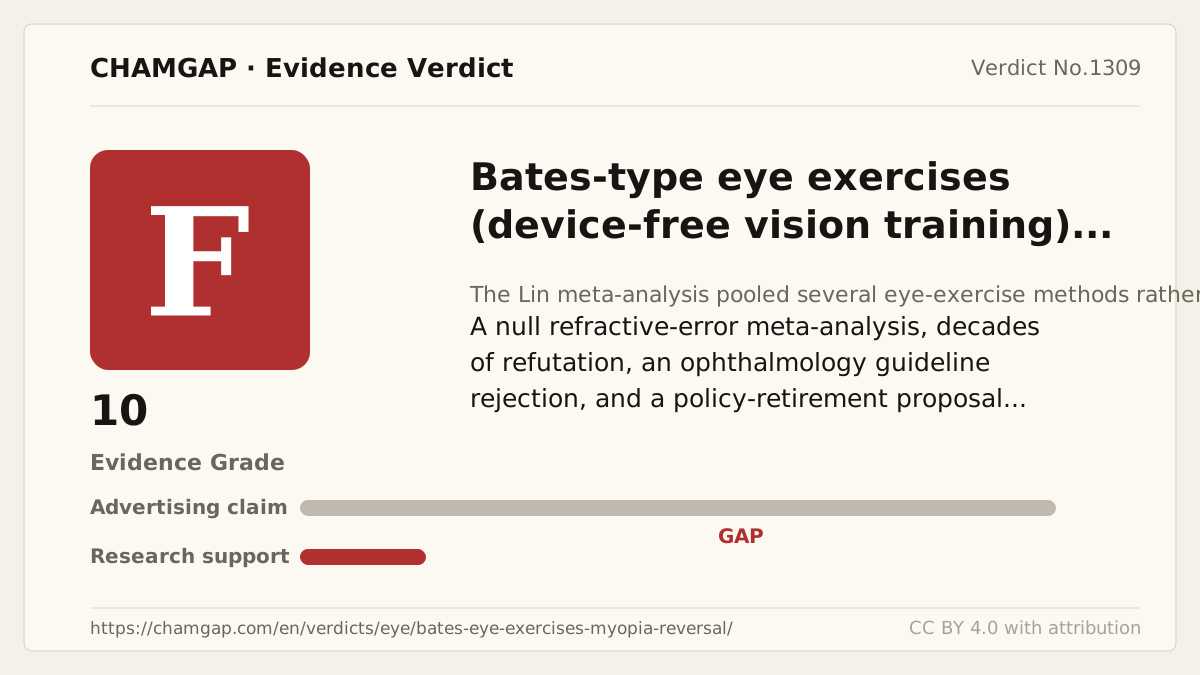
[Chamgap] Bates-type eye exercises x reduced myopia and permanent restoration of unaided vision — Evidence Grade D·35. 4 cited sources checked. Source: https://chamgap.com/en/verdicts/eye/bates-eye-exercises-myopia-reversal/ · CC BY 4.0CC BY 4.0 — free to use with attribution; do not distort grades, numbers, or verdict meaning.
What this document does and does not do
Chamgap is an information source. It reports what research has and has not confirmed; it does not tell readers what to take or buy. That decision belongs to readers and, when needed, medical or legal professionals. This verdict reflects literature available up to the search date and may change as new research appears. Nothing here is medical advice.