
Medicinal-plant antioxidant glasses,
does it really help with Reduced OSDI symptoms in mild dry eye?
research showsThe grade is C with 50 points. In a 50-person randomized double-blind trial, the prespecified OSDI comparison was null at week 4 and significant only at week 8. However, the week-8 between-group comparison is reported as P=0.007 in the abstract and P<0.001 in Table 1 and the Results text, so a precise effect size cannot be established. The trial was registered after completion, was small and eight weeks long, and involved the product company as a co-funder and device supplier.
ads claimDelivery of volatile plant extracts from a spectacle pad does not by itself establish antioxidant repair of the ocular surface. The confirmed result is an eight-week symptom signal in mild dry eye, not replicated tear production.
Useful facts when choosing a product
- The paper described EPA II-alpha as a commercially available Korean product from BM Biotechnology.
- Pads contained ethanol extracts of Schizonepeta, Angelica dahurica, Rehmannia, and Cassia tora.
- The registry lists the company and hospital institute as co-funders, and the paper says the company supplied the trial glasses.
Chamgap Semantic Classification Code
Candidate index · review held
P.glasses-with-pads-containing-ethanol-extracts-of-four-medicinal-plants.device.osdi-symptoms-in-mild-dry-eye.reduce.placeboProcedures, devices and tests > Glasses with pads containing ethanol extracts of four medicinal plants > Device delivered > OSDI symptoms in mild dry eye > Reduction claim > Placebo
An automated migration candidate, not an issued permanent code; exact claim scope remains under review. This machine-generated migration candidate helps retrieval but is not a permanent assignment. The original verdict ID and URL remain authoritative.
What the research actually shows
Fifty participants were assigned 25 per group; 49 were analyzed after one placebo participant withdrew. Median OSDI was 29.16 to 20.83 to 18.72 with active glasses and 28.12 to 25.00 to 25.00 with placebo. The between-group comparison was P=0.455 at week 4 and the group-by-time test was P=0.002. For week 8, the abstract reports P=0.007, whereas Table 1 and the Results text report P<0.001. Using the abstract value would yield an approximation in the conventional medium range, but that quantity is reconstructed from P=0.007 and N=49 rather than reported by the authors; the conflict with the body-text value prevents a precise effect-size estimate. No widely validated between-group minimum important difference was located. Computer randomization and double masking were reported, but concealment implementation and missing-data adjustment were not confirmed; registration followed trial completion.
Why this is classified as C (50)
The patient-reported primary outcome showed a significant week-8 signal, but conflicting abstract and body P values prevent a precise effect-size estimate and week 4 was null. Retrospective registration, a 50-person sample, eight-week duration, and company participation give C with 50 points.
Counterpoint. Stop for irritation or suspected plant allergy, and seek eye assessment for persistent dryness, pain, or visual change.
Rejudgment record. Cross-check applied — Cross-checked the PLOS report and ISRCTN71217488 for visit-specific primary results, the conflicting week-8 P values in the abstract and body, randomization, masking, denominators, retrospective registration, and mixed funding
| Endpoint | P | Symptom or function itself is the target - including patient reports and performance tests |
| Replication | R1 | Single confirmatory trial |
| Independence | I1 | Mixed funding sources |
| Effect size | E+ | Meets the clinically important threshold |
Stored derived and displayed grades match; this is not a current recalculation or validity check (C).
Sub-claim grades by effect
This ingredient is marketed for several effects. A single overall grade blends strong and weak claims together, so each effect is graded separately here. The overall grade reflects the strongest disconfirming or core claim.
| Effect (sub-claim) | Grade | Basis |
|---|---|---|
| Reduced dry-eye symptoms at eight weeks | C | In one small trial, week-8 OSDI was P=0.007 in the abstract and P<0.001 in the body. |
| Increased tear production | D | The Schirmer group-by-time test was null, P=0.320. |
Cross-check — AI research and Codex final gate
Evidence Table
| Study | Design | Sample | Funding | Endpoint | Result | Weight |
|---|---|---|---|---|---|---|
| Choi W, Kim JC, Kim WS, Oh HJ, Yang JM, Lee JB, Yoon KC. 2015 | Two-center Korean randomized double-blind placebo-glasses-controlled parallel trial | 50 randomized (25/25); 49 analyzed at eight weeks (25/24) | Hospital research institute support; ISRCTN also lists BM Biotechnology as co-funder, and the company supplied glasses | Change in OSDI symptom score at baseline, four weeks, and eight weeks | Between-group P=0.455 at week 4 and group-by-time P=0.002; the week-8 comparison conflicts between abstract P=0.007 and Table 1/Results P<0.001, preventing a precise effect-size estimate | Small retrospectively registered patient-reported outcome trial |
Receipt — 1 References
All 1 cited sources were verified for existence at the original page (as of 2026-08-15).
Final verification and publication gate: Codex · Evidence date: 2026-08-15 · Corrections: none
Cite this verdict
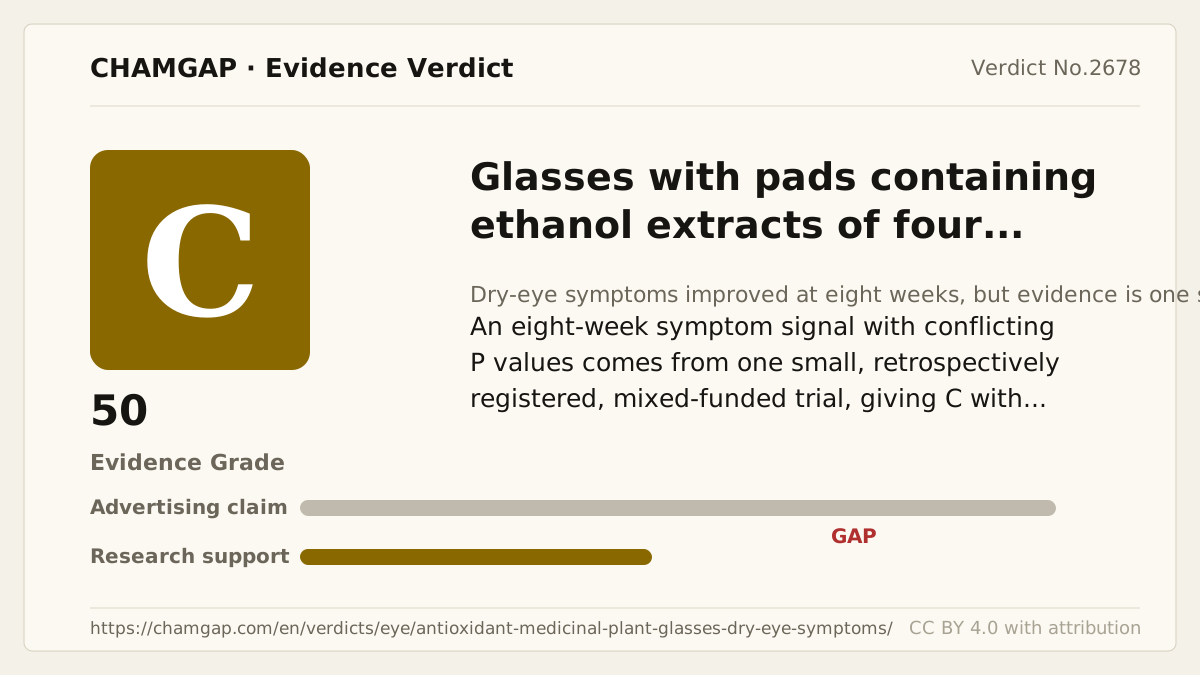
[Chamgap] Medicinal-plant antioxidant glasses x dry-eye symptoms — Evidence Grade C·50. 1 cited sources checked. Source: https://chamgap.com/en/verdicts/eye/antioxidant-medicinal-plant-glasses-dry-eye-symptoms/ · CC BY 4.0CC BY 4.0 — free to use with attribution; do not distort grades, numbers, or verdict meaning.
What this document does and does not do
Chamgap is an information source. It reports what research has and has not confirmed; it does not tell readers what to take or buy. That decision belongs to readers and, when needed, medical or legal professionals. This verdict reflects literature available up to the search date and may change as new research appears. Nothing here is medical advice.