
Aflibercept,
does it really help with Prevention of vision loss and improvement of vision in neovascular age-related macular degeneration?
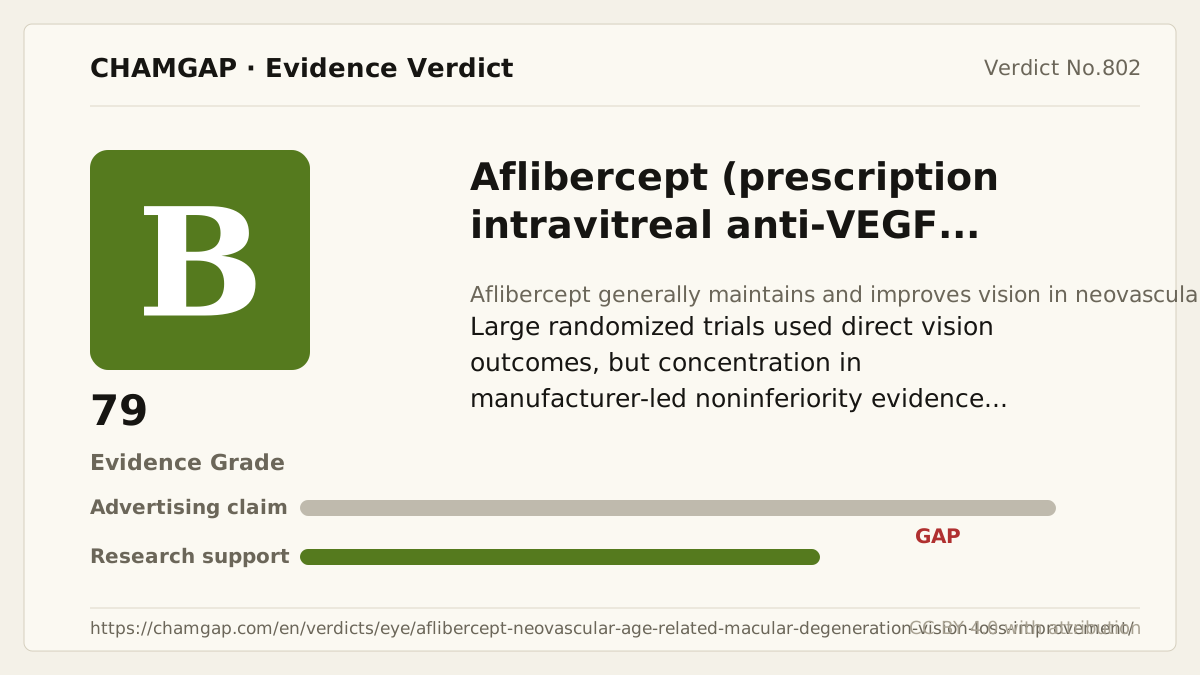
research showsAflibercept is rated B because it prevents vision loss and improves mean vision in neovascular age-related macular degeneration. In the double-masked VIEW 1 and VIEW 2 trials involving 2,419 participants, all aflibercept regimens were noninferior to monthly ranibizumab: 52-week vision-maintenance rates were 95.1% to 96.3% versus 94.4%, and mean best-corrected visual acuity improved by about 8.4 to 9.3 ETDRS letters from baseline. Visual improvement and protection were sustained through 96 weeks. The pivotal evidence is concentrated in manufacturer-led active-controlled noninferiority trials rather than independent placebo-controlled confirmation, so the grade is upper B.
ads claimThe phrase vision-restoring injection expands a mean improvement into normal vision for every eye. Response varies with lesion features, treatment timing, dosing interval, and adherence; some eyes only maintain vision or continue to worsen.
Useful facts when choosing a product
- Aflibercept is a prescription biologic administered aseptically into the vitreous by an eye specialist; it is neither an oral medicine nor a home injection.
- Neovascular macular degeneration treatment uses initial loading injections followed by intervals adjusted to disease activity and the approved product instructions, so scheduled retinal examinations and visits matter.
- Severe eye pain, redness, photophobia, or sudden loss of vision after injection can signal endophthalmitis, retinal detachment, or another emergency complication and requires immediate evaluation.
Chamgap Semantic Classification Code
Candidate index · review held
M.aflibercept.intravitreal.vision-loss-and-improvement-of-vision-in-neovascular-age-related-macular-degeneration.prevent.activeMedicinal interventions > Aflibercept > Intravitreal > vision loss and improvement of vision in neovascular age-related macular degeneration > Occurrence-prevention claim > Active comparator
An automated migration candidate, not an issued permanent code; exact claim scope remains under review. This machine-generated migration candidate helps retrieval but is not a permanent assignment. The original verdict ID and URL remain authoritative.
What the research actually shows
VIEW 1 and VIEW 2 assigned 2,419 patients with active subfoveal choroidal neovascularization to three aflibercept regimens or monthly ranibizumab. At 52 weeks, vision-maintenance rates were 95.1% to 96.3% with aflibercept and 94.4% with ranibizumab; every aflibercept regimen was noninferior, and integrated mean best-corrected visual-acuity gains were within 0.5 letters of the reference. At 96 weeks the treatments remained similarly effective for improving vision and preventing loss. A meta-analysis of 18 comparative observational studies also reported similar two-year real-world vision outcomes for treatment-naive patients, but this was not independent randomized replication.
Why this is classified as B (79)
A large 2,419-participant double-masked randomized program produced positive direct functional outcomes for vision maintenance and mean improvement that persisted to 96 weeks. Concentration in a manufacturer-led active-control noninferiority program limits the grade to B with 79 points. Endophthalmitis, increased intraocular pressure, and retinal detachment remain separate safety issues.
Counterpoint. Noninferiority does not mean inefficacy. It is a practical design when effective anti-VEGF therapy already exists, but it provides less independent confirmation than a large replicated superiority program.
Rejudgment record. New verdict — Gave substantial weight to direct ETDRS vision maintenance and improvement in a 2,419-participant double-masked randomized program with persistence to 96 weeks, but applied upper B because pivotal evidence is concentrated in a manufacturer-led active-control noninferiority program
Sub-claim grades by effect
This ingredient is marketed for several effects. A single overall grade blends strong and weak claims together, so each effect is graded separately here. The overall grade reflects the strongest disconfirming or core claim.
| Effect (sub-claim) | Grade | Basis |
|---|---|---|
| Prevention of vision loss in neovascular age-related macular degeneration | B | Large double-masked noninferiority trials produced vision-maintenance rates above 95% at 52 weeks. |
| Mean vision improvement in neovascular age-related macular degeneration | B | Mean best-corrected visual acuity improved by about eight to nine ETDRS letters, but this does not mean recovery in every patient. |
| Identical efficacy regardless of injection frequency | D | Efficacy depends on regimen and disease activity and cannot be generalized to arbitrary low-frequency dosing. |
Cross-check — AI research and Codex final gate
Evidence Table
| Study | Design | Sample | Funding | Endpoint | Result | Weight |
|---|---|---|---|---|---|---|
| Heier JS et al. 2012 VIEW 1 and VIEW 2 | Two double-masked multicenter active-controlled randomized phase 3 noninferiority trials | 2,419 participants with neovascular age-related macular degeneration | Regeneron and Bayer development program with company-employed coauthors | ETDRS vision maintenance and change in best-corrected visual acuity at week 52 | Every aflibercept group was noninferior, with vision maintenance of 95.1% to 96.3% versus 94.4% with ranibizumab, and mean vision improved. | Pivotal large direct-vision-outcome evidence |
| Schmidt-Erfurth U et al. 2014 VIEW 96-week follow-up | Two-year follow-up of randomized double-masked active-controlled trials | 2,457 participants as reported | Regeneron and Bayer development program with company-employed coauthors | Improvement in best-corrected visual acuity and prevention of vision loss at week 96 | Aflibercept and ranibizumab groups remained similarly effective for improving vision and preventing loss at 96 weeks. | Durability evidence |
| Zhang Y et al. 2017 | Systematic review and meta-analysis of comparative real-world observational studies | 18 comparative studies | University-based academic research | Best-corrected visual acuity and central retinal thickness over 3 to 24 months | Two-year real-world vision outcomes in treatment-naive patients were generally comparable with ranibizumab. | Supportive external-validity evidence |
Receipt — 3 References
All 3 cited sources were verified for existence at the original page (as of 2026-07-20).
Final verification and publication gate: Codex · Evidence date: 2026-07-20 · Corrections: none
Cite this verdict
[Chamgap] Aflibercept x maintenance and improvement of vision in neovascular age-related macular degeneration — Evidence Grade B·79. 3 cited sources checked. Source: https://chamgap.com/en/verdicts/eye/aflibercept-neovascular-age-related-macular-degeneration-vision-loss-improvement/ · CC BY 4.0CC BY 4.0 — free to use with attribution; do not distort grades, numbers, or verdict meaning.
What this document does and does not do
Chamgap is an information source. It reports what research has and has not confirmed; it does not tell readers what to take or buy. That decision belongs to readers and, when needed, medical or legal professionals. This verdict reflects literature available up to the search date and may change as new research appears. Nothing here is medical advice.