
The 20-20-20 rule,
does it really help with Relief of digital eye strain and dry-eye symptoms?
research showsThe grade is D with 28 points. Johnson's 30-person repeated comparison found no difference by break schedule in symptoms (P=.70), reading speed (P=.93), or accuracy (P=.55). However, the 40-person Alghamdi-Alrasheed parallel randomized comparison found significant improvement in dry-eye symptoms and tear break-up time after 20 days of education, while the 24-person Redondo randomized-order crossover found benefits for some symptoms and near-work-induced transient myopia with breaks every 10 minutes or self-paced breaks. Both trials therefore reported a statistically significant benefit on a claimed outcome, although consistent benefit from the exact 20-minute interval was not shown.
ads claimTwenty feet converts to about 6.1 meters, and software did measure breaks and gaze. Those facts do not establish that the exact three-number formula treats eye strain or dry eye.
Useful facts when choosing a product
- Twenty feet equals 6.096 meters and is commonly rounded to about 6 meters.
- The two-week single-arm study used laptop-webcam software to record breaks, gaze, and blinking.
- Search date was 2026-08-04; the initial narrow query missed parallel and crossover trials, which were added after author-name and break-schedule searches.
- Verdict 1199 is F with 10 points for blue-light filtering glasses. This verdict concerns scheduled gaze breaks, not lenses.
Chamgap Semantic Classification Code
Candidate index · review held
UNK.looking-about-20-feet-away.UNK.digital-eye-strain-and-dry-eye-symptoms.relieve.baselineUnknown > Looking about 20 feet away > Unknown > digital eye strain and dry-eye symptoms > Symptom-relief claim > Within-group baseline comparison
An automated migration candidate, not an issued permanent code; exact claim scope remains under review. This machine-generated migration candidate helps retrieval but is not a permanent assignment. The original verdict ID and URL remain authoritative.
What the research actually shows
On 2026-08-04, the initial search narrowly combined the exact phrase '20-20-20 rule' with digital-eye-strain or dry-eye terms and randomized, controlled, or trial filters, missing the Alghamdi-Alrasheed and Redondo reports. The search was expanded with author names and the English terms 'break schedules,' 'educational intervention,' 'tear break-up time,' and 'random order crossover,' identifying a 40-person parallel randomized comparison and a 24-person randomized-order crossover. The earlier claim that no parallel randomized trial existed was removed. Registration, a single prespecified primary outcome, and detailed funding were not confirmed in accessible reporting.
Why this is classified as D (28)
Direct comparisons are mixed. Johnson's exact-interval comparison was null, while the 40-person parallel trial found significant dry-eye symptom and tear-film changes and the 24-person crossover found benefits for some outcomes with more frequent or self-paced breaks. All studies were small and short, and consistent between-group benefit from the exact formula remains uncertain, so D with 28 points is unchanged.
Counterpoint. Longer or differently scheduled breaks are outside this verdict; persistent symptoms warrant assessment for refraction, dry eye, and binocular-vision problems.
Rejudgment record. Cross-check applied — The initially narrow exact-phrase search and expanded author and break-schedule searches were documented; four studies were cross-checked for design, sample, duration, subjective and objective outcomes, statistical significance, and available precision
| Endpoint | P | Symptom or function itself is the target - including patient reports and performance tests |
| Replication | R1 | Single confirmatory trial |
| Independence | I1 | Mixed funding sources |
| Effect size | E0 | Null |
| Precision | CX | No pooled confidence interval could be confirmed |
Stored derived and displayed grades match; this is not a current recalculation or validity check (D).
Sub-claim grades by effect
This ingredient is marketed for several effects. A single overall grade blends strong and weak claims together, so each effect is graded separately here. The overall grade reflects the strongest disconfirming or core claim.
| Effect (sub-claim) | Grade | Basis |
|---|---|---|
| The exact 20-20-20 rule reduces digital eye strain | D | The direct repeated comparison found no symptom difference. |
| Two weeks of use improves objective dry-eye signs | D | Tear-film and ocular-surface measures did not change in the single-arm study. |
Cross-check — AI research and Codex final gate
Evidence Table
| Study | Design | Sample | Funding | Endpoint | Result | Weight |
|---|---|---|---|---|---|---|
| Johnson S and Rosenfield M, Optometry and Vision Science, 2023 | Four-session repeated-condition comparison | 30 young adults | Not confirmed in accessible reporting | Pre-post ocular and visual symptoms, reading speed, and accuracy | Break-schedule effects: symptoms P=.70, speed P=.93, accuracy P=.55 | Direct null comparison of the exact rule |
| Talens-Estarelles C et al., Contact Lens and Anterior Eye, 2023 | Single-arm two-week before-after study | 29 symptomatic computer users | Not confirmed in accessible reporting | Eye-strain and dryness questionnaires plus tear-film and binocular tests | Subjective improvement, null objective signs, and symptom rebound after one week off | Positive signal without a comparator |
| Alghamdi WM and Alrasheed SH, African Vision and Eye Health, 2020 | Twenty-day parallel-group randomized comparison | 40 men with computer vision syndrome; 20 education and 20 water-advice control | Not confirmed in accessible reporting | Computer-vision-syndrome and dry-eye questionnaires, tear break-up time, and ocular surface | Education-group dry-eye score 9.05 to 7.10, P=.04; tear break-up time 6.20 to 8.55 seconds, P=.005; computer vision syndrome P=.38 | Significant claimed-outcome signals, but small and based mainly on within-group change |
| Redondo B et al., Experimental Eye Research, 2025 | Four-condition randomized-order crossover trial | 24 young adults in four 40-minute reading sessions | Not confirmed in accessible reporting | Visual symptoms, accommodative lag and variability, and near-work-induced transient myopia | Every-10-minute and self-paced breaks improved some symptoms and transient myopia; one break at 20 minutes and accommodative lag were not significant | Shows significant benefit from more frequent or self-paced breaks alongside a null exact interval |
Receipt — 4 References
All 4 cited sources were verified for existence at the original page (as of 2026-08-04).
Final verification and publication gate: Codex · Evidence date: 2026-08-04 · Corrections: none
Cite this verdict
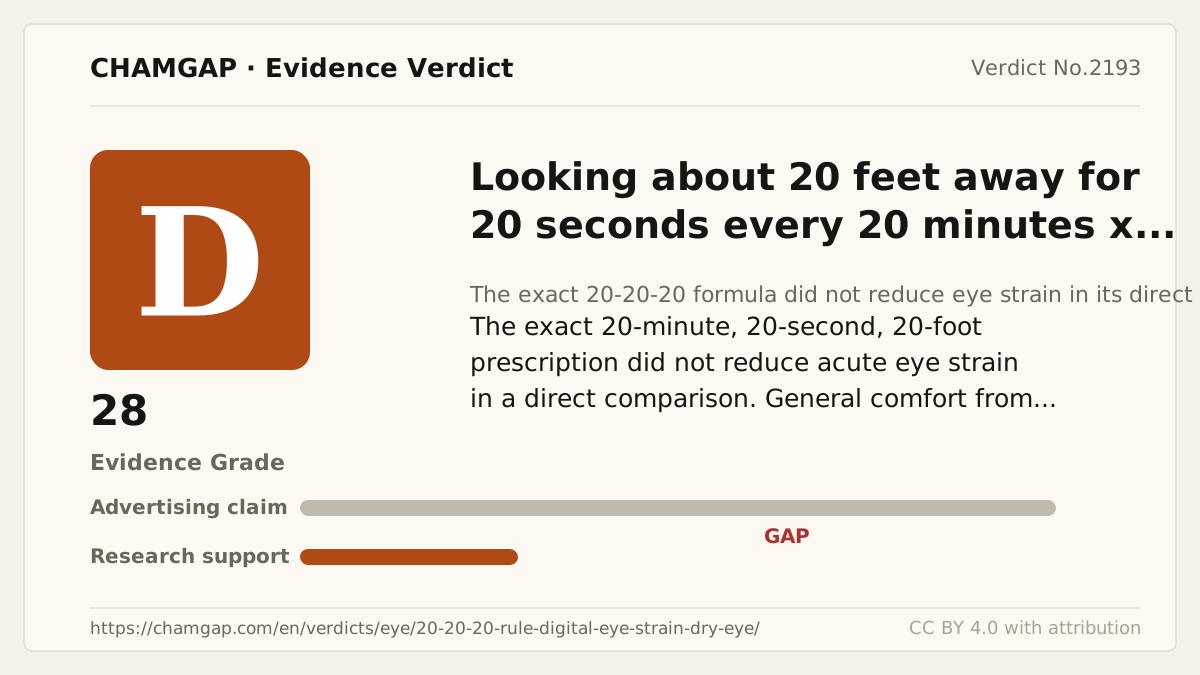
[Chamgap] The 20-20-20 rule x relief of digital eye strain and dry eye — Evidence Grade D·28. 4 cited sources checked. Source: https://chamgap.com/en/verdicts/eye/20-20-20-rule-digital-eye-strain-dry-eye/ · CC BY 4.0CC BY 4.0 — free to use with attribution; do not distort grades, numbers, or verdict meaning.
What this document does and does not do
Chamgap is an information source. It reports what research has and has not confirmed; it does not tell readers what to take or buy. That decision belongs to readers and, when needed, medical or legal professionals. This verdict reflects literature available up to the search date and may change as new research appears. Nothing here is medical advice.