
Stabilized oxaloacetate,
does it really help with Reduced physical and mental fatigue in myalgic encephalomyelitis/chronic fatigue syndrome?
research showsStabilized oxaloacetate has a positive fatigue signal in ME/CFS but is rated C with 41 points. In an 82-person, single-center, double-blind trial, 2,000 mg/day for three months reduced the Chalder fatigue score by 27% from baseline, but the key continuous between-group comparison was p=0.057 and missed the conventional significance threshold. Responder and selected secondary analyses were positive, yet all efficacy outcomes were patient-reported fatigue scales, and the evidence remains affected by company sponsorship, a company-officer lead author, one center, and no independent replication. The twenty-fold gap between the trial dose and a common 100-mg/day retail product also prevents low-dose extrapolation.
ads claimMarketing extends a mitochondrial-energy rationale into restored daily function and assumes that a retail 100-mg product reproduces the fatigue result. The actual positive signal is limited to one stabilized formulation at 2,000 mg/day for three months and to patient-reported fatigue in mild-to-moderate ME/CFS.
Useful facts when choosing a product
- benaGene-type stabilized oxaloacetate is sold as a supplement or medical-food formulation designed to reduce the heat and moisture instability of ordinary oxaloacetate, and labeled amount and excipients can differ by product.
- The pivotal ME/CFS randomized trial used a total of 2,000 mg/day, equivalent to four 500-mg capsules and twenty times a common 100-mg/day supplement label amount.
- The study administered 1,000 mg with breakfast and 1,000 mg with lunch, but this does not establish a universal retail dosing instruction or long-term safety.
- Evidence for post-exertional malaise, orthostatic intolerance, sleep disturbance, and functional disability is distinct from a fatigue-scale result, and the supplement does not replace diagnostic evaluation or symptom-specific care.
Chamgap Semantic Classification Code
Candidate index · review held
S.stabilized-oxaloacetate.UNK.physical-and-mental-fatigue-in-myalgic-encephalomyelitis-chronic-fatigue-syndrome.reduce.placeboSupplements and nutraceuticals > Stabilized oxaloacetate > Unknown > physical and mental fatigue in myalgic encephalomyelitis/chronic fatigue syndrome > Reduction claim > Placebo
An automated migration candidate, not an issued permanent code; exact claim scope remains under review. This machine-generated migration candidate helps retrieval but is not a permanent assignment. The original verdict ID and URL remain authoritative.
What the research actually shows
Cash and colleagues' 2024 RESTORE ME trial assigned 82 adults with mild-to-moderate ME/CFS, 42 and 40 per group, to 1,000 mg twice daily or control. Chalder fatigue fell 27% from baseline in the oxaloacetate group and 32% among completers; greater-than-25% responders were 40.5% versus 20%. The key continuous between-group result was nevertheless p=0.057, and both fatigue instruments were patient-reported. The preceding 2022 study was open-label, nonrandomized, used a historical placebo estimate, and had the same company sponsor. A six-person pharmacokinetic study of 100-mg capsules did not show a consistent, clear rise in blood oxaloacetate, so it does not support low-dose extrapolation.
Why this is classified as C (41)
The randomized double-blind signal and responder difference are accepted, but a p=0.057 key continuous comparison, patient-reported outcomes only, 82 participants at one center, sponsor and officer involvement, and no independent replication place the verdict at the bottom of C with 41 points. Low-dose extrapolation and safety remain separate from efficacy.
Counterpoint. Anyone considering use should recognize that the studied high dose may greatly increase cost and nausea or abdominal-pain risk and should discuss it with a clinician. A 100-mg product should not be assumed equivalent, and lack of benefit should not prompt unsupervised dose escalation.
Rejudgment record. New verdict — Accepted responder and secondary-analysis signals from the 82-person, single-center, company-sponsored double-blind trial, but applied rules ① and ②-b because the key continuous comparison was p=0.057, outcomes were patient-reported, independent replication is absent, and the 2,000-mg/day trial dose is twenty-fold above a common 100-mg/day retail dose
Sub-claim grades by effect
This ingredient is marketed for several effects. A single overall grade blends strong and weak claims together, so each effect is graded separately here. The overall grade reflects the strongest disconfirming or core claim.
| Effect (sub-claim) | Grade | Basis |
|---|---|---|
| Reduction of physical and mental fatigue in ME/CFS | C | An 82-person high-dose trial had responder and secondary-analysis signals, but the key comparison was borderline and evidence is subjective, sponsor-concentrated, and unreplicated. |
| Equivalent fatigue improvement from a retail 100-mg/day product | ? | The direct ME/CFS trial used 2,000 mg/day, and no efficacy trial of 100 mg/day was identified. |
| Independent multicenter reproducibility | ? | Positive efficacy evidence is concentrated in the same commercial-development axis, with no independent multicenter replication. |
Cross-check — AI research and Codex final gate
Evidence Table
| Study | Design | Sample | Funding | Endpoint | Result | Weight |
|---|---|---|---|---|---|---|
| Cash A et al. 2024 RESTORE ME | Single-center randomized double-blind controlled trial | 82 adults with ME/CFS; 42 oxaloacetate and 40 control | Sponsored by Terra Biological LLC; the lead author was an officer of the sponsor | Three-month Chalder fatigue scale, RAND-36, and safety | Fatigue fell 27% from baseline and responders were 40.5% versus 20%, but the key continuous between-group comparison was p=0.057. | Key direct evidence with a borderline main result, subjective outcomes, and sponsor concentration |
| Cash A and Kaufman DL. 2022 | Open-label dose-escalation nonrandomized trial with historical placebo comparison | 76 participants with ME/CFS and 43 with long COVID | Sponsored by Terra Biological LLC; one author was a company officer | Self-reported Chalder physical and mental fatigue | Reported a high-dose fatigue-improvement signal without masking or a concurrent randomized control. | Preliminary exploratory evidence at high risk of bias |
| Swerdlow RH et al. 2016 | Small open-label pharmacokinetic and tolerability study | Six participants with Alzheimer disease | Academic study | Tolerability and blood pharmacokinetics of 100 mg twice daily | One-month tolerability was acceptable, but the rise in blood oxaloacetate was not consistent or clear. | Supportive low-dose extrapolation and safety evidence; not ME/CFS efficacy |
Receipt — 3 References
All 3 cited sources were verified for existence at the original page (as of 2026-07-20).
Final verification and publication gate: Codex · Evidence date: 2026-07-20 · Corrections: none
Cite this verdict
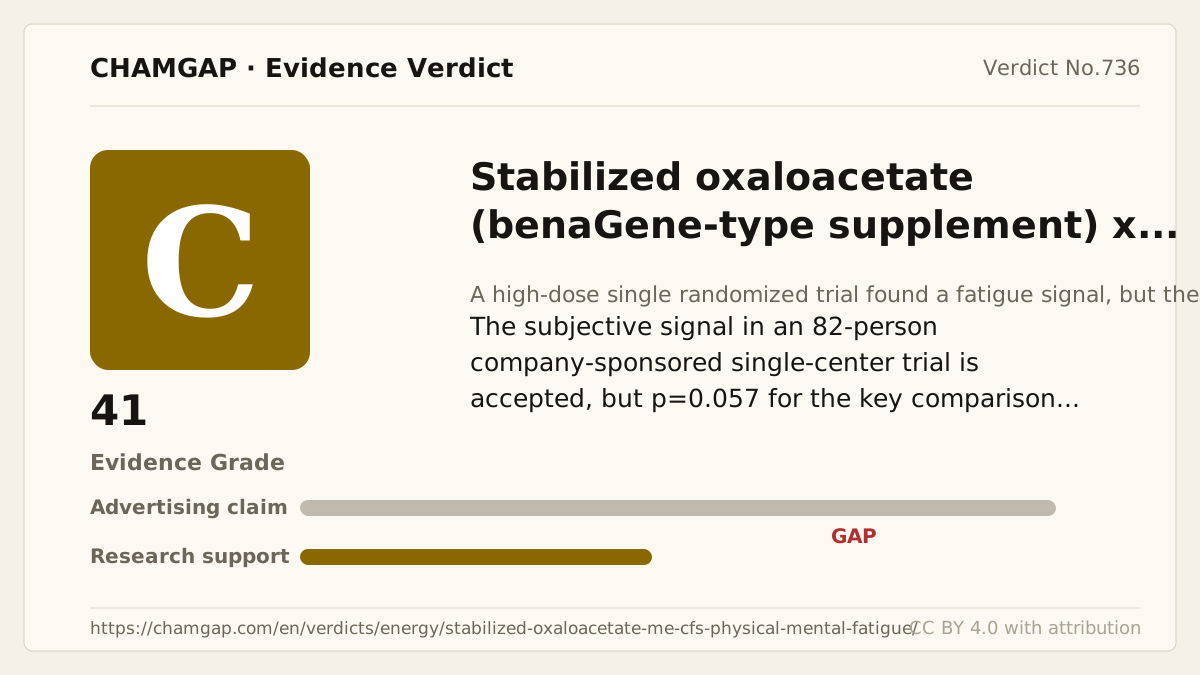
[Chamgap] Stabilized oxaloacetate x reduced physical and mental fatigue in ME/CFS — Evidence Grade C·41. 3 cited sources checked. Source: https://chamgap.com/en/verdicts/energy/stabilized-oxaloacetate-me-cfs-physical-mental-fatigue/ · CC BY 4.0CC BY 4.0 — free to use with attribution; do not distort grades, numbers, or verdict meaning.
What this document does and does not do
Chamgap is an information source. It reports what research has and has not confirmed; it does not tell readers what to take or buy. That decision belongs to readers and, when needed, medical or legal professionals. This verdict reflects literature available up to the search date and may change as new research appears. Nothing here is medical advice.