
Oral iron,
does it really help with Correction of iron-deficiency anemia and improvement of deficiency-related fatigue?
research showsIn people with confirmed iron deficiency, oral iron consistently restores hemoglobin and iron stores, corrects anemia, and can reduce fatigue associated with deficiency, supporting an A grade. This conclusion does not apply to general fatigue in iron-replete people.
ads claimKorean products often combine claims about energy production, oxygen transport, and vitality. Nutrient-function labeling and evidence for treating deficiency must not be expanded into immediate fatigue relief for iron-replete consumers.
Useful facts when choosing a product
- Single-ingredient iron and combinations with vitamin C, folate, or B vitamins are widely sold in Korean pharmacies and online stores.
- Korean health-functional-food labeling commonly uses an iron intake range of 3.6-15 mg/day, while treatment trials often use about 60-100 mg/day of elemental iron; the purposes and doses differ.
- Ferrous sulfate, fumarate, and gluconate contain different proportions of elemental iron, so the elemental amount on the label matters.
- Excess iron can cause gastrointestinal adverse effects and poisoning; accidental ingestion by children can be an emergency. Confirming deficiency and its cause comes first.
Chamgap Semantic Classification Code
Candidate index · review held
UNK.iron.oral.correction-of-iron-deficiency-anemia-and-improvement-of-deficiency-related-fatigue.improve.MULTIUnknown > Iron > Oral > Correction of iron-deficiency anemia and improvement of deficiency-related fatigue > Improvement claim > Multiple: primary unresolved
An automated migration candidate, not an issued permanent code; exact claim scope remains under review. This machine-generated migration candidate helps retrieval but is not a permanent assignment. The original verdict ID and URL remain authoritative.
What the research actually shows
The 2016 Low Cochrane review synthesized 67 trials and 8,506 menstruating women and found that daily oral iron reduced anemia and iron deficiency and increased hemoglobin and ferritin. The 2023 Pasupathy double-blind RCT in 200 adults with iron-deficiency anemia found that both daily and alternate-day oral iron increased hemoglobin by about 1 g/dL at eight weeks. Houston 2018 pooled 18 RCTs and 1,170 iron-deficient non-anemic adults and found reduced subjective fatigue but no improvement in objective physical capacity such as VO2max. Vaucher 2012 found that elemental iron 80 mg/day for 12 weeks reduced fatigue more than placebo in 198 non-anemic menstruating women with ferritin below 50 micrograms/L. By contrast, the 405-participant Keller 2020 blood-donor trial increased iron stores and hemoglobin but not fatigue. The A grade is therefore confined to correction of iron-deficiency anemia and deficiency-related fatigue.
Why this is classified as A (92)
Correction of iron-deficiency anemia has large, repeated RCT and Cochrane evidence, and fatigue improvement is supported in deficient populations, yielding A with 92 points. General fatigue without deficiency and harms from excess are handled separately as a subclaim and safety issue.
Counterpoint. Fatigue can improve in iron-deficient non-anemic women, but that does not establish the same effect in people with normal iron stores.
Rejudgment record. New verdict — Repeated RCT and Cochrane evidence for iron-deficiency anemia and fatigue, separated from general fatigue without deficiency
Sub-claim grades by effect
This ingredient is marketed for several effects. A single overall grade blends strong and weak claims together, so each effect is graded separately here. The overall grade reflects the strongest disconfirming or core claim.
| Effect (sub-claim) | Grade | Basis |
|---|---|---|
| Correction of iron-deficiency anemia and deficiency-related fatigue | A | Numerous RCTs and Cochrane evidence consistently show hematologic recovery and support fatigue improvement in deficient populations. |
| General fatigue relief in iron-replete people | D | There is no direct positive evidence, and the primary fatigue endpoint was null in a large placebo-controlled blood-donor trial. |
Cross-check — AI research and Codex final gate
Evidence Table
| Study | Design | Sample | Funding | Endpoint | Result | Weight |
|---|---|---|---|---|---|---|
| Low et al. 2016 | Cochrane systematic review | 8506 | Cochrane review | Anemia, hemoglobin, ferritin, and fatigue | Daily oral iron reduced anemia and iron deficiency, increased hemoglobin and ferritin, and showed a signal for less fatigue. | Key |
| Pasupathy et al. 2023 | Double-blind active-control RCT | 200 | Academic institutions | Hemoglobin at eight weeks | Both daily and alternate-day oral iron increased hemoglobin by about 1 g/dL in iron-deficiency anemia. | Key |
| Houston et al. 2018 | Systematic review and meta-analysis | 1170 | Nonprofit research support | Fatigue and physical capacity | Subjective fatigue decreased in iron-deficient non-anemic adults, but objective physical capacity did not improve. | Key |
| Keller et al. 2020 | Randomized double-blind placebo-controlled trial | 405 | Academic and public support | Primary fatigue endpoint, ferritin, and hemoglobin | Intravenous iron increased ferritin and hemoglobin but did not change fatigue. | Boundary |
Receipt — 4 References
All 4 cited sources were verified for existence at the original page (as of 2026-07-17).
Final verification and publication gate: Codex · Evidence date: 2026-07-17 · Corrections: none
Cite this verdict
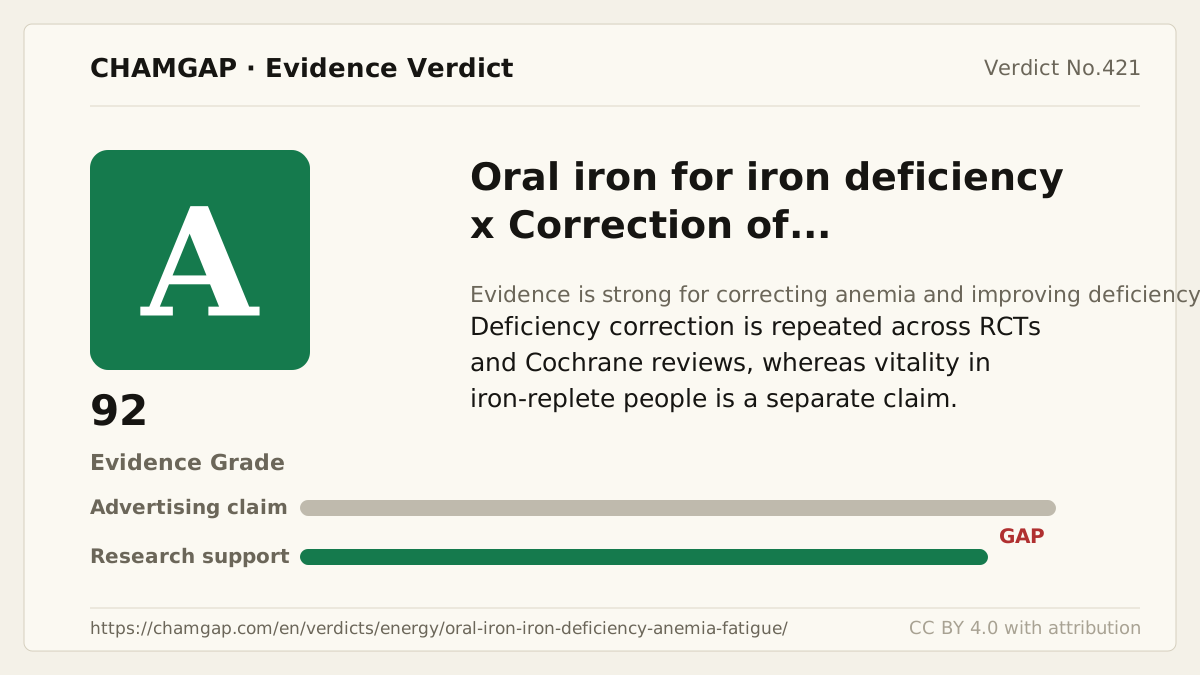
[Chamgap] Oral iron x iron-deficiency anemia and deficiency-related fatigue — Evidence Grade A·92. 4 cited sources checked. Source: https://chamgap.com/en/verdicts/energy/oral-iron-iron-deficiency-anemia-fatigue/ · CC BY 4.0CC BY 4.0 — free to use with attribution; do not distort grades, numbers, or verdict meaning.
What this document does and does not do
Chamgap is an information source. It reports what research has and has not confirmed; it does not tell readers what to take or buy. That decision belongs to readers and, when needed, medical or legal professionals. This verdict reflects literature available up to the search date and may change as new research appears. Nothing here is medical advice.