
Solriamfetol,
does it really help with Reduced excessive daytime sleepiness and sustained wakefulness in adults with narcolepsy?
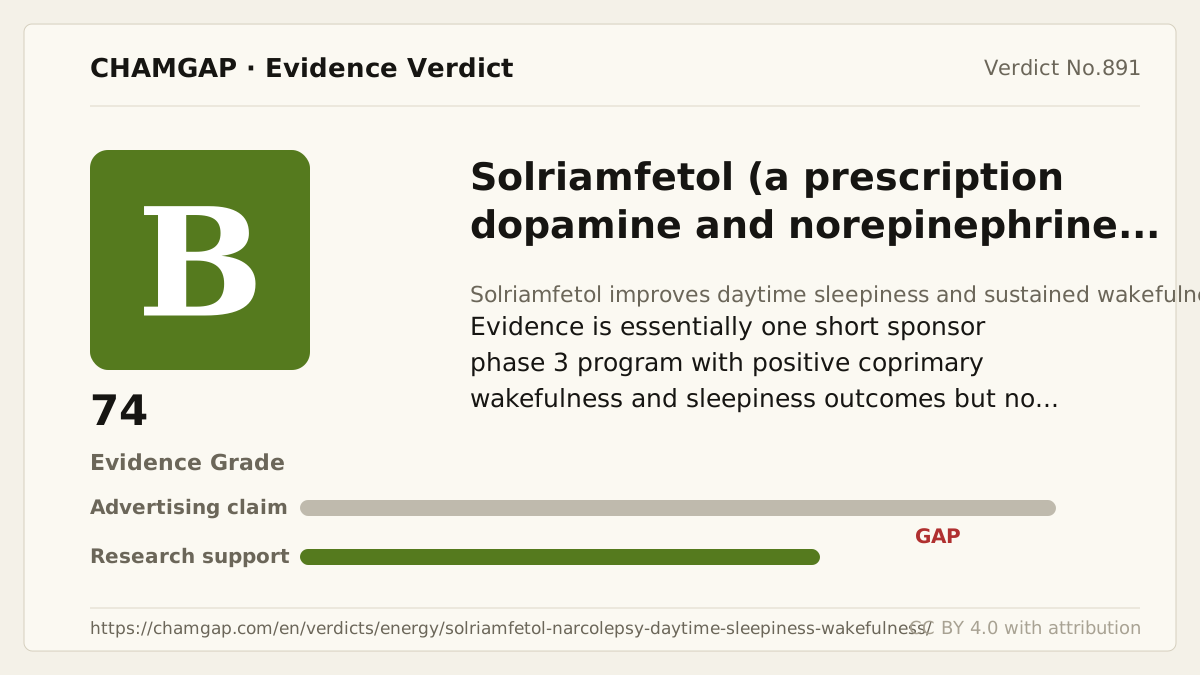
research showsSolriamfetol is rated B because placebo-controlled trials show less excessive daytime sleepiness and longer objectively measured wakefulness in adults with narcolepsy. In phase 3 TONES 2, 150 mg and 300 mg improved both coprimary outcomes, the Maintenance of Wakefulness Test and Epworth Sleepiness Scale, at week 12, and the AASM issued a strong recommendation. Evidence remains concentrated in 12-week sponsor-funded trials rather than long-term functional or accident outcomes, preventing A. This is symptomatic treatment, not a cure.
ads claimPromotion may imply normal alertness all day or resolution of narcolepsy, while trials show average improvement in sleepiness scales and wakefulness tests. Evidence does not establish treatment of cataplexy or the underlying disorder.
Useful facts when choosing a product
- Solriamfetol is a once-daily prescription wake-promoting medicine for narcolepsy-related excessive daytime sleepiness in adults, with dosing adjusted to labeling and kidney function.
- It does not replace adequate sleep or cure narcolepsy, and driving or hazardous work should be avoided until sleepiness is controlled.
- Headache, nausea, reduced appetite, insomnia, and anxiety can occur, while blood pressure and heart rate can rise and require assessment.
- Use with monoamine oxidase inhibitors or soon after their discontinuation is contraindicated, and other blood-pressure-raising drugs require caution.
Chamgap Semantic Classification Code
Candidate index · review held
M.solriamfetol.UNK.excessive-daytime-sleepiness-and-sustained-wakefulness-with-narcolepsy.reduce.placeboMedicinal interventions > Solriamfetol > Unknown > excessive daytime sleepiness and sustained wakefulness with narcolepsy > Reduction claim > Placebo
An automated migration candidate, not an issued permanent code; exact claim scope remains under review. This machine-generated migration candidate helps retrieval but is not a permanent assignment. The original verdict ID and URL remain authoritative.
What the research actually shows
TONES 2 assigned 239 participants to placebo or solriamfetol 75, 150, or 300 mg for 12 weeks. The 150-mg and 300-mg doses improved both wakefulness and sleepiness. Subedi and colleagues' meta-analysis confirmed favorable objective and subjective effects. The 2021 AASM guideline strongly recommended solriamfetol for adult narcolepsy, although evidence is mainly short-term development trials. Efficacy is established without proof of long-term disease modification or hard outcomes.
Why this is classified as B (74)
The essentially single short sponsor phase 3 program had positive coprimary objective wakefulness and subjective sleepiness outcomes, and the AASM made a strong recommendation. Missing accident and occupational-function data and secondary or post hoc functional analyses place it slightly above suvorexant B72 at B74. Cardiovascular stimulation remains a separate safety issue.
Counterpoint. For appropriately diagnosed adult narcolepsy, this is an evidence-based option. Sleep duration, comorbid sleep disorders, sedating medicines, and cardiovascular risk still require evaluation.
Rejudgment record. New verdict — Accepted positive coprimary wakefulness and sleepiness outcomes in a 12-week sponsor phase 3 trial and the strong AASM recommendation, while accounting for an essentially single short development program, absent accident and occupational-function outcomes, and secondary or post hoc functional evidence
Sub-claim grades by effect
This ingredient is marketed for several effects. A single overall grade blends strong and weak claims together, so each effect is graded separately here. The overall grade reflects the strongest disconfirming or core claim.
| Effect (sub-claim) | Grade | Basis |
|---|---|---|
| Reduction of excessive daytime sleepiness in adults with narcolepsy | B | Sleepiness scores fell versus placebo, although long-term data are limited. |
| Objective maintenance of wakefulness in adults with narcolepsy | B | Wakefulness latency increased versus placebo at 150 mg and 300 mg. |
| Improvement in narcolepsy-related daily functioning | C | Signals on functional measures come mainly from secondary, post hoc, sponsor-led analyses and therefore have lower certainty. |
Cross-check — AI research and Codex final gate
Evidence Table
| Study | Design | Sample | Funding | Endpoint | Result | Weight |
|---|---|---|---|---|---|---|
| Thorpy MJ et al. TONES 2. 2019 | Multicenter randomized double-blind placebo-controlled phase 3 trial | 239 randomized; 231 in the modified intention-to-treat population | Funded by Jazz Pharmaceuticals with sponsor involvement in design | Week-12 Maintenance of Wakefulness Test and Epworth Sleepiness Scale coprimary outcomes | The 150-mg and 300-mg doses improved both outcomes, with placebo-adjusted wakefulness differences of 7.7 and 10.1 minutes and sleepiness differences of -3.8 and -4.7 points. | Pivotal direct efficacy evidence |
| Subedi R et al. 2020 | Systematic review and meta-analysis of clinical trials | Pooled randomized trials in narcolepsy and obstructive sleep apnea | Academic analysis; included trials were mainly sponsor funded | Maintenance of Wakefulness Test and Epworth Sleepiness Scale | Solriamfetol increased wakefulness by 9.93 minutes and reduced sleepiness by 4.44 points versus placebo. | Consistency-supporting synthesis |
| Maski K et al. AASM guideline. 2021 | Systematic evidence review and clinical practice guideline | Treatment literature for central disorders of hypersomnolence | American Academy of Sleep Medicine | Treatment benefits and harms in adult narcolepsy | Issued a strong recommendation for solriamfetol in adults with narcolepsy. | Specialty-guideline support |
Receipt — 3 References
All 3 cited sources were verified for existence at the original page (as of 2026-07-20).
Final verification and publication gate: Codex · Evidence date: 2026-07-20 · Corrections: none
Cite this verdict
[Chamgap] Solriamfetol x reduced daytime sleepiness and sustained wakefulness in adults with narcolepsy — Evidence Grade B·74. 3 cited sources checked. Source: https://chamgap.com/en/verdicts/energy/solriamfetol-narcolepsy-daytime-sleepiness-wakefulness/ · CC BY 4.0CC BY 4.0 — free to use with attribution; do not distort grades, numbers, or verdict meaning.
What this document does and does not do
Chamgap is an information source. It reports what research has and has not confirmed; it does not tell readers what to take or buy. That decision belongs to readers and, when needed, medical or legal professionals. This verdict reflects literature available up to the search date and may change as new research appears. Nothing here is medical advice.