
Vitamin C,
does it really help with Isotope-measured fractional iron absorption in nonanemic women with low iron stores?
research showsYes, under the verified conditions. In a crossover trial of nonanemic women with ferritin ≤30 μg/L, 80 mg pure L-ascorbic acid taken simultaneously with the same fasted iron dose produced a median fractional iron absorption of 26.7%, versus 20.6% without added vitamin C (34 participants, P<0.001). This is a short-term absorption result, not proof of better anemia treatment, less fatigue or improved health. [S01: Methods 2.1–2.5, Results 3, Figure 2A]
ads claimThis result alone does not show that vitamin C treats anemia faster or removes fatigue. Its effect size cannot be transferred to juice/foods, sodium/calcium salts, multinutrient products, different iron formulations, fed conditions or intravenous administration. Orange juice alone was not a measured condition. [S01: Methods 2.3, Discussion 4]
Four separate assessment dimensions
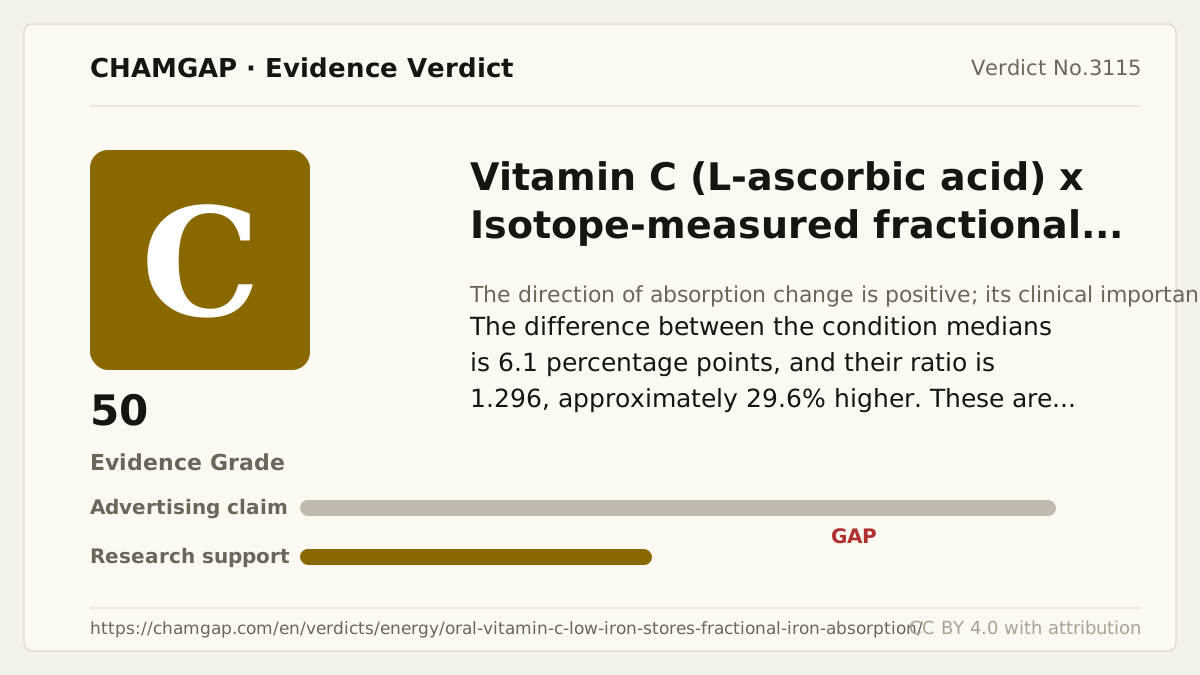
| Effect direction and size | The difference between the condition medians is 6.1 percentage points, and their ratio is 1.296, approximately 29.6% higher. These are descriptive comparisons of marginal medians, not the mean or median individual change or an adjusted crossover treatment estimate. The IQRs are 19.1–32.6% around the 26.7% median and 12.3–25.5% around the 20.6% median; they are not confidence intervals. A paired-effect CI, SD and SE were not verified. [S01: Results 3; CALC01] |
|---|---|
| Evidence certainty | The selected acute absorption contrast is positive; C/50 reflects evidence on a physiological surrogate, not established clinical treatment benefit. |
| Applicability | The direction of absorption change is positive; its clinical importance and exact paired magnitude remain uncertain. Do not directly generalize to men, older adults, normal stores, anemia, pregnancy/lactation, children, renal disease, iron overload or inflammatory conditions. The energy category is navigation, not an energy/fatigue claim. [S01: Methods 2.1] |
| Safety | Condition-specific adverse-event counts are not reported. One of 35 participants withdrew after the first visit because fasting was difficult; the condition is unknown. High-dose/long-term oral gastrointestinal and renal/oxalate concerns and iron overload are separate safety issues. Do not transfer high-dose/IV G6PD contexts directly to the 80 mg oral test. Pregnancy, lactation, children, renal disease and iron overload are outside the demonstrated scope. Study doses are not personal dosing instructions. |
C / 50. The seven axes are B·S·R1·I2·EX·CX·B2 (claim, endpoint, replication, independence, effect, precision, bias). Isotope-derived absorption is a surrogate. Academic funding is documented, but only 1 fully verified directly comparable trial family is decisive. Medians/IQR and limited P reporting cannot yield a valid standardized effect or paired CI, supporting EX(a)/CX. The supplied rubric counts n<200 and completer per-protocol analysis as B2. I2 is the sole strength; the fixed C/1 anchor gives 50. The score is neither a treatment-success probability nor an official GRADE score. [S01; supplied rubric/calculator]
Useful facts when choosing a product
- The tested vitamin C was single-ingredient food-grade L-ascorbic acid (Sigma Aldrich); manufacturing origin, lot and exact purity were not reported. [S01: Methods 2.3]
- The iron capsule was Ferrum Hausmann 100 mg Kaps (Vifor). Naming a brand does not establish product donation or manufacturer funding; product provision was not reported. [S01: Methods 2.3, Acknowledgments]
- The 100 mg refers to elemental iron in the capsule. Total elemental iron including the reported 3 mg label was not separately tabulated, so absolute absorbed iron in mg was not invented. [S01: Methods 2.3; S17: registry-data mirror]
- Baseline vitamin C status, habitual diet and total vitamin C intake were not reported. This is not classified as a vitamin C deficiency-correction trial. [S01: Methods 2.1–2.5]
Chamgap Semantic Classification Code
Permanent code issued
S.vitamin-c.oral-aqueous-80mg-with-ferrous-fumarate-100mg-elemental-single-fasted-dose.low-iron-stores-nonanemic-women-isotope-fractional-iron-absorption.increase.identical-iron-water-no-added-vitamin-cSubstances > Vitamin C > Oral aqueous 80 mg with 100 mg elemental iron as ferrous fumarate, single fasted dose > Isotope fractional iron absorption in nonanemic women with low stores > Increase > Identical iron and water without added vitamin C
Retains the direction of marginal medians, 26.7% versus 20.6%, without turning 6.1 percentage points into an individual paired effect or anemia-treatment benefit. The code identifies the intervention and claim; it never contains the evidence grade, score, or safety result.
Exact Claim Classification
These independent facets prevent evidence from different forms, routes, populations, effects, and comparators from being mixed.
| Intervention class | S · Supplement or nutraceutical |
|---|---|
| Canonical ingredient or intervention | Vitamin C (L-ascorbic acid) |
| Source or part used | Purified food-grade L-ascorbic acid; manufacturing origin, lot and exact purity not reported. |
| Formulation or processing | Single-ingredient L-ascorbic acid in water; not sodium/calcium ascorbate, juice or a multinutrient formula. |
| Route | Oral |
| Dose | 80 mg AA with 100 mg elemental iron as ferrous fumarate capsule plus reported 3 mg isotopic label; author-reported AA:iron molar ratio 0.24:1. |
| Duration | One exposure per condition; crossover days 1,3,5,22,24,26; Methods-based isotope integration 17–21 days after each dose, blood days 22/43. |
| Population | Nonpregnant, nonlactating women 18–45 years; ferritin ≤30 μg/L, Hb >12 g/dL, CRP <5 mg/L; BMI 18.5–26.5 kg/m², weight <70 kg; no major chronic disease. |
| Effect or condition | Increased fractional absorption of an otherwise identical oral non-heme iron dose. |
| Primary endpoint | Stable-isotope-derived fractional iron absorption (%), erythrocyte incorporation model with assumed 80% incorporation; not hemoglobin/ferritin recovery. |
| Comparator | Same participant; identical labeled ferrous fumarate capsule with 200 mL water and no added AA, simultaneous morning 07:00–09:00 after overnight fast. |
| Duplicate-detection key | S|vitamin-c|l-ascorbic-acid-source-unknown|single-ingredient-aqueous|oral|80mg-aa+100mg-elemental-fefum-capsule+reported-3mg-label|simultaneous-morning-overnight-fast|women18-45-ferritin<=30ugL-hb>12gdl-crp<5mgL|increased-fractional-iron-absorption|54fe-57fe-58fe-rbc-isotope-dilution-assume80pct|17-21d-integration-methods-days22-43|identical-iron-water-no-added-aa |
What the research actually shows
The difference between the condition medians is 6.1 percentage points, and their ratio is 1.296, approximately 29.6% higher. These are descriptive comparisons of marginal medians, not the mean or median individual change or an adjusted crossover treatment estimate. The IQRs are 19.1–32.6% around the 26.7% median and 12.3–25.5% around the 20.6% median; they are not confidence intervals. A paired-effect CI, SD and SE were not verified. [S01: Results 3; CALC01] The question is locked to adding only ascorbic acid to otherwise identical non-heme iron exposure in the same participants. Erythrocyte incorporation of stable 54Fe, 57Fe and 58Fe was measured, then converted to absorption using isotope dilution and an assumed 80% incorporation fraction. Serum iron or hemoglobin changes were not substituted for fractional absorption. [S01: Methods 2.3; S16: section 7.4, pp.37–38] Eligibility was restricted to women aged 18–45 years with ferritin ≤30 μg/L, Hb >12 g/dL and CRP <5 mg/L. Of 35 enrolled, 34 completed all 6 conditions. At 07:00–09:00 after an overnight fast, participants received the same ferrous fumarate capsule (100 mg elemental iron), reported 3 mg isotopic label and 200 mL water; the test condition added 80 mg food-grade L-ascorbic acid. The author-reported molar ratio was 0.24:1. Methods specify blood sampling on days 22/43, with isotope-specific incorporation integrated 17–21 days after dosing. [S01: Methods 2.1–2.3, Results 3]
Why this is classified as C (50)
C / 50. The seven axes are B·S·R1·I2·EX·CX·B2 (claim, endpoint, replication, independence, effect, precision, bias). Isotope-derived absorption is a surrogate. Academic funding is documented, but only 1 fully verified directly comparable trial family is decisive. Medians/IQR and limited P reporting cannot yield a valid standardized effect or paired CI, supporting EX(a)/CX. The supplied rubric counts n<200 and completer per-protocol analysis as B2. I2 is the sole strength; the fixed C/1 anchor gives 50. The score is neither a treatment-success probability nor an official GRADE score. [S01; supplied rubric/calculator]
Counterpoint. Absence of registration is not asserted. The printed NCT04074707 link appears to concern pregnancy, but a registry-data mirror identified NCT05414474 with matching 6 conditions, investigators and enrollment. Official history was inaccessible, and discrepancies in recruitment year, blood sampling day and registry versus report eligibility remain unresolved. Condition-specific adverse-event counts were not reported. [S01: Methods 2.1–2.5, Figure 1, Results 3; S04; S17]
Rejudgment record. Supplied calculator C agrees with assigned C; fixed score anchor agrees. — Supplied rubric and grade calculator used unmodified.
| Endpoint | S | Surrogate marker - laboratory or imaging measures Case application: S: isotope-derived FIA is a physiologic surrogate, not anemia correction or a patient-important event. |
| Replication | R1 | Single confirmatory trial Case application: R1: one fully verified directly comparable controlled trial family. Other populations, meals, non-coadministered isotope tests and balance studies fail comparability or remain incompletely verified. R1 is not a claim that only one human study exists; prospective confirmatory hierarchy is unverified. |
| Independence | I2 | Decisive evidence is publicly or non-profit funded Case application: I2: S01 explicitly acknowledges funding from the Laboratory of Human Nutrition, ETH Zurich; authors declare no competing financial interests. Product provision is not reported; brand names are not funding evidence. |
| Effect size | EX | The clinical size of the effect could not be judged Case application: EX(a): no verified clinical anchor, then no valid standardized effect can be reconstructed from marginal medians/IQR and only P<.001. Current paired variance, model contrast SE/CI and exact test statistic are unavailable. The borrowed power SD is not usable. This is not a finding of no absorption effect. |
| Precision | CX | No pooled confidence interval could be confirmed Case application: CX: no verified paired/model contrast confidence interval. IQR is not a CI; significant P does not provide precision of clinically relevant benefit. |
Stored derived and displayed grades match; this is not a current recalculation or validity check (C).
Review performed and remaining limitations
Absence of registration is not asserted. The printed NCT04074707 link appears to concern pregnancy, but a registry-data mirror identified NCT05414474 with matching 6 conditions, investigators and enrollment. Official history was inaccessible, and discrepancies in recruitment year, blood sampling day and registry versus report eligibility remain unresolved. Condition-specific adverse-event counts were not reported. [S01: Methods 2.1–2.5, Figure 1, Results 3; S04; S17]
Preliminary RoB 2-informed review — not a complete formal assessment
| Randomization | Computer-generated crossover order; concealment and laboratory masking not reported. |
|---|---|
| Deviations from assigned interventions | Open label, supervised dosing, per-protocol analysis. Registry-mirror/paper criteria differences retained. |
| Missing outcome data | 1 of 35 withdrew; 34 analyzed. CRP imputation is not FIA imputation. |
| Outcome measurement | Objective stable-isotope method with 80% erythrocyte incorporation assumption. |
| Selection of the reported result | Prospective outcome hierarchy unverified; multiple comparisons uncorrected. Outcome switching not proven. |
Reasons for the certainty judgment — not formal GRADE
| Risk of bias | B2 for two supplied-rubric defects. |
|---|---|
| Inconsistency | No second fully verified same-contract result; inconsistency not established. |
| Indirectness | Restricted to younger nonanemic women, low stores and fasted high-dose iron. |
| Imprecision | Paired/adjusted contrast CI unverified: CX. |
| Publication bias | Not statistically assessable with one decisive family; absence not guaranteed. |
Search scope and limitations. 2026-09-16; 59 general web queries and one failed native PubMed query. Direct openings and failures logged separately. No exhaustive-search assurance.
Evidence Table
| Study | Design | Sample | Funding | Endpoint | Result | Weight |
|---|---|---|---|---|---|---|
| von Siebenthal et al. 2023 | Randomized open-label crossover; one page comparison selected from six within-person conditions | 35 enrolled, 34 analyzed; 204 observations are not 204 participants | Laboratory of Human Nutrition, ETH Zurich; no competing financial interests declared; product provision not reported | FIA (%), modeled from label-specific incorporation 17–21 days after dose | The difference between the condition medians is 6.1 percentage points, and their ratio is 1.296, approximately 29.6% higher. These are descriptive comparisons of marginal medians, not the mean or median individual change or an adjusted crossover treatment estimate. The IQRs are 19.1–32.6% around the 26.7% median and 12.3–25.5% around the 20.6% median; they are not confidence intervals. A paired-effect CI, SD and SE were not verified. [S01: Results 3; CALC01] | Only fully verified directly comparable family; decisive evidence |
Receipt — 22 References
Evidence access cutoff: 2026-09-16. Each citation states its actual access level (full-text transcription, abstract, index, or other) and remaining limitations. Bibliographic checking does not certify the study results or treatment efficacy.
Technical integration by: Codex · Evidence date: 2026-09-16 · Corrections: 6
Correction log — 6
Corrections applied to this verdict, in chronological order. Changes are logged, not erased.
- 2026-09-16 · Boundary correction — Did not label 907 a duplicate merely because vitamin C and oral route match.
- 2026-09-16 · Estimand guard — Kept 6.1 percentage points descriptive; did not invent paired CI from IQR.
- 2026-09-16 · Registration linkage correction — Separated the pregnancy link from probable matching NCT05414474 mirror; no assertion of absent registration.
- 2026-09-16 · Conflicting source values retained — Retained recruitment-year, blood-day, eligibility, coffee-P and reference-median discrepancies.
- 2026-09-16 · Unmeasured extrapolation removed — Did not create orange-juice-alone, absolute absorbed-mg, optimal-dose or clinical-health results.
- 2026-09-16 · Supporting-file URL corrected — Used the actual publisher download link verified by final click; retained the 403 failure. No numeric or grading change. (grade C unchanged)
Cite this verdict
[Chamgap] Does taking vitamin C with iron increase iron absorption when iron stores are low? — Evidence Grade C·50. 22 cited sources checked. Source: https://chamgap.com/en/verdicts/energy/oral-vitamin-c-low-iron-stores-fractional-iron-absorption/ · CC BY 4.0CC BY 4.0 — free to use with attribution; do not distort grades, numbers, or verdict meaning.
What this document does and does not do
Chamgap is an information source. It reports what research has and has not confirmed; it does not tell readers what to take or buy. That decision belongs to readers and, when needed, medical or legal professionals. This verdict reflects literature available up to the search date and may change as new research appears. Nothing here is medical advice.