
NADH,
does it really help with Improved chronic fatigue?
research showsA small crossover trial reported more responders, but a larger monotherapy RCT found no difference in most fatigue, function, and quality-of-life outcomes. Positive CoQ10 combination trials cannot isolate NADH, resulting in a C grade.
ads claimAdvertisements directly convert cellular-energy and ATP mechanisms into claims of chronic-fatigue improvement, while monotherapy clinical results are mixed.
Useful facts when choosing a product
- Monotherapy trials used 10-20 mg/day.
- Positive later trials mainly used CoQ10 200 mg plus NADH 20 mg.
- Short-term tolerability was generally acceptable in studies.
Chamgap Semantic Classification Code
Candidate index · review held
S.nadh.UNK.chronic-fatigue.improve.placeboSupplements and nutraceuticals > NADH > Unknown > chronic fatigue > Improvement claim > Placebo
An automated migration candidate, not an issued permanent code; exact claim scope remains under review. This machine-generated migration candidate helps retrieval but is not a permanent assignment. The original verdict ID and URL remain authoritative.
What the research actually shows
In Forsyth 1999, 31% of 26 participants responded to NADH versus 8% to placebo. Alegre 2010 enrolled 86 participants and found no difference in most fatigue, function, and quality-of-life measures apart from selected changes in anxiety and maximum heart rate. Castro-Marrero 2015 reported reduced fatigue with CoQ10 200 mg plus NADH 20 mg in 73 participants.
Why this is classified as C (42)
Monotherapy RCTs exist, but a small positive study conflicts with a larger negative study and combination evidence cannot be attributed to NADH, resulting in C with 42 points.
Counterpoint. Signals in selected responders and combination groups remain.
Rejudgment record. New verdict — Small positive monotherapy RCT conflicts with a larger negative monotherapy RCT; positive combination evidence cannot isolate the ingredient
Cross-check — AI research and Codex final gate
Evidence Table
| Study | Design | Sample | Funding | Endpoint | Result | Weight |
|---|---|---|---|---|---|---|
| Forsyth LM et al. 1999 | Randomized double-blind placebo-controlled crossover trial | 26 | Included formulation developer; details unknown | Composite responder assessment | Response was 31% with NADH and 8% with placebo. | Positive, small |
| Alegre J et al. 2010 | Randomized double-blind placebo-controlled trial | 77 | Non-U.S. public research support | Fatigue, function, mood, quality of life, and exercise capacity | Most clinical variables and global function did not differ, apart from anxiety and maximum heart rate. | Key, negative |
| Castro-Marrero J et al. 2015 | Randomized double-blind placebo-controlled combination trial | 73 | Public and foundation support; supplement combination | Fatigue and cellular biochemical markers | Fatigue and selected biochemical measures improved with CoQ10 plus NADH. | Indirect, combination |
Receipt — 3 References
All 3 cited sources were verified for existence at the original page (as of 2026-07-11).
Final verification and publication gate: Codex · Evidence date: 2026-07-11 · Corrections: none
Cite this verdict
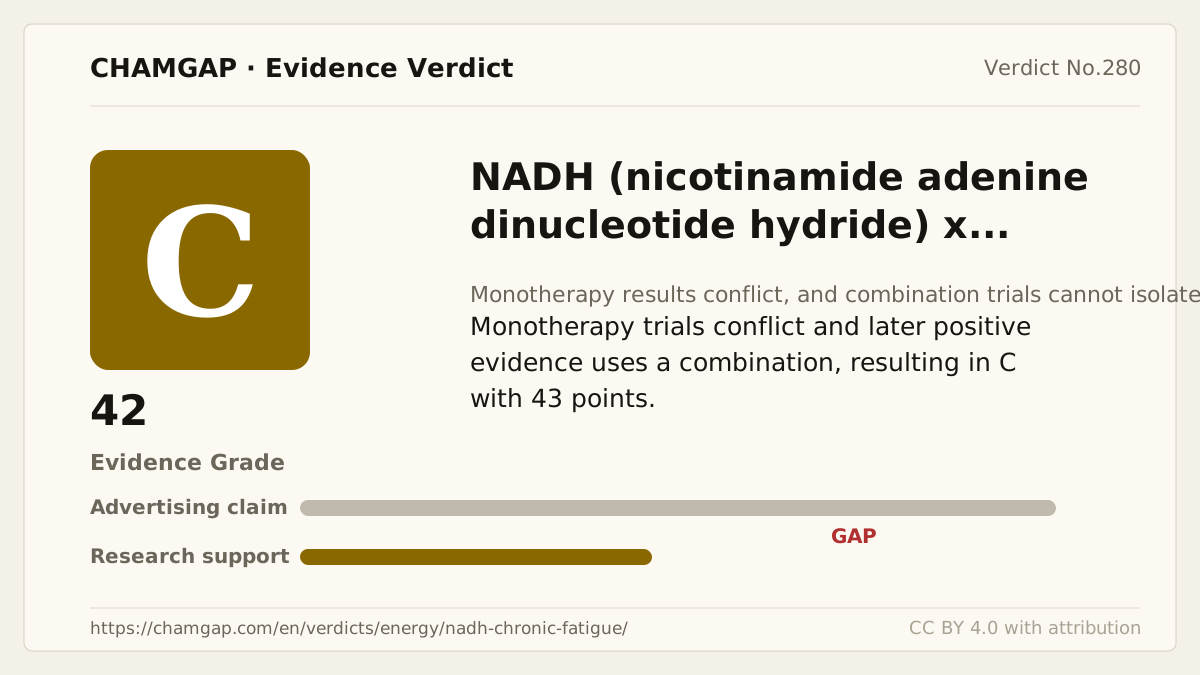
[Chamgap] NADH (nicotinamide adenine dinucleotide hydride) x improved chronic fatigue — Evidence Grade C·42. 3 cited sources checked. Source: https://chamgap.com/en/verdicts/energy/nadh-chronic-fatigue/ · CC BY 4.0CC BY 4.0 — free to use with attribution; do not distort grades, numbers, or verdict meaning.
What this document does and does not do
Chamgap is an information source. It reports what research has and has not confirmed; it does not tell readers what to take or buy. That decision belongs to readers and, when needed, medical or legal professionals. This verdict reflects literature available up to the search date and may change as new research appears. Nothing here is medical advice.