
Bedtime versus morning-fasting levothyroxine,
does it really help with Lower thyroid-stimulating hormone versus dosing 30 minutes before breakfast?
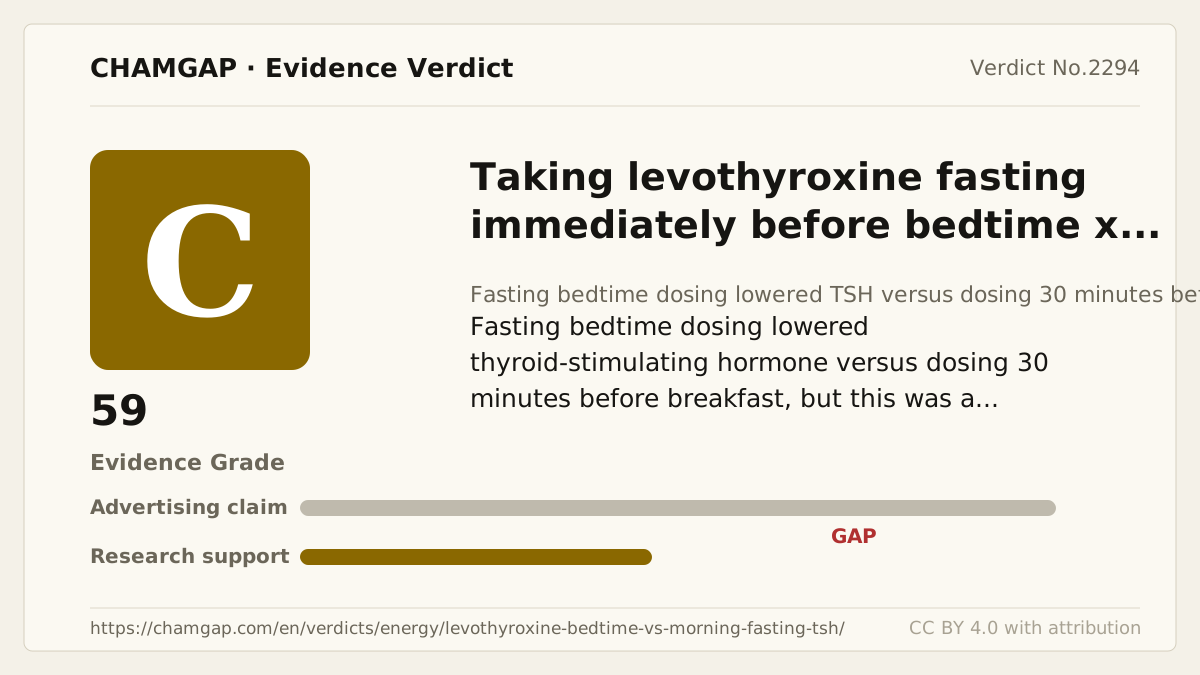
research showsThe grade is C with 50 points. In a double-blind crossover trial, 105 adults enrolled and 90 were analyzed. Each schedule lasted 12 weeks and participants switched directly without a separate washout. Bedtime dosing lowered thyroid-stimulating hormone by 1.25 mIU/L versus dosing 30 minutes before breakfast, 95% CI 0.60 to 1.89. Laboratory values changed, but quality of life, fatigue, and symptoms did not.
ads claimVerdict 923 is A with 86 points for levothyroxine correcting overt hypothyroidism, while verdict 1779 is F with 8 points for symptom improvement in subclinical hypothyroidism. This is the separate dosing-time question of bedtime fasting versus morning fasting.
Useful facts when choosing a product
- Each crossover schedule lasted 12 weeks, with no separate washout before switching.
- Ninety of 105 enrolled participants provided the analyzed completer data.
- Thyroid-stimulating hormone is a surrogate; symptoms, fatigue, and quality of life did not improve.
- No financial conflicts were reported, but the funding source was not confirmed.
Chamgap Semantic Classification Code
Candidate index · review held
UNK.taking-levothyroxine-fasting-immediately-before-bedtime.UNK.thyroid-stimulating-hormone.reduce.placeboUnknown > Taking levothyroxine fasting immediately before bedtime > Unknown > thyroid-stimulating hormone > Reduction claim > Placebo
An automated migration candidate, not an issued permanent code; exact claim scope remains under review. This machine-generated migration candidate helps retrieval but is not a permanent assignment. The original verdict ID and URL remain authoritative.
What the research actually shows
Bolk and colleagues enrolled 105 adults with primary hypothyroidism on a stable dose for at least six months. Participants took one morning and one bedtime capsule, one containing levothyroxine and the other placebo, then switched contents after three months for another three months. Ninety completers were analyzed. There was no separate washout; the paper tested first-order carryover and did not detect it. Bedtime direct effects were TSH -1.25 mIU/L, 95% CI -1.89 to -0.60, free T4 +0.07 ng/dL, 0.02 to 0.13, and total T3 +6.5 ng/dL, 0.9 to 12.1. Quality of life, fatigue, and symptoms did not differ. The financial-disclosure section reported none. The funding source could not be confirmed.
Why this is classified as C (50)
A small single crossover trial found a medium-sized TSH difference, but the outcome was surrogate-only, giving C with 50 points.
Counterpoint. Food, iron, and calcium near bedtime can change absorption. Timing should not be changed without a consistent routine and follow-up testing.
Rejudgment record. Cross-check applied — Crossover design, 12-week periods, no separate washout, 105 enrolled versus 90 completers, the direct TSH effect and approximate standardized magnitude, null symptom outcomes, and unconfirmed funding were applied
| Endpoint | S | Surrogate marker - laboratory or imaging measures |
| Replication | R1 | Single confirmatory trial |
| Independence | I1 | Mixed funding sources |
| Effect size | E+ | Meets the clinically important threshold |
Stored derived and displayed grades match; this is not a current recalculation or validity check (C).
Sub-claim grades by effect
This ingredient is marketed for several effects. A single overall grade blends strong and weak claims together, so each effect is graded separately here. The overall grade reflects the strongest disconfirming or core claim.
| Effect (sub-claim) | Grade | Basis |
|---|---|---|
| Fasting bedtime dosing lowers TSH versus dosing 30 minutes before breakfast | C | The direct effect was -1.25 mIU/L in 90 completers. |
| Bedtime dosing improves fatigue or symptoms | D | Quality-of-life, fatigue, and symptom questionnaires did not differ. |
Cross-check — AI research and Codex final gate
Evidence Table
| Study | Design | Sample | Funding | Endpoint | Result | Weight |
|---|---|---|---|---|---|---|
| Bolk N et al. 2010 | Randomized double-blind placebo-capsule crossover trial | 105 enrolled; 90 completers analyzed | Nothing was reported in the financial-disclosure section; the funding source could not be confirmed | TSH, free T4, and total T3 after each 12-week period; symptoms and quality of life were secondary | Bedtime dosing lowered TSH by 1.25 mIU/L, 95% CI 0.60 to 1.89; quality of life, fatigue, and symptoms did not differ. | Pivotal small surrogate-endpoint crossover trial |
Receipt — 1 References
All 1 cited sources were verified for existence at the original page (as of 2026-08-05).
Final verification and publication gate: Codex · Evidence date: 2026-08-05 · Corrections: none
Cite this verdict
[Chamgap] Bedtime versus morning-fasting levothyroxine x thyroid-stimulating hormone — Evidence Grade C·50. 1 cited sources checked. Source: https://chamgap.com/en/verdicts/energy/levothyroxine-bedtime-vs-morning-fasting-tsh/ · CC BY 4.0CC BY 4.0 — free to use with attribution; do not distort grades, numbers, or verdict meaning.
What this document does and does not do
Chamgap is an information source. It reports what research has and has not confirmed; it does not tell readers what to take or buy. That decision belongs to readers and, when needed, medical or legal professionals. This verdict reflects literature available up to the search date and may change as new research appears. Nothing here is medical advice.