
Gongjin-dan,
does it really help with Improved fatigue severity and physical function in unexplained chronic fatigue?
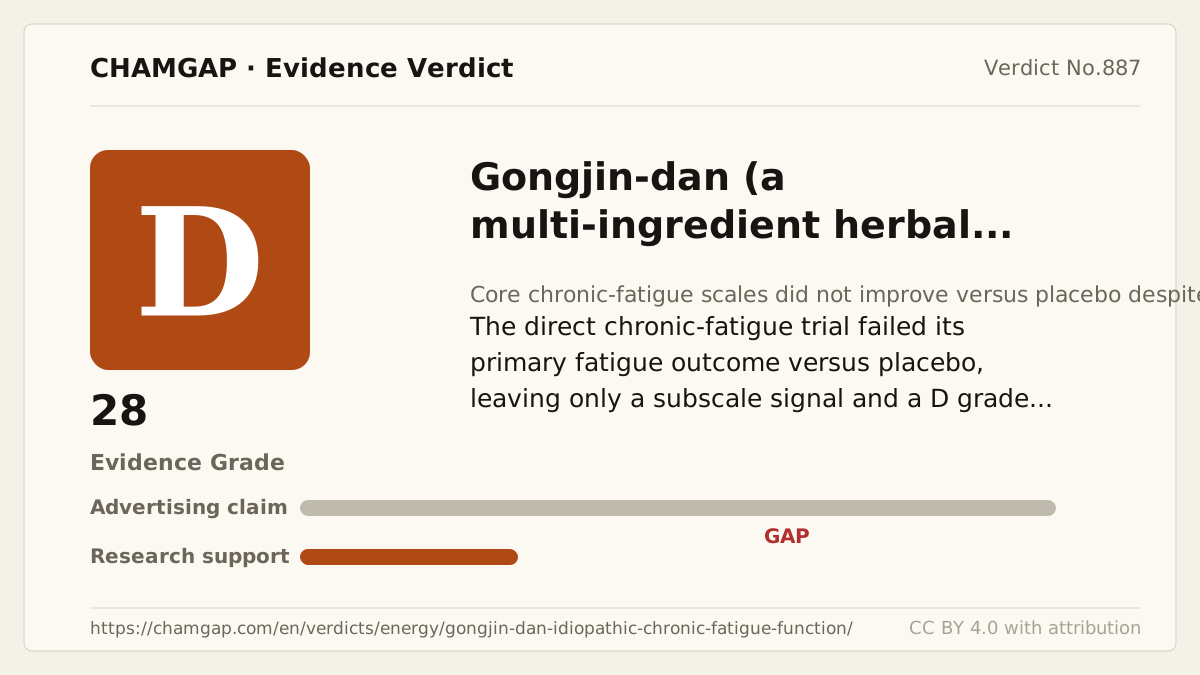
research showsGongjin-dan is rated D for improving core fatigue severity and physical function in unexplained chronic fatigue. This was not a 90-person Gongjin-dan comparison: 90 participants were split among three groups, leaving 30 on Gongjin-dan and 30 controls for the relevant comparison. The primary FSS difference was -0.19 (97.5% CI -0.64 to 0.26; P=0.408), and MFI-20 and CFQ were also null. Only SF-36 Social Functioning was exploratorily positive (P=0.0118). One small trial is not repeated large-scale disproof sufficient for F, and the multi-herb preparation is judged as a whole.
ads claimMarketing expands traditional tonic status or an isolated quality-of-life subscale into recovery from generalized fatigue and improved stamina or physical function. The direct trial did not show superiority on core fatigue scales, and its result cannot be split into efficacy claims for musk or deer antler alone.
Useful facts when choosing a product
- Gongjin-dan is a multi-ingredient prescription that must be assessed as a whole; the 2024 trial used a 3.75-g pill containing Angelica root, Cornus fruit, ginseng, prepared Rehmannia root, musk, and deer antler.
- The trial used one specific authorized product at one pill daily for 28 days, so its result cannot be assumed for preparations with different compounding, composition, or content.
- No serious intervention-related event occurred in the 90-person trial, but four weeks cannot establish rare-event or long-term safety.
- Products combining animal-derived musk and deer antler with multiple herbs require attention to identity, contamination, heavy metals, content consistency, and drug interactions.
Chamgap Semantic Classification Code
Candidate index · review held
M.gongjin-dan.UNK.fatigue-severity-and-physical-function-in-unexplained-chronic-fatigue.improve.placeboMedicinal interventions > Gongjin-dan > Unknown > fatigue severity and physical function in unexplained chronic fatigue > Improvement claim > Placebo
An automated migration candidate, not an issued permanent code; exact claim scope remains under review. This machine-generated migration candidate helps retrieval but is not a permanent assignment. The original verdict ID and URL remain authoritative.
What the research actually shows
Choi and colleagues in 2024 randomized 90 people with unexplained chronic fatigue to Gongjin-dan, Ssanghwa-tang, or control, 30 per group, for 28 days. For Gongjin-dan versus control, the primary FSS difference was -0.19 (97.5% CI -0.64 to 0.26; P=0.408), while MFI-20 and CFQ were null. Only SF-36 Social Functioning was exploratorily positive (P=0.0118). In a 23-person sleep-deprivation crossover trial, overall BFI, FSS, and cortisol were also not significant. Direct chronic-fatigue evidence receives priority, but the evidence is not repeated and large enough for F.
Why this is classified as D (28)
Among 90 participants split across three groups, the relevant 30-person Gongjin-dan versus 30-person control comparison found a primary FSS difference of -0.19 (97.5% CI -0.64 to 0.26; P=0.408), with null MFI-20 and CFQ. One exploratorily positive SF-36 Social Functioning result (P=0.0118) carries less weight. The result is D with 28 points, but the absence of repeated large disproof prevents F.
Counterpoint. Fatigue lasting six months warrants evaluation for anemia, thyroid disease, sleep disorders, depression or anxiety, post-infectious illness, medicines, and other causes. Taking a particular preparation should not delay diagnosis or evidence-based treatment of the cause.
Rejudgment record. New verdict — Applied rule ② for failure of the direct primary endpoint because the 30-person Gongjin-dan versus 30-person control comparison within a three-group 90-person trial found an FSS difference of -0.19 (P=0.408) and null MFI-20 and CFQ, while one Social Functioning result was exploratory; repeated large disproof required for F was absent
Sub-claim grades by effect
This ingredient is marketed for several effects. A single overall grade blends strong and weak claims together, so each effect is graded separately here. The overall grade reflects the strongest disconfirming or core claim.
| Effect (sub-claim) | Grade | Basis |
|---|---|---|
| Improved FSS fatigue severity in unexplained chronic fatigue | D | Within a three-group 90-person trial, the primary FSS difference for 30 Gongjin-dan participants versus 30 controls was -0.19 (P=0.408) and null. |
| Improved multidimensional fatigue in unexplained chronic fatigue | D | MFI-20 and CFQ did not improve significantly versus placebo. |
| Improved physical function in unexplained chronic fatigue | D | The Gongjin-dan group did not show superior SF-36 Physical Functioning; only one Social Functioning subscale was positive. |
Cross-check — AI research and Codex final gate
Evidence Table
| Study | Design | Sample | Funding | Endpoint | Result | Weight |
|---|---|---|---|---|---|---|
| Choi JY et al. 2024 | Randomized double-blind double-dummy placebo-controlled trial | 90 participants with unexplained chronic fatigue; 30 each in Gongjin-dan, Ssanghwa-tang, and control groups | Institutional research from the Korea Institute of Oriental Medicine; study products were purchased from Iksu Pharmaceuticals | Four-week primary FSS endpoint, MFI-20, CFQ, SF-36, and biomarkers | For 30 Gongjin-dan participants versus 30 controls, the FSS difference was -0.19 (97.5% CI -0.64 to 0.26; P=0.408), MFI-20 and CFQ were null, and only Social Functioning was exploratorily positive (P=0.0118). | Key direct null randomized trial |
| Son MJ et al. 2018 | Randomized double-blind placebo-controlled exploratory crossover trial | 23 healthy men; 20 Gongjin-dan and 21 placebo periods analyzed | Supported by the Korea Institute of Oriental Medicine (K18121) | Cortisol, BFI, FSS, and sleep quality after two nights of sleep deprivation | Overall crossover analyses of cortisol, BFI, and FSS were not significant; only selected first-period analyses were positive. | Small indirect exploratory evidence in acute fatigue |
Receipt — 2 References
All 2 cited sources were verified for existence at the original page (as of 2026-07-20).
Final verification and publication gate: Codex · Evidence date: 2026-07-20 · Corrections: none
Cite this verdict
[Chamgap] Gongjin-dan x improved fatigue and physical function in unexplained chronic fatigue — Evidence Grade D·28. 2 cited sources checked. Source: https://chamgap.com/en/verdicts/energy/gongjin-dan-idiopathic-chronic-fatigue-function/ · CC BY 4.0CC BY 4.0 — free to use with attribution; do not distort grades, numbers, or verdict meaning.
What this document does and does not do
Chamgap is an information source. It reports what research has and has not confirmed; it does not tell readers what to take or buy. That decision belongs to readers and, when needed, medical or legal professionals. This verdict reflects literature available up to the search date and may change as new research appears. Nothing here is medical advice.