
Elamipretide,
does it really help with Improved walking ability and fatigue in primary mitochondrial myopathy?
research showsElamipretide is rated D. In MMPOWER-3 (n=218), both co-primary endpoints failed: the placebo-adjusted six-minute walk difference was −3.2 m (p=0.69) and PMMSA Total Fatigue was −0.07 (p=0.37). A post hoc signal in participants with nuclear-DNA defects cannot overturn the null overall result.
ads claimClaims of mitochondrial restoration or energy enhancement cannot substitute for failed patient outcomes in phase 3.
Useful facts when choosing a product
- Elamipretide is a synthetic peptide developed to target cardiolipin in the inner mitochondrial membrane.
- It was studied as a daily subcutaneous injection for primary mitochondrial myopathy.
- Both walking and fatigue co-primary endpoints failed in MMPOWER-3.
- Injection-site reactions were common, and current regional regulatory status should be checked.
Chamgap Semantic Classification Code
Candidate index · review held
M.elamipretide.subcutaneous.walking-ability-and-fatigue-in-primary-mitochondrial-myopathy.improve.placeboMedicinal interventions > Elamipretide > Subcutaneous > walking ability and fatigue in primary mitochondrial myopathy > Improvement claim > Placebo
An automated migration candidate, not an issued permanent code; exact claim scope remains under review. This machine-generated migration candidate helps retrieval but is not a permanent assignment. The original verdict ID and URL remain authoritative.
What the research actually shows
MMPOWER-3 randomized 109 participants per group. At week 24 the six-minute walk difference was −3.2 m and PMMSA Total Fatigue difference was −0.07, neither significant. Small signals from MMPOWER and MMPOWER-2 were not confirmed.
Why this is classified as D (28)
Both overall co-primary endpoints failed in a large phase 3 trial, giving D with 28 points. The post hoc subgroup did not raise the grade.
Counterpoint. A subgroup hypothesis is not efficacy evidence until independently confirmed in a prespecified trial.
Rejudgment record. New verdict — Both co-primary endpoints failed in a large phase 3 trial; the post hoc subgroup was not used to raise the grade
Sub-claim grades by effect
This ingredient is marketed for several effects. A single overall grade blends strong and weak claims together, so each effect is graded separately here. The overall grade reflects the strongest disconfirming or core claim.
| Effect (sub-claim) | Grade | Basis |
|---|---|---|
| Improved walking ability | D | The phase 3 six-minute walk endpoint was null. |
| Improved fatigue | D | The phase 3 PMMSA fatigue endpoint was null. |
| Improved walking and fatigue in nDNA disease | D | This was a post hoc exploratory subgroup. |
Cross-check — AI research and Codex final gate
Evidence Table
| Study | Design | Sample | Funding | Endpoint | Result | Weight |
|---|---|---|---|---|---|---|
| Karaa A et al. 2023 (MMPOWER-3) | Randomized double-blind placebo-controlled phase 3 trial | 218 participants | Stealth BioTherapeutics | Co-primary six-minute walk and PMMSA Total Fatigue | Both were null: −3.2 m (p=0.69) and −0.07 (p=0.37). | Pivotal confirmatory null evidence |
| Karaa A et al. 2020 (MMPOWER-2) | Randomized crossover trial | 30 participants | Stealth BioTherapeutics | Walking and fatigue | A fatigue signal was not replicated in phase 3. | Early exploratory evidence |
Receipt — 2 References
All 2 cited sources were verified for existence at the original page (as of 2026-07-24).
Final verification and publication gate: Codex · Evidence date: 2026-07-24 · Corrections: none
Cite this verdict
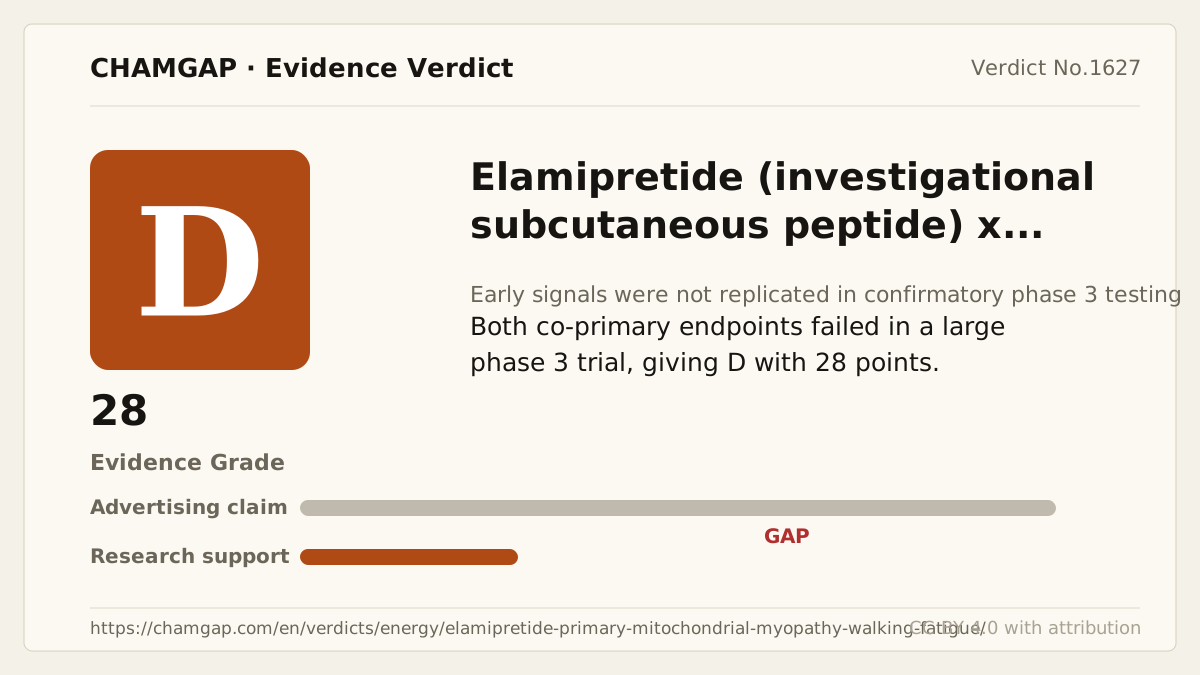
[Chamgap] Elamipretide x walking ability and fatigue in primary mitochondrial myopathy — Evidence Grade D·28. 2 cited sources checked. Source: https://chamgap.com/en/verdicts/energy/elamipretide-primary-mitochondrial-myopathy-walking-fatigue/ · CC BY 4.0CC BY 4.0 — free to use with attribution; do not distort grades, numbers, or verdict meaning.
What this document does and does not do
Chamgap is an information source. It reports what research has and has not confirmed; it does not tell readers what to take or buy. That decision belongs to readers and, when needed, medical or legal professionals. This verdict reflects literature available up to the search date and may change as new research appears. Nothing here is medical advice.