
Whole walnuts, 30 to 60 g daily,
does it really help with Prevention of age-related cognitive decline?
research showsThe grade is D with 28 points. WAHA randomized 708 healthy older adults, and the registered primary global-cognition composite did not differ after two years: change was -0.072 with walnuts and -0.086 with control. The modified intention-to-treat analysis of 657 participants gave p=0.491.
ads claimInferring cognitive benefit because a walnut resembles a brain is the doctrine of signatures. The resemblance is real, but it is not evidence of prevention, and the directly tested health claim was null.
Useful facts when choosing a product
- Whole walnuts are energy-dense and rich in unsaturated fat; a representative composition value is about 654 kcal per 100 g. WAHA used whole walnuts, not an extract or oil, at 30 to 60 g daily.
- A walnut can visibly resemble the human brain. Shape resemblance cannot measure or calculate a long-term cognitive effect.
- Walnuts reached East Asia from western regions. No unverified classical passage or chapter is quoted.
- Verdict 707 is ? for a black-walnut, wormwood, and clove parasite-cleanse mixture. That multi-herb product and indication are entirely different from whole walnuts for age-related cognitive decline.
Chamgap Semantic Classification Code
Candidate index · review held
F.whole-walnuts.food.age-related-cognitive-decline.prevent.UNKFoods and beverages > Whole walnuts > Food consumption > age-related cognitive decline > Occurrence-prevention claim > Unknown
An automated migration candidate, not an issued permanent code; exact claim scope remains under review. This machine-generated migration candidate helps retrieval but is not a permanent assignment. The original verdict ID and URL remain authoritative.
What the research actually shows
The 2020 American Journal of Clinical Nutrition paper by Sala-Vila, Valls-Pedret, and colleagues was checked against NCT01634841. The registered primary outcome matched the published global-cognition composite. The California Walnut Commission funded the study; investigators disclosed institutional research funding, and some reported unpaid advisory roles for the commission.
Why this is classified as D (28)
The registered primary cognitive outcome was null in a large two-year randomized trial, but the approximate interval did not exclude a conventionally small benefit. Registration also occurred after the trial began. This is one failed trial rather than repeated refutation, yielding D with 28 points.
Counterpoint. Long-term replication independent of commission funding and post hoc subgroup selection is needed.
Rejudgment record. Cross-check applied — WAHA paper and registry cross-checked for the pooled primary analysis, analyzed population, approximate between-group interval, and commission funding
| Endpoint | P | Symptom or function itself is the target - including patient reports and performance tests |
| Replication | R1 | Single confirmatory trial |
| Independence | I0 | Evidence comes only from manufacturer studies |
| Effect size | E0 | Null |
| Precision | CX | No pooled confidence interval could be confirmed |
Stored derived and displayed grades match; this is not a current recalculation or validity check (D).
Sub-claim grades by effect
This ingredient is marketed for several effects. A single overall grade blends strong and weak claims together, so each effect is graded separately here. The overall grade reflects the strongest disconfirming or core claim.
| Effect (sub-claim) | Grade | Basis |
|---|---|---|
| Whole walnuts are energy-dense and rich in unsaturated fat, and their shape resembles a brain | ? | These are composition and shape observations, not graded clinical outcomes. |
| Whole walnuts at 30 to 60 g daily prevent age-related cognitive decline | D | The registered primary global-cognition outcome was null in the two-year randomized trial. |
Cross-check — AI research and Codex final gate
Evidence Table
| Study | Design | Sample | Funding | Endpoint | Result | Weight |
|---|---|---|---|---|---|---|
| Sala-Vila A, Valls-Pedret C et al., Am J Clin Nutr, 2020, WAHA | Two-center, two-year parallel randomized controlled trial | 708 randomized, 636 completed, 657 in modified intention-to-treat analysis | California Walnut Commission support; institutional research funding and some unpaid advisory roles disclosed | Registered primary change in global cognition composite | -0.072 versus -0.086, p=0.491; approximate difference +0.014, about 95% CI -0.027 to +0.055 | Direct null registered primary result from a large long-term trial |
Receipt — 3 References
All 3 cited sources were verified for existence at the original page (as of 2026-08-02).
Final verification and publication gate: Codex · Evidence date: 2026-08-02 · Corrections: none
Cite this verdict
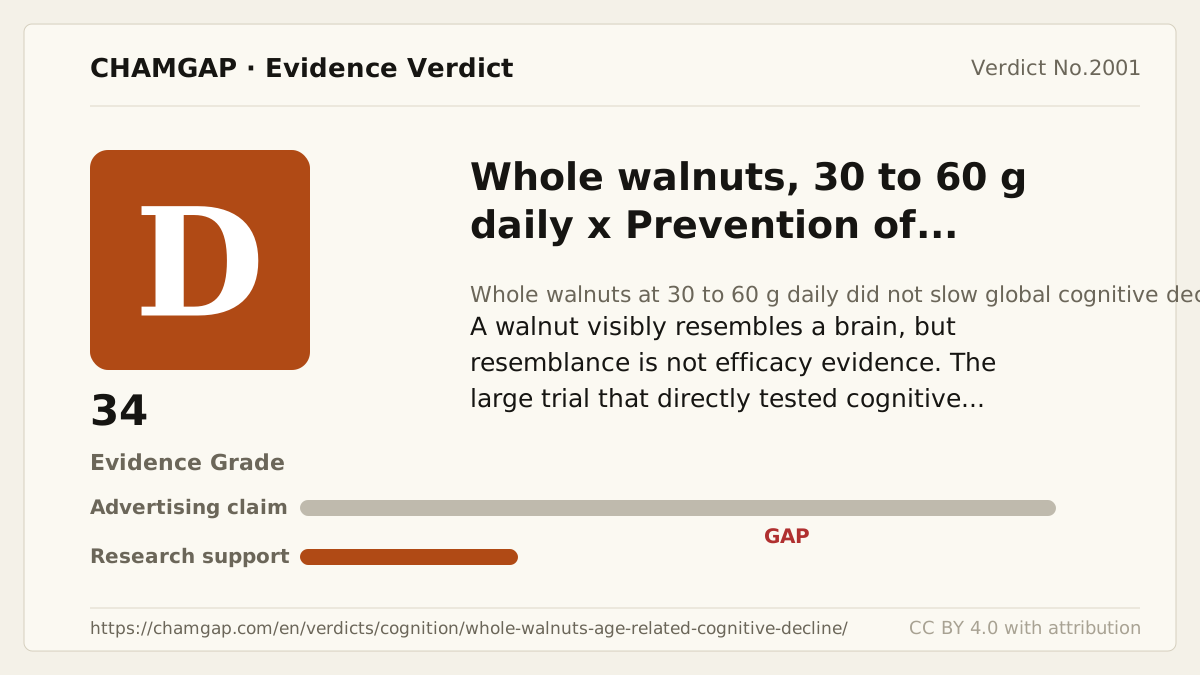
[Chamgap] Whole walnuts, 30 to 60 g daily x age-related cognitive decline prevention — Evidence Grade D·28. 3 cited sources checked. Source: https://chamgap.com/en/verdicts/cognition/whole-walnuts-age-related-cognitive-decline/ · CC BY 4.0CC BY 4.0 — free to use with attribution; do not distort grades, numbers, or verdict meaning.
What this document does and does not do
Chamgap is an information source. It reports what research has and has not confirmed; it does not tell readers what to take or buy. That decision belongs to readers and, when needed, medical or legal professionals. This verdict reflects literature available up to the search date and may change as new research appears. Nothing here is medical advice.