
One whole Brazil nut daily,
does it really help with Improved cognition in mild cognitive impairment?
research showsThe grade is C with 54 points. A pilot trial randomized 31 people with mild cognitive impairment but analyzed only 20 completers. At six months, verbal fluency gave p=0.007 and constructional praxis p=0.031, with approximate effect sizes of 1.3 and 1.0.
ads claimHigh selenium content cannot be converted directly into better memory or cognition. Positive findings on selected subtests in a small pilot are not confirmation.
Useful facts when choosing a product
- A typical Brazil nut contains about 68 to 91 micrograms of selenium, enough to exceed the adult recommended intake of about 55 micrograms with one nut.
- The trial nut was estimated at about 288.75 micrograms of selenium per nut, distinctly above the general range. The adult upper intake level is 400 micrograms daily, and other foods or supplements can add to exposure.
- Brazil nuts originate in South America, so absence from East Asian classical texts is expected. No unverified passage is quoted.
- Verdict 258 is C with 44 points for isolated sesamin, verdict 226 is C with 43 points for pumpkin-seed oil, and verdict 062 is A with 84 points for psyllium husk. These isolated constituents, oil, and husk are not a whole Brazil nut.
Chamgap Semantic Classification Code
Candidate index · review held
F.one-whole-brazil-nut.food.cognition-in-mild-cognitive-impairment.improve.UNKFoods and beverages > One whole Brazil nut > Food consumption > cognition in mild cognitive impairment > Improvement claim > Unknown
An automated migration candidate, not an issued permanent code; exact claim scope remains under review. This machine-generated migration candidate helps retrieval but is not a permanent assignment. The original verdict ID and URL remain authoritative.
What the research actually shows
The 2016 European Journal of Nutrition paper by Cardoso and colleagues and its PubMed record were checked. The exact original funding statement still requires confirmation from the full paper, and no producer-board or food-company support was confirmed. Industry funding was not inferred from affiliations.
Why this is classified as C (54)
Selected cognitive tests had large approximate effects, but they were back-calculated from P values rather than reported directly. This single pilot analyzed only 20 of 31 randomized participants and assessed multiple subtests, yielding C with 54 points.
Counterpoint. A sufficiently powered independent trial with one prospectively registered primary cognitive outcome is needed.
Rejudgment record. Cross-check applied — Original-report and PubMed data cross-checked with authoritative selenium guidance to separate analyzed sample, multiple subtests, approximate P-value-derived effects, trial-nut selenium, and general composition
| Endpoint | P | Symptom or function itself is the target - including patient reports and performance tests |
| Replication | R1 | Single confirmatory trial |
| Independence | I2 | Decisive evidence is publicly or non-profit funded |
| Effect size | E+ | Meets the clinically important threshold |
| Precision | CX | No pooled confidence interval could be confirmed |
Stored derived and displayed grades match; this is not a current recalculation or validity check (C).
Sub-claim grades by effect
This ingredient is marketed for several effects. A single overall grade blends strong and weak claims together, so each effect is graded separately here. The overall grade reflects the strongest disconfirming or core claim.
| Effect (sub-claim) | Grade | Basis |
|---|---|---|
| One Brazil nut contains a very large amount of selenium | ? | This is a composition fact, not a graded clinical outcome. |
| One whole Brazil nut daily improves cognition in mild cognitive impairment | C | Only selected subtests were positive in a small completer analysis. |
Cross-check — AI research and Codex final gate
Evidence Table
| Study | Design | Sample | Funding | Endpoint | Result | Weight |
|---|---|---|---|---|---|---|
| Cardoso BR et al., Eur J Nutr, 2016 | Six-month randomized controlled pilot with completer analysis | 31 randomized; 20 completed and analyzed, 11 versus nine | Exact original funding wording requires confirmation; no confirmed producer-board or food-company support | Multiple CERAD cognitive subtests | Verbal fluency p=0.007 and constructional praxis p=0.031; approximate P-value-derived effects 1.3 and 1.0 | Large approximate effects but unstable because of attrition, multiplicity, and small sample |
Receipt — 3 References
All 3 cited sources were verified for existence at the original page (as of 2026-08-02).
Final verification and publication gate: Codex · Evidence date: 2026-08-02 · Corrections: none
Cite this verdict
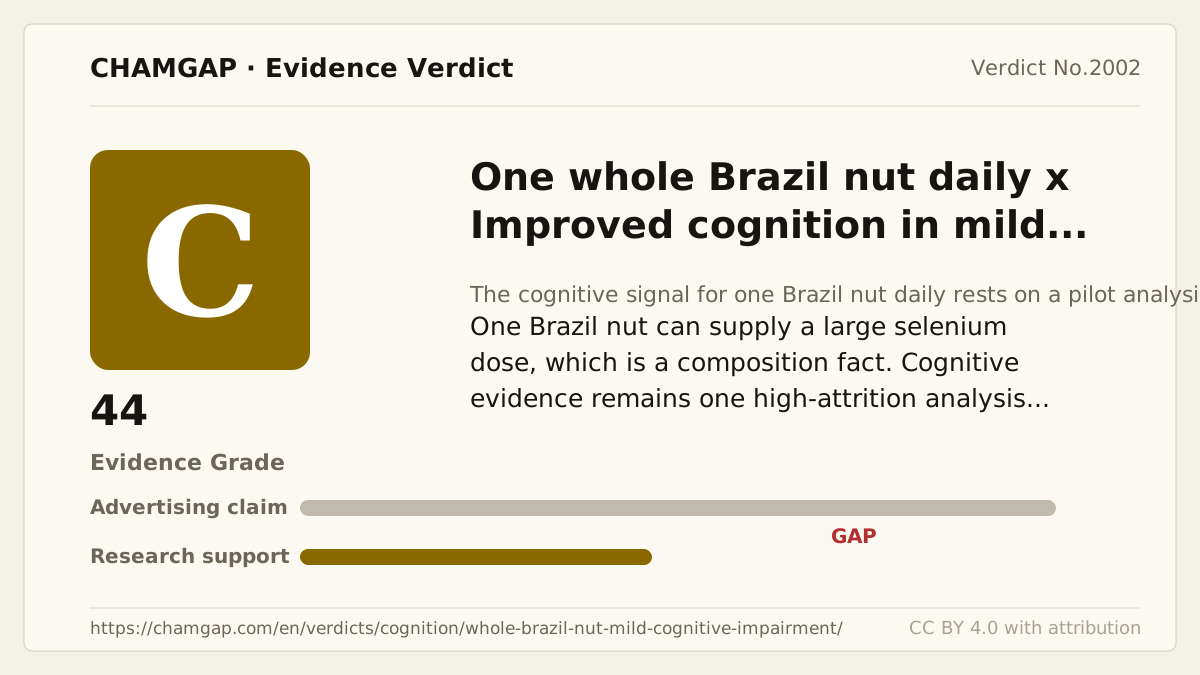
[Chamgap] One whole Brazil nut daily x cognition in mild cognitive impairment — Evidence Grade C·54. 3 cited sources checked. Source: https://chamgap.com/en/verdicts/cognition/whole-brazil-nut-mild-cognitive-impairment/ · CC BY 4.0CC BY 4.0 — free to use with attribution; do not distort grades, numbers, or verdict meaning.
What this document does and does not do
Chamgap is an information source. It reports what research has and has not confirmed; it does not tell readers what to take or buy. That decision belongs to readers and, when needed, medical or legal professionals. This verdict reflects literature available up to the search date and may change as new research appears. Nothing here is medical advice.