
Whole-body therapeutic hypothermia,
does it really help with Prevention of death or severe neurodevelopmental disability in neonates with moderate or severe hypoxic-ischemic encephalopathy?
research showsWhole-body therapeutic hypothermia is rated A because multiple independent trials in appropriate neonatal intensive-care settings reduced death or major neurodevelopmental disability in moderate or severe hypoxic-ischemic encephalopathy. A Cochrane analysis of 11 trials and 1,505 infants found RR 0.75 for death or major disability and an NNT of 7; mortality alone also had RR 0.75. The NICHD whole-body trial and TOBY independently replicated benefit. The HELIX trial in India, Sri Lanka, and Bangladesh found no benefit and increased mortality, so the result cannot be generalized to all low- and middle-income settings.
ads claimCooling may be expanded to every neonatal encephalopathy, mild HIE, initiation after six hours, or every care environment. Direct evidence applies to carefully selected moderate-to-severe HIE in systems capable of protocolized intensive care.
Useful facts when choosing a product
- Whole-body hypothermia is generally started within six hours of birth, maintains a core temperature near 33°C to 34°C for 72 hours, and is followed by slow rewarming.
- Eligibility requires evidence of perinatal hypoxia-ischemia and moderate or severe encephalopathy, with continuous temperature, cardiopulmonary, and neurologic monitoring.
- Bradycardia and thrombocytopenia can increase, and coagulopathy, hypotension, arrhythmia, electrolyte disturbances, and subcutaneous fat necrosis have been reported.
- HELIX means equivalent benefit cannot be assumed where resources, infection burden, obstetric care, and neonatal intensive-care systems differ.
Chamgap Semantic Classification Code
Candidate index · review held
P.whole-body-therapeutic-hypothermia.procedural.death-or-severe-neurodevelopmental-disability-in-neonates-with-moderate-or-severe-hypoxic-ischemic-encephalopathy.prevent.usual-careProcedures, devices and tests > Whole-body therapeutic hypothermia > Procedural > death or severe neurodevelopmental disability in neonates with moderate or severe hypoxic-ischemic encephalopathy > Occurrence-prevention claim > Usual care
An automated migration candidate, not an issued permanent code; exact claim scope remains under review. This machine-generated migration candidate helps retrieval but is not a permanent assignment. The original verdict ID and URL remain authoritative.
What the research actually shows
Jacobs 2013 synthesized 11 trials and 1,505 term or late-preterm infants with moderate or severe encephalopathy and intrapartum asphyxia. In eight trials and 1,344 infants, death or major disability at 18 months had RR 0.75 (95% CI 0.68 to 0.83), risk difference -0.15, and NNT 7; mortality in 11 trials and 1,468 infants had RR 0.75 (95% CI 0.64 to 0.88) and NNT 11. The NICHD trial randomized 208 infants within six hours to whole-body cooling at 33.5°C for 72 hours or usual care and reduced death or moderate-to-severe disability from 62% to 44%. TOBY studied whole-body cooling in 325 infants. In contrast, HELIX enrolled 408 infants and found death or moderate-to-severe disability of 50% versus 47%, with a hazard ratio for death of 1.47 (95% CI 1.06 to 2.04; p=0.020).
Why this is classified as A (85)
An 11-trial synthesis of 1,505 infants found high-certainty evidence with RR about 0.75 for death or major disability, and independent trials plus guideline status as standard care support A. The null HELIX result and possible increase in mortality limit benefit to settings with neonatal intensive-care infrastructure, giving A with 85 points.
Counterpoint. Mortality alone fell in the pooled trials, but HELIX found no composite benefit and a possible increase in mortality, limiting applicability to settings with neonatal intensive-care infrastructure.
Rejudgment record. Cross-check applied — High-certainty synthesis of 11 trials and 1,505 infants plus independent trials including NICHD and TOBY established lower death or major neurodevelopmental disability, and guideline status as standard care supports retaining A. The null HELIX result and possible mortality increase represent an applicability limit to settings with neonatal intensive-care infrastructure rather than conflicting evidence, and are reflected in the score
Sub-claim grades by effect
This ingredient is marketed for several effects. A single overall grade blends strong and weak claims together, so each effect is graded separately here. The overall grade reflects the strongest disconfirming or core claim.
| Effect (sub-claim) | Grade | Basis |
|---|---|---|
| Prevention of death or severe neurodevelopmental disability | A | Multiple independent whole-body trials and synthesis in appropriate intensive-care settings directly reduced the composite. |
| Reduction in mortality alone | A | The 11-trial synthesis found RR 0.75, but the opposite HELIX result makes setting-specific applicability essential. |
| Prevention of death or disability in low- and middle-income care settings | C | HELIX found no composite benefit and increased mortality, so generalization is unsupported. |
Cross-check — AI research and Codex final gate
Evidence Table
| Study | Design | Sample | Funding | Endpoint | Result | Weight |
|---|---|---|---|---|---|---|
| Jacobs SE et al. 2013 | Cochrane systematic review and meta-analysis of randomized trials | 11 randomized trials and 1,505 term or late-preterm infants | Cochrane Neonatal academic synthesis | Death or major neurodevelopmental disability at 18 months; mortality alone | Death or major disability had RR 0.75 (95% CI 0.68 to 0.83), RD -0.15, and NNT 7; mortality had RR 0.75 (95% CI 0.64 to 0.88) and NNT 11. | Pivotal multiple-trial hard-endpoint synthesis |
| Shankaran S et al. 2005 | NICHD multicenter randomized whole-body cooling trial | 208 neonates with moderate or severe HIE | Public funding from the U.S. NICHD and NIH | Death or moderate-to-severe disability at 18 to 22 months | The outcome occurred in 44% with whole-body cooling and 62% with control (risk ratio 0.72, 95% CI 0.54 to 0.95; p=0.01). | Pivotal whole-body-specific trial |
| Thayyil S et al. 2021 HELIX | Multicenter randomized trial in India, Sri Lanka, and Bangladesh | 408 infants with moderate or severe neonatal encephalopathy | United Kingdom public and charitable research support | Death or moderate-to-severe disability at 18 months; mortality | The composite was 50% versus 47% with no reduction, and the hazard ratio for death was 1.47 (95% CI 1.06 to 2.04; p=0.020). | Applicability limit and harm signal in lower-resource settings |
Receipt — 4 References
All 4 cited sources were verified for existence at the original page (as of 2026-07-23).
Final verification and publication gate: Codex · Evidence date: 2026-07-23 · Corrections: none
Cite this verdict
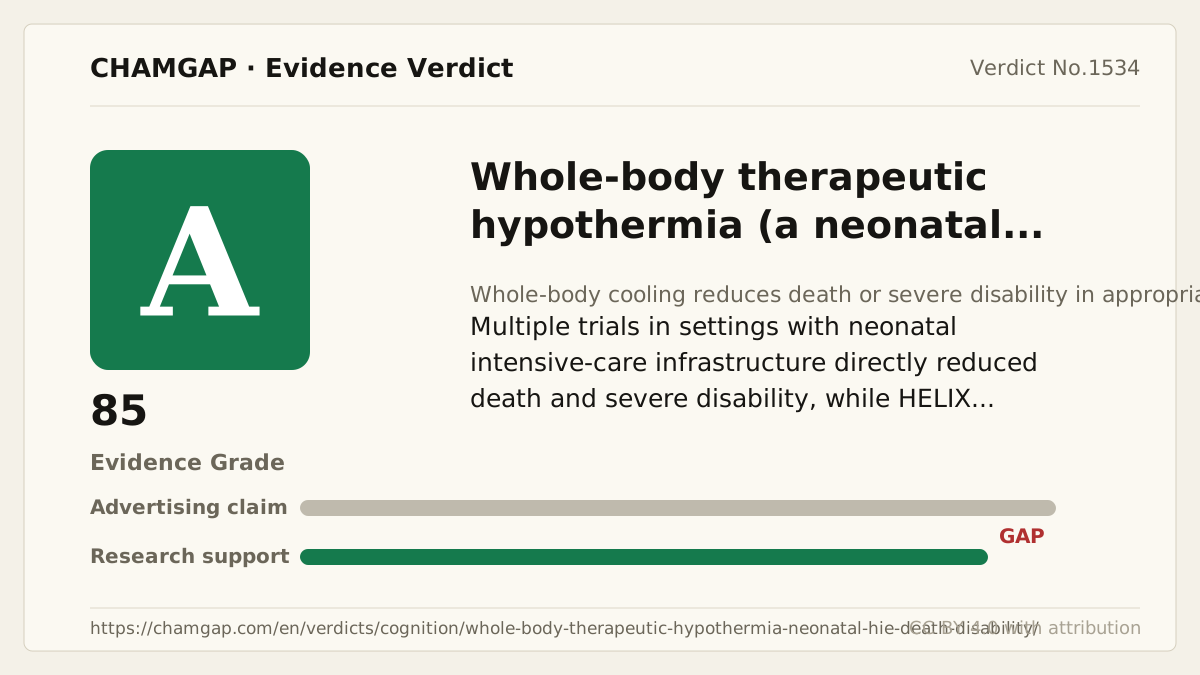
[Chamgap] Whole-body therapeutic hypothermia x prevention of death or severe disability in neonatal hypoxic-ischemic encephalopathy — Evidence Grade A·85. 4 cited sources checked. Source: https://chamgap.com/en/verdicts/cognition/whole-body-therapeutic-hypothermia-neonatal-hie-death-disability/ · CC BY 4.0CC BY 4.0 — free to use with attribution; do not distort grades, numbers, or verdict meaning.
What this document does and does not do
Chamgap is an information source. It reports what research has and has not confirmed; it does not tell readers what to take or buy. That decision belongs to readers and, when needed, medical or legal professionals. This verdict reflects literature available up to the search date and may change as new research appears. Nothing here is medical advice.