
Video-game training,
does it really help with Improved untrained general cognitive ability?
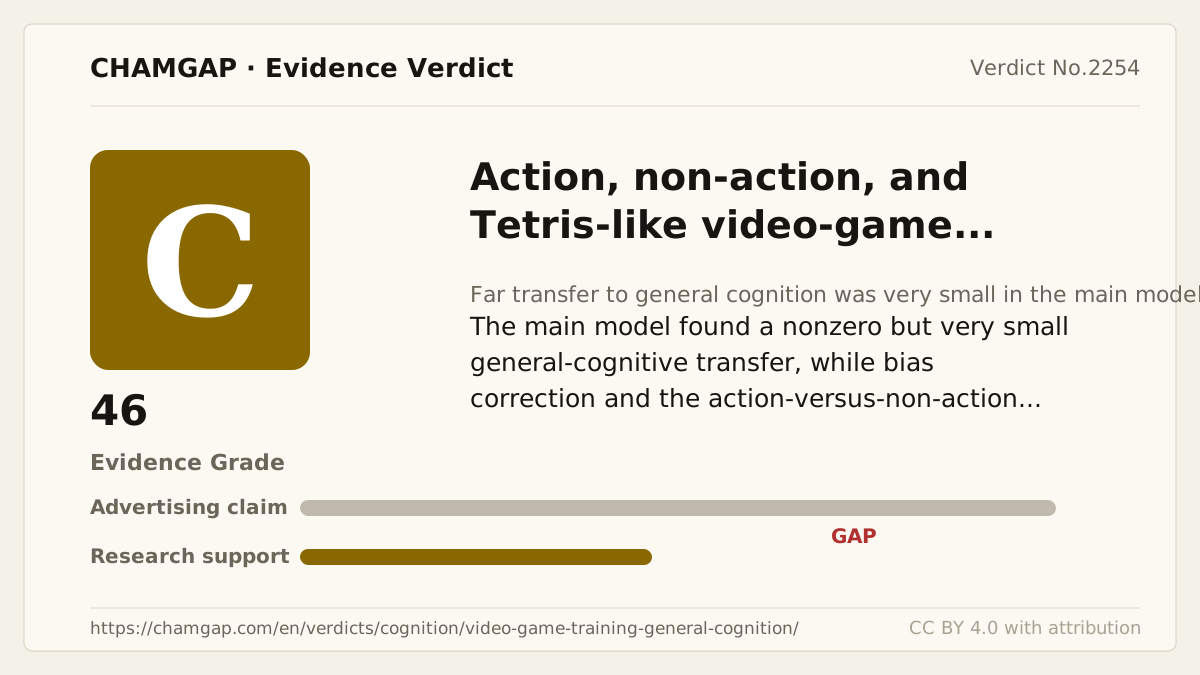
research showsThe grade is C. The main model across 63 studies, 3,286 participants, and 359 effects gave g=0.07, 95% CI 0.02-0.12, with I-squared 18%; its interval excluded zero. General-cognitive transfer therefore was not exactly absent, but it was below Cohen's 0.2 convention for a small effect. Publication-bias correction after imputing 37 effects gave -0.01, -0.06 to 0.05, and the action-versus-non-action game subgroup was also inconclusive at 0.10, -0.01 to 0.20.
ads claimImprovement in a particular game or a closely related task is real practice learning. It cannot be marketed as broad transfer to untrained memory, reasoning, cognitive control, or everyday functioning when the meta-analysis did not confirm that transfer.
Useful facts when choosing a product
- The meta-analysis included 63 training studies and 3,286 participants with cognitive measures unrelated to the trained games.
- Overall training effect was g=0.07; publication-bias-adjusted effect was g=-0.01.
- Action games versus other active games yielded g=0.10 with a confidence interval crossing zero and adjusted g=-0.03.
- Skill at a game or a similar task is a different claim from improvement in untrained general cognition.
Chamgap Semantic Classification Code
Candidate index · review held
X.action.behavioral.untrained-general-cognitive-ability.improve.UNKBehaviors, exposures and policies > Action > Behavioral delivery > untrained general cognitive ability > Improvement claim > Unknown
An automated migration candidate, not an issued permanent code; exact claim scope remains under review. This machine-generated migration candidate helps retrieval but is not a permanent assignment. The original verdict ID and URL remain authoritative.
What the research actually shows
ERIC, PsycINFO, MEDLINE, JSTOR, ScienceDirect, and dissertations were searched through 2016. Sixty-three training studies with 3,286 participants and 359 effects were included. Outcomes were grouped as visual attention, spatial ability, cognitive control, memory, and intelligence or reasoning, and inclusion required a domain-general measure unrelated to the game. The main model gave g=0.07, 95% CI 0.02-0.12, with I-squared 18%. Bias correction imputing 37 effects gave -0.01, -0.06 to 0.05. The 96-effect action-versus-non-action subgroup gave 0.10, -0.01 to 0.20, and adjusted -0.03, -0.14 to 0.09. Which analysis was prespecified as primary could not be established. No meta-analysis registration or funding statement was identified, and funding of all included primary trials was not verified.
Why this is classified as C (46)
The main model found a nonzero but very small effect, while publication-bias correction and the action-versus-non-action analysis were inconclusive, giving C with 46 points.
Counterpoint. C does not imply a large general-cognitive benefit. The main-model interval excluded zero, but its magnitude was very small and near-task learning remains a different claim.
Rejudgment record. Cross-check applied — Separation of overall, publication-bias-corrected, and active-control meta-analytic estimates, and distinction between trained-task learning and far cognitive transfer
| Endpoint | P | Symptom or function itself is the target - including patient reports and performance tests |
| Replication | R1 | Single confirmatory trial |
| Independence | I1 | Mixed funding sources |
| Effect size | E~ | Statistically positive but below the threshold |
Stored derived and displayed grades match; this is not a current recalculation or validity check (C).
Sub-claim grades by effect
This ingredient is marketed for several effects. A single overall grade blends strong and weak claims together, so each effect is graded separately here. The overall grade reflects the strongest disconfirming or core claim.
| Effect (sub-claim) | Grade | Basis |
|---|---|---|
| Improved untrained general cognitive ability | D | Publication-bias-adjusted g was -0.01. |
| General-cognitive superiority of action games over other games | D | The active-control estimate g=0.10 had a confidence interval crossing zero. |
| Improved skill in the trained game or nearby tasks | C | Some task-specific small gains occurred, but they are not general cognitive transfer. |
Cross-check — AI research and Codex final gate
Evidence Table
| Study | Design | Sample | Funding | Endpoint | Result | Weight |
|---|---|---|---|---|---|---|
| Sala, Tatlidil, and Gobet 2018 training meta-analysis | Meta-analysis of randomized and quasi-randomized video-game training studies | 63 training studies, 3,286 participants, and 359 effect sizes | Funding of the meta-analysis and all included trials was not established | Game-unrelated visual attention, spatial ability, cognitive control, memory, and intelligence or reasoning tasks | Main-model g=0.07, 95% CI 0.02-0.12, I-squared 18%; adjusted g=-0.01, -0.06 to 0.05 after imputing 37 effects; action versus non-action games g=0.10, -0.01 to 0.20 | Very small positive main model with inconclusive bias-corrected and action-versus-non-action estimates |
Receipt — 1 References
All 1 cited sources were verified for existence at the original page (as of 2026-08-05).
Final verification and publication gate: Codex · Evidence date: 2026-08-05 · Corrections: none
Cite this verdict
[Chamgap] Video-game training x improved general cognitive ability — Evidence Grade C·46. 1 cited sources checked. Source: https://chamgap.com/en/verdicts/cognition/video-game-training-general-cognition/ · CC BY 4.0CC BY 4.0 — free to use with attribution; do not distort grades, numbers, or verdict meaning.
What this document does and does not do
Chamgap is an information source. It reports what research has and has not confirmed; it does not tell readers what to take or buy. That decision belongs to readers and, when needed, medical or legal professionals. This verdict reflects literature available up to the search date and may change as new research appears. Nothing here is medical advice.