
Valproate,
does it really help with Suppression of seizure recurrence and achievement of 12-month remission in newly diagnosed generalized or unclassifiable epilepsy?
research showsValproate is rated B because it outperformed lamotrigine and levetiracetam on 12-month seizure remission or treatment retention in newly diagnosed generalized and unclassifiable epilepsy. In the 716-participant SANAD I trial, valproate produced faster 12-month remission than lamotrigine and fewer treatment failures than lamotrigine and topiramate in idiopathic generalized epilepsy. In the 520-participant SANAD II trial, levetiracetam failed to establish noninferiority for 12-month remission, valproate was superior in the per-protocol analysis, and treatment failure was lower with valproate. Seizure remission is a direct treatment goal, but both trials were open active comparisons and cannot isolate absolute benefit versus no treatment, supporting B with 74 points. Fetal malformation and neurodevelopmental risks are separated from efficacy and highlighted under safety.
ads claimAn efficacy message can expand valproate into the best treatment for every seizure type and every patient or imply trouble-free long-term use. The evidence concerns comparative effectiveness in newly diagnosed generalized or unclassifiable epilepsy, not first choice for focal epilepsy or routine priority in people who could become pregnant.
Useful facts when choosing a product
- Valproic acid and sodium valproate are broad-spectrum prescription antiseizure medicines used for several generalized seizure types; dose is individualized by seizure type, age, weight, formulation, interacting drugs, blood levels, and response.
- Abrupt withdrawal can worsen seizures or provoke status epilepticus, so patients should not stop or switch treatment without a supervised tapering or transition plan.
- Hepatotoxicity, pancreatitis, hyperammonemia, thrombocytopenia, sedation, tremor, and weight gain can occur, requiring liver function, blood counts, and symptom review early and when clinically indicated.
- Exposure during pregnancy raises the risk of major congenital malformations, including neural tube defects, and adverse cognitive or neurodevelopmental outcomes; people who could become pregnant need specialist review of alternatives, effective contraception, and pregnancy plans, and should not stop treatment on their own after discovering a pregnancy.
Chamgap Semantic Classification Code
Candidate index · review held
M.valproic-acid-or-sodium-valproate.UNK.suppression-of-seizure-recurrence-and-achievement-of-remission-in-newly-diagnosed-generalized-or-unclassifiable-epilepsy.treat.activeMedicinal interventions > Valproic acid or sodium valproate > Unknown > Suppression of seizure recurrence and achievement of remission in newly diagnosed generalized or unclassifiable epilepsy > Treatment or remission claim > Active comparator
An automated migration candidate, not an issued permanent code; exact claim scope remains under review. This machine-generated migration candidate helps retrieval but is not a permanent assignment. The original verdict ID and URL remain authoritative.
What the research actually shows
The 2007 Marson SANAD I Arm B openly randomized 716 participants with generalized-onset or difficult-to-classify seizures for whom valproate was considered standard treatment. Valproate produced faster 12-month remission than lamotrigine overall, reported with HR 0.76, and fewer treatment failures than lamotrigine and topiramate in idiopathic generalized epilepsy. The 2021 Marson SANAD II trial randomized 520 people with newly diagnosed generalized or unclassifiable epilepsy to valproate or levetiracetam. Levetiracetam did not establish noninferiority for 12-month remission in the intention-to-treat analysis, the per-protocol analysis favored valproate with HR 1.68, and treatment failure favored valproate with HR 0.65.
Why this is classified as B (74)
Two independent publicly funded randomized trials, SANAD I and II, consistently support comparative advantages for 12-month remission and treatment retention in generalized or unclassifiable epilepsy. Seizure remission is a direct treatment goal, so a surrogate or subjective-outcome ceiling does not apply, but open active comparisons cannot isolate absolute recurrence reduction versus no treatment. This supports B with 74 points.
Counterpoint. Strong seizure-control efficacy and serious fetal risk are simultaneously true. A person who could become pregnant should first determine whether a safer alternative can provide adequate control.
Rejudgment record. New verdict — The publicly funded SANAD I and II randomized trials consistently support valproate over lamotrigine or levetiracetam for 12-month seizure remission and treatment retention in newly diagnosed generalized or unclassifiable epilepsy, and remission is a direct treatment goal; however, open active-comparator designs cannot isolate absolute benefit versus no treatment, supporting B
Sub-claim grades by effect
This ingredient is marketed for several effects. A single overall grade blends strong and weak claims together, so each effect is graded separately here. The overall grade reflects the strongest disconfirming or core claim.
| Effect (sub-claim) | Grade | Basis |
|---|---|---|
| Twelve-month seizure remission in newly diagnosed generalized or unclassifiable epilepsy | B | SANAD I favored valproate over lamotrigine and the SANAD II per-protocol analysis favored it over levetiracetam, but both were open active comparisons. |
| Long-term treatment retention and reduced treatment failure | B | Valproate was favored in idiopathic generalized epilepsy in SANAD I and in the overall SANAD II treatment-failure comparison. |
| Suppression of further seizure recurrence during treatment | B | Sustained 12-month remission directly reflects recurrence suppression, but the absence of placebo or untreated control means it is a comparative effect. |
Cross-check — AI research and Codex final gate
Evidence Table
| Study | Design | Sample | Funding | Endpoint | Result | Weight |
|---|---|---|---|---|---|---|
| Marson AG et al. 2007, SANAD I Arm B | Multicenter open randomized active-comparator pragmatic trial | 716 participants with generalized or unclassifiable epilepsy | Public funding from the United Kingdom NHS Health Technology Assessment Programme | Time to treatment failure and time to 12-month seizure remission | Valproate was better than lamotrigine for 12-month remission overall and better than lamotrigine and topiramate for treatment failure in idiopathic generalized epilepsy. | Key long-term direct remission evidence |
| Marson A et al. 2021, SANAD II | Multicenter phase 4 open noninferiority randomized active-comparator trial | 520 participants; 260 assigned to valproate and 260 to levetiracetam | Public funding from the United Kingdom NIHR Health Technology Assessment Programme | Twelve-month seizure remission and treatment failure | Levetiracetam failed to meet noninferiority in the intention-to-treat analysis; per-protocol remission favored valproate with HR 1.68, and treatment failure favored valproate with HR 0.65. | Independent replication of comparative advantage |
Receipt — 3 References
All 3 cited sources were verified for existence at the original page (as of 2026-07-24).
Final verification and publication gate: Codex · Evidence date: 2026-07-24 · Corrections: none
Cite this verdict
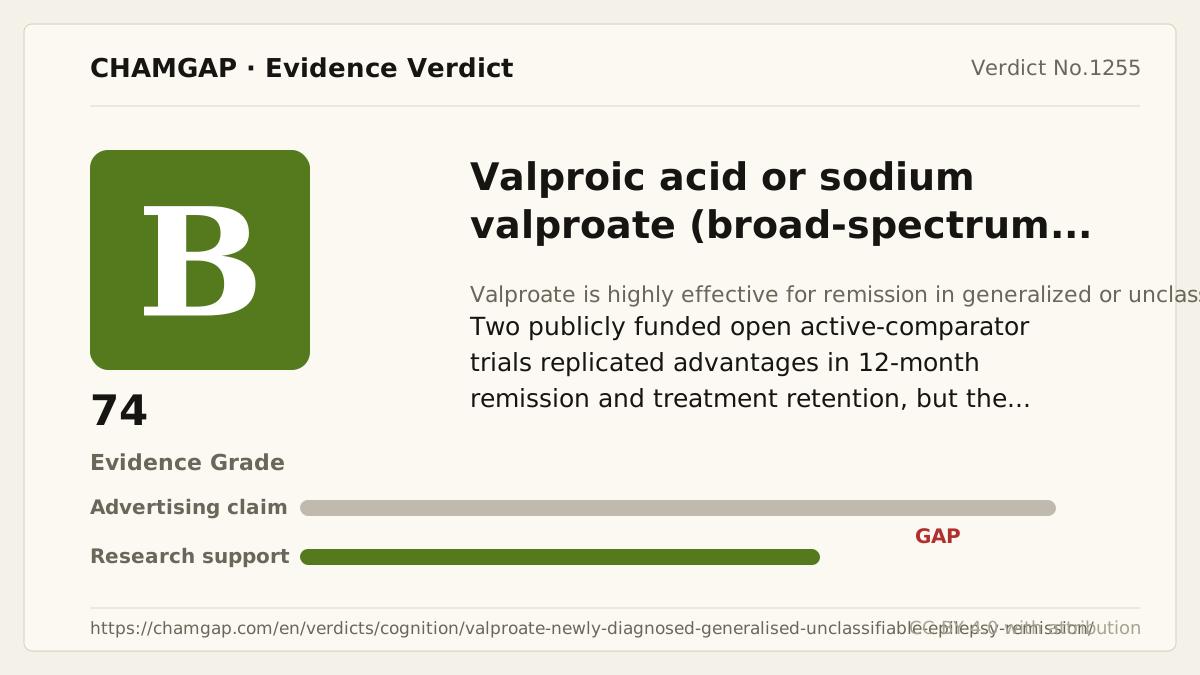
[Chamgap] Valproate x seizure control and 12-month remission in newly diagnosed generalized or unclassifiable epilepsy — Evidence Grade B·74. 3 cited sources checked. Source: https://chamgap.com/en/verdicts/cognition/valproate-newly-diagnosed-generalised-unclassifiable-epilepsy-remission/ · CC BY 4.0CC BY 4.0 — free to use with attribution; do not distort grades, numbers, or verdict meaning.
What this document does and does not do
Chamgap is an information source. It reports what research has and has not confirmed; it does not tell readers what to take or buy. That decision belongs to readers and, when needed, medical or legal professionals. This verdict reflects literature available up to the search date and may change as new research appears. Nothing here is medical advice.