
Topiramate,
does it really help with Reduced monthly attack frequency and prevention of migraine in adults?
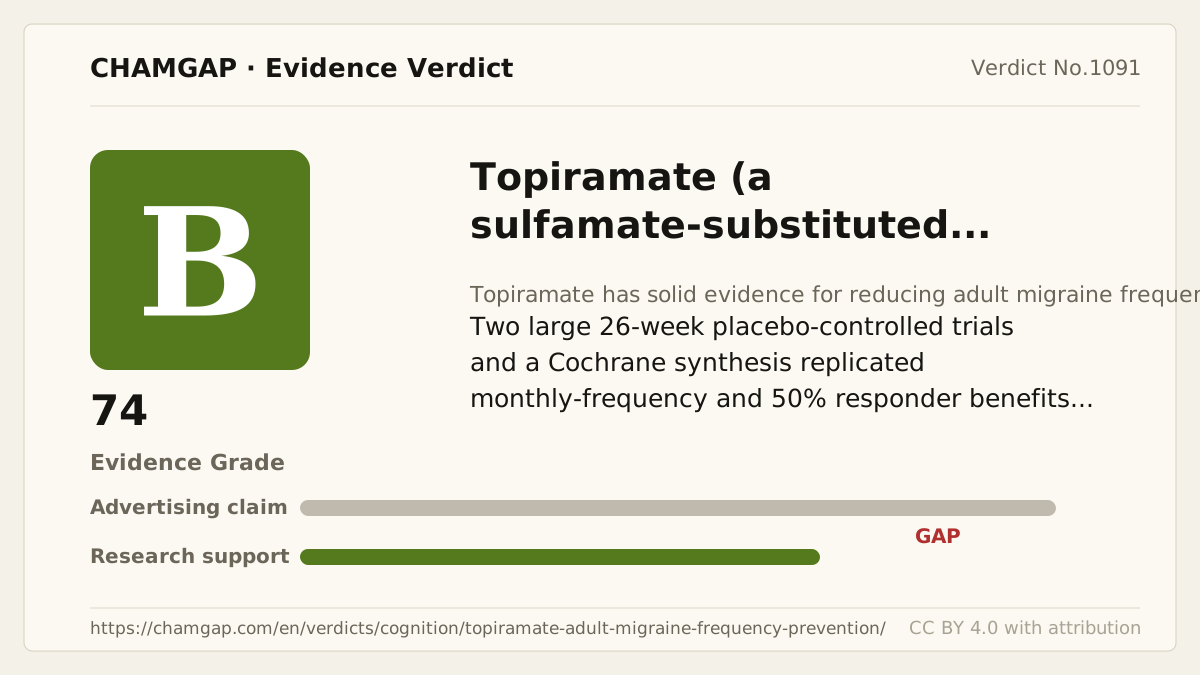
research showsTopiramate is rated B because it repeatedly improved monthly migraine frequency and the 50% responder rate in adult migraine prevention. In the 26-week MIGR-002 trial, monthly frequency fell by 2.1 and 2.4 attacks with 100 and 200 mg/day, respectively, versus 1.1 with placebo, and MIGR-001 replicated significant reductions at both doses. A Cochrane review also found consistent frequency and responder benefits at 100 mg/day. The pivotal evidence, however, is concentrated in the same Johnson & Johnson-sponsored program, the mean incremental reduction is about one attack per month, and the outcomes are patient-reported symptoms rather than hard outcomes such as hospitalization or survival; the result is B with 74 points. Cognitive slowing, paresthesia, weight loss, kidney stones, and fetal harm are separate safety issues.
ads claimPromotion may imply that topiramate eliminates migraine or present weight loss as an added benefit. The evidence supports a reduction in average monthly attack frequency while treatment is taken; it neither treats an attack already underway nor produces a response in every patient.
Useful facts when choosing a product
- Topiramate is a prescription antiseizure drug with a sulfamate functional group that is used for migraine prevention; it is not a rescue treatment for an attack already in progress.
- The pivotal trials started at 25 mg/day and increased the dose by 25 mg each week. A common adult prevention target is 100 mg/day in two divided doses, but actual titration and dosing must follow the prescription and product label.
- Abrupt discontinuation can cause problems, including seizure risk, so tapering should follow clinical direction. Dose adjustment may be needed with impaired kidney function.
- Adequate hydration can help reduce kidney-stone risk. Topiramate should not be used for migraine prevention during pregnancy because of fetal malformation and growth-restriction risk, and pregnancy prevention and alternatives should be discussed in advance when pregnancy is possible.
Chamgap Semantic Classification Code
Candidate index · review held
M.topiramate.UNK.monthly-attack-frequency-and-prevention-of-migraine.prevent.placeboMedicinal interventions > Topiramate > Unknown > monthly attack frequency and prevention of migraine > Occurrence-prevention claim > Placebo
An automated migration candidate, not an issued permanent code; exact claim scope remains under review. This machine-generated migration candidate helps retrieval but is not a permanent assignment. The original verdict ID and URL remain authoritative.
What the research actually shows
Brandes and colleagues randomized 483 participants in MIGR-002 and analyzed 468 for efficacy. Monthly migraine frequency fell by 2.1 and 2.4 with 100 and 200 mg/day versus 1.1 with placebo; 50% responder rates were 39%, 49%, and 47% with 50, 100, and 200 mg/day versus 23% with placebo. Silberstein and colleagues randomized 487 and analyzed 469 in MIGR-001, again finding significant monthly-frequency reductions at 100 and 200 mg/day and responder rates of 54.0% and 52.3% versus 22.6%. In the Cochrane review, five trials with 852 participants produced an odds ratio of 3.49 for response at 100 mg/day, and there was no evidence that 200 mg/day was more effective than 100 mg/day. Shared Johnson & Johnson sponsorship and company-author involvement in the pivotal trials were reflected in the score.
Why this is classified as B (74)
Two separate 26-week placebo-controlled trials with 483 and 487 randomized participants and a Cochrane synthesis consistently improved monthly migraine frequency and the 50% responder rate. These direct patient-centered outcomes warrant more than C, but an average placebo-adjusted effect of about one monthly attack and concentration of pivotal evidence in one manufacturer-sponsored program yield B with 74 points. Cognitive slowing, paresthesia, weight loss, nephrolithiasis, and pregnancy harm remain safety issues independent of the efficacy score.
Counterpoint. The efficacy-tolerability balance varies substantially among patients. If meaningful reduction is absent after an adequate titration or cognitive and sensory effects persist, treatment should be adjusted with the prescriber rather than stopped abruptly.
Rejudgment record. New verdict — Applied B because MIGR-001, MIGR-002, and the Cochrane synthesis repeatedly improved direct patient-centered monthly migraine frequency and 50% response, while accounting for a limited placebo-adjusted effect and concentration of pivotal evidence in the same manufacturer-sponsored program
Sub-claim grades by effect
This ingredient is marketed for several effects. A single overall grade blends strong and weak claims together, so each effect is graded separately here. The overall grade reflects the strongest disconfirming or core claim.
| Effect (sub-claim) | Grade | Basis |
|---|---|---|
| Reduced monthly migraine attack frequency in adults | B | MIGR-001 and MIGR-002 repeatedly showed direct reductions at 100 to 200 mg/day, confirmed by the Cochrane review. |
| Increased likelihood of at least a 50% reduction in monthly migraine frequency | B | Across the pivotal trials, response rose from about 23% with placebo to about 49% to 54% with 100 mg/day. |
| Reduced days requiring rescue medication for migraine | B | Secondary outcomes in the pivotal trials were consistently favorable, although confidence is lower than for the monthly-frequency primary outcome. |
Cross-check — AI research and Codex final gate
Evidence Table
| Study | Design | Sample | Funding | Endpoint | Result | Weight |
|---|---|---|---|---|---|---|
| Brandes JL et al.; MIGR-002 Study Group. 2004 | Multicenter randomized double-blind 26-week placebo-controlled trial | 483 randomized and 468 included in efficacy analysis | Sponsored by Johnson & Johnson Pharmaceutical Research and Development with company authors | Change in monthly migraine frequency and at least 50% responder rate | Monthly frequency changes were -2.1 and -2.4 with 100 and 200 mg/day versus -1.1 with placebo; responder rates were 49% and 47% versus 23%. | Pivotal direct prevention randomized evidence |
| Silberstein SD et al.; MIGR-001 Study Group. 2004 | Multicenter randomized double-blind 26-week placebo-controlled trial | 487 randomized and 469 included in the intention-to-treat analysis | Supported by Johnson & Johnson Pharmaceutical Research and Development | Mean monthly migraine frequency during treatment and 50% responder rate | The 100- and 200-mg/day doses significantly reduced monthly frequency; responder rates were 54.0% and 52.3% versus 22.6% with placebo. | Replicating direct prevention randomized evidence |
| Linde M et al. 2013 Cochrane review | Systematic review and meta-analysis of controlled prevention trials in adults with episodic migraine | Five trials with 852 participants for 100-mg response and six trials with 1,025 participants for 200-mg response | Academic Cochrane synthesis; pivotal component trials included industry sponsorship | Headache frequency, 50% response, quality of life, and adverse events | The response odds ratio was 3.49 (95% CI 2.23-5.45) at 100 mg/day, with no evidence that 200 mg was more effective than 100 mg. | Synthesis establishing consistency and dose range |
Receipt — 3 References
All 3 cited sources were verified for existence at the original page (as of 2026-07-22).
Final verification and publication gate: Codex · Evidence date: 2026-07-22 · Corrections: none
Cite this verdict
[Chamgap] Topiramate x reduced monthly attack frequency and prevention of migraine in adults — Evidence Grade B·74. 3 cited sources checked. Source: https://chamgap.com/en/verdicts/cognition/topiramate-adult-migraine-frequency-prevention/ · CC BY 4.0CC BY 4.0 — free to use with attribution; do not distort grades, numbers, or verdict meaning.
What this document does and does not do
Chamgap is an information source. It reports what research has and has not confirmed; it does not tell readers what to take or buy. That decision belongs to readers and, when needed, medical or legal professionals. This verdict reflects literature available up to the search date and may change as new research appears. Nothing here is medical advice.