
High-bioavailability curcumin,
does it really help with Improved memory and attention in middle-aged and older adults without dementia?
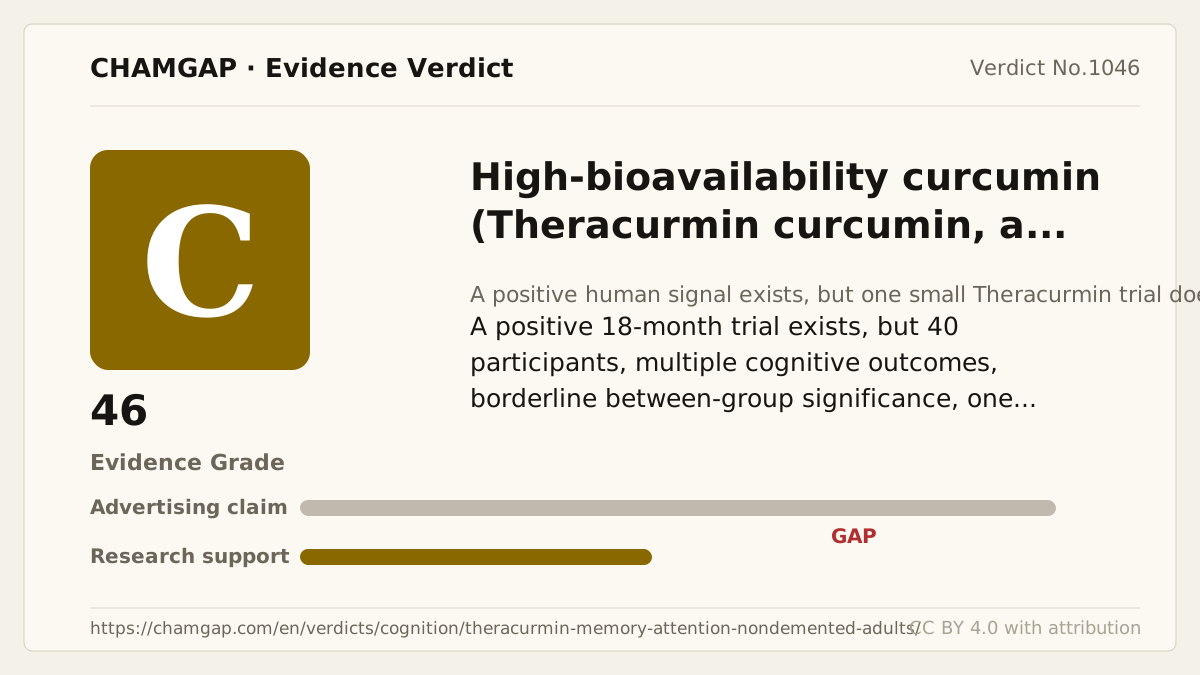
research showsHigh-bioavailability curcumin is rated C for improving memory and attention in middle-aged and older adults without dementia. An 18-month double-blind randomized trial found improvement in selected memory and attention measures among 40 participants taking Theracurmin providing 90 mg of curcumin twice daily, but it was a very small, single-team trial of one branded formulation and has not been independently replicated. A 2025 meta-analysis reported a broader cognitive signal across curcumin preparations, but it included only nine trials and 501 participants, had very high heterogeneity, and did not directly replicate the Theracurmin memory and attention results. Credible positive human evidence supports C rather than D, while the small, product-specific, unreplicated evidence does not support a higher grade. Gastrointestinal effects and formulation-dependent absorption and quality remain separate safety issues.
ads claimMarketing may combine reduced brain amyloid, restored memory, and dementia prevention into one established benefit. The human evidence instead consists of selected test changes in a small single trial and does not establish prevention of dementia or improvement in daily functioning. Ordinary curcumin powder and a high-bioavailability branded formulation also cannot be assumed to produce the same exposure.
Useful facts when choosing a product
- Theracurmin is a branded formulation designed to improve the water dispersibility and systemic exposure of curcumin; its absorption is not equivalent to ordinary turmeric powder or standard curcumin products.
- The key cognition trial used Theracurmin providing 90 mg of curcumin twice daily for 18 months. That dose and result cannot be transferred automatically to other formulations or labeled amounts.
- Curcumin products vary in actual curcuminoid content, absorption enhancers, contaminant control, and bioavailability, creating substantial product-to-product variability.
- Oral turmeric or curcumin is generally tolerated in the short term, but nausea, reflux, abdominal upset, diarrhea, or constipation can occur. Liver injury has been reported with some products, including highly bioavailable formulations, so jaundice, dark urine, or severe fatigue warrants stopping the product and seeking care.
Chamgap Semantic Classification Code
Candidate index · review held
S.high-bioavailability-curcumin.UNK.memory-and-attention-in-middle-aged-and-older-adults-without-dementia.improve.placeboSupplements and nutraceuticals > High-bioavailability curcumin > Unknown > memory and attention in middle-aged and older adults without dementia > Improvement claim > Placebo
An automated migration candidate, not an issued permanent code; exact claim scope remains under review. This machine-generated migration candidate helps retrieval but is not a permanent assignment. The original verdict ID and URL remain authoritative.
What the research actually shows
Small and colleagues randomized 40 adults aged 51 to 84 without dementia to Theracurmin providing 90 mg of curcumin twice daily or placebo for 18 months. Multiple verbal-memory, visual-memory, and attention outcomes were assessed. Selected signals favored curcumin, but key between-group comparisons were borderline at p=0.05 for consistent long-term retrieval on the Selective Reminding Test and p=0.04 for attention, and the analyzed sample was about 40. The manufacturer supplied active and placebo products and supported blood-curcumin testing and some conference travel. The 2025 meta-analysis by Wang and colleagues reported an overall cognitive benefit across nine randomized trials and 501 participants, but heterogeneity was I² 91.4% and formulations, populations, and assessment tools varied. It supports a broader possibility for curcumin supplements but does not independently confirm that Theracurmin improves memory and attention in middle-aged and older adults without dementia.
Why this is classified as C (46)
A direct 18-month randomized trial provides a positive human signal for memory and attention and meets the floor for C. The evidence is nevertheless a single trial of about 40 participants with multiple cognitive outcomes and borderline between-group p values, one branded formulation, no independent replication, and manufacturer provision of products and testing support; the broader meta-analysis also includes only 501 participants with high heterogeneity. The rule ②-b ceiling of C applies. Prevention of dementia and improvement in daily function remain unproven, yielding C with 46 points.
Counterpoint. Anyone choosing curcumin should verify the studied formulation, actual curcumin dose, and independent product-quality testing. Progressive memory problems or loss of daily function should prompt assessment for medicines, sleep disorders, depression, thyroid disease, vitamin deficiency, and neurocognitive disease rather than delay care with a supplement.
Rejudgment record. Cross-check incorporated — Accepted the positive memory and attention signal in an 18-month randomized trial, but applied the rule ②-b and limited-human-evidence ceiling of C because it was an approximately 40-person study of one branded formulation without independent replication and the manufacturer supplied products and supported some analyses
Sub-claim grades by effect
This ingredient is marketed for several effects. A single overall grade blends strong and weak claims together, so each effect is graded separately here. The overall grade reflects the strongest disconfirming or core claim.
| Effect (sub-claim) | Grade | Basis |
|---|---|---|
| Improved memory in middle-aged and older adults without dementia | C | Selected verbal and visual memory measures were positive in a small 18-month Theracurmin trial, but independent replication is absent. |
| Improved attention in middle-aged and older adults without dementia | C | Attention improved on a secondary measure in one small trial, with no confirmatory trial. |
| Long-term cognitive improvement from high-bioavailability curcumin | C | An 18-month signal exists, but a single branded formulation, manufacturer support, and high meta-analytic heterogeneity prevent confirmation. |
Cross-check — AI research and Codex final gate
Evidence Table
| Study | Design | Sample | Funding | Endpoint | Result | Weight |
|---|---|---|---|---|---|---|
| Small GW et al. 2018 | Eighteen-month randomized double-blind placebo-controlled trial | 40 adults aged 51 to 84 without dementia; 21 assigned curcumin and 19 placebo | Theravalues supplied active and placebo products and supported blood curcumin testing and some conference travel | Primary verbal and visual memory measures, secondary attention measures, and brain PET | Theracurmin providing 90 mg of curcumin twice daily improved selected verbal memory, visual memory, and attention measures versus placebo, but the sample was very small and the trial was singular. | Key direct positive human trial; small and brand-specific |
| Wang W et al. 2025 | Systematic review and meta-analysis of randomized controlled trials | Nine randomized trials, 12 comparisons, and 501 participants | No commercial funding reported; authors declared no conflicts of interest | Standardized global cognitive-function scores | The overall effect was SMD 0.82 (95% CI 0.19 to 1.45), but heterogeneity was very high at I² 91.4% and formulations and populations varied. | Supportive positive synthesis with high heterogeneity |
Receipt — 3 References
All 3 cited sources were verified for existence at the original page (as of 2026-07-21).
Final verification and publication gate: Codex · Evidence date: 2026-07-21 · Corrections: none
Cite this verdict
[Chamgap] High-bioavailability curcumin x improved memory and attention in adults without dementia — Evidence Grade C·46. 3 cited sources checked. Source: https://chamgap.com/en/verdicts/cognition/theracurmin-memory-attention-nondemented-adults/ · CC BY 4.0CC BY 4.0 — free to use with attribution; do not distort grades, numbers, or verdict meaning.
What this document does and does not do
Chamgap is an information source. It reports what research has and has not confirmed; it does not tell readers what to take or buy. That decision belongs to readers and, when needed, medical or legal professionals. This verdict reflects literature available up to the search date and may change as new research appears. Nothing here is medical advice.