
Testosterone 1% gel,
does it really help with Improved memory and cognition in older men with low testosterone?
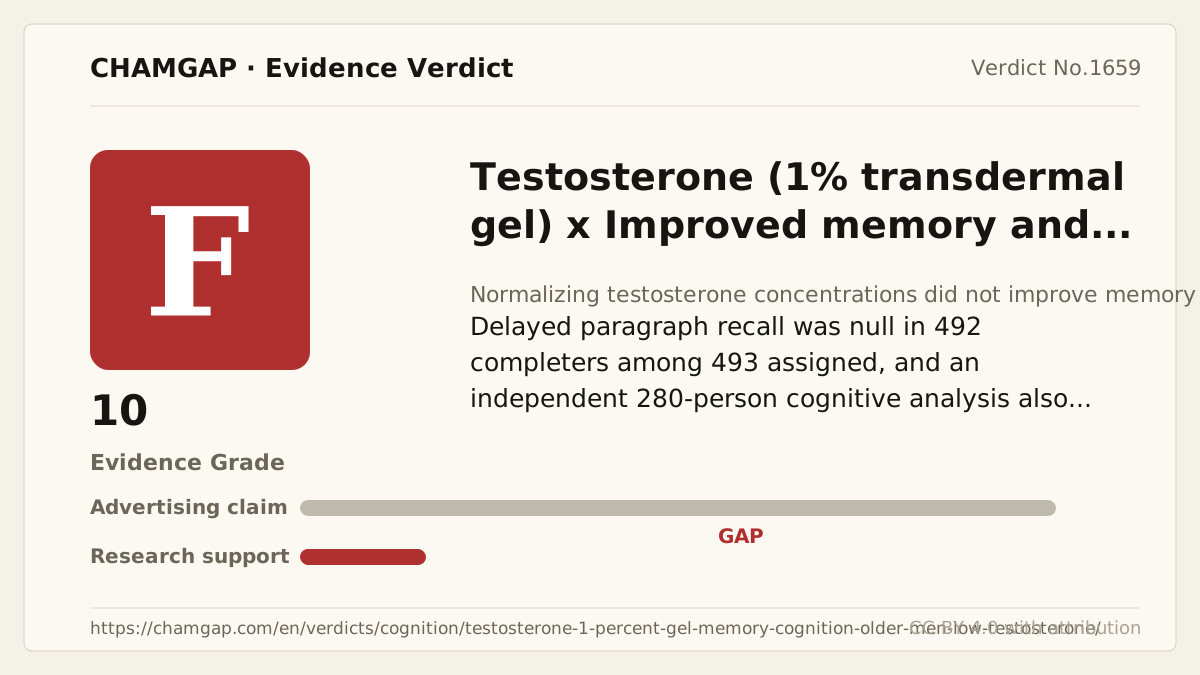
research showsTestosterone 1% gel is rated F for improving memory or cognition in older men with low testosterone. The age-associated-memory-impairment substudy assigned 493 men (247 testosterone, 246 placebo), and 492 (247, 245) completed delayed paragraph recall. In those 492 participants, the primary endpoint failed with −0.07 points (95% CI −0.92 to 0.79), P=.88, and other cognitive domains were null. The independent TEAAM trial randomized 308 men and analyzed baseline cognition in 280, finding no benefit in any domain over three years. Repeated independent failure in the same indication supports F with 10 points.
ads claimPromotion turns restoration of testosterone into claims of youthful memory, concentration, and relief of brain fog. Large trials repeatedly found no memory or global-cognition improvement despite raising testosterone concentrations.
Useful facts when choosing a product
- The Testosterone Trials titrated AndroGel 1% to target concentrations typical of younger men; this was prescription hormone therapy, not a dietary-supplement study.
- Treatment should be considered only for medically diagnosed hypogonadism with compatible symptoms and repeatedly low morning testosterone, not as a stand-alone cognitive treatment.
- Erythrocytosis, acne or oily skin, edema, possible worsening of sleep apnea, and prostate monitoring require attention, while cardiovascular risk must be individualized.
- Gel can transfer by skin contact to women or children, so the application site must be washed or covered according to product instructions.
Chamgap Semantic Classification Code
Candidate index · review held
UNK.testosterone.transdermal.memory-and-cognition-with-low-testosterone.improve.placeboUnknown > Testosterone > Transdermal > memory and cognition with low testosterone > Improvement claim > Placebo
An automated migration candidate, not an issued permanent code; exact claim scope remains under review. This machine-generated migration candidate helps retrieval but is not a permanent assignment. The original verdict ID and URL remain authoritative.
What the research actually shows
The Cognitive Function Trial within the Testosterone Trials assigned 493 men with low testosterone and age-associated memory impairment, 247 testosterone and 246 placebo. Delayed paragraph recall was completed by 492 men, 247 and 245 respectively, who comprised the primary endpoint analysis. The prespecified delayed-paragraph-recall primary endpoint failed at P=.88 and every secondary cognitive outcome was nonsignificant. The independent TEAAM trial randomized 308 men aged 60 years or older to testosterone gel or placebo, with 280, 140 per group, completing baseline cognitive assessment. Over three years, visuospatial ability, verbal fluency, verbal memory, manual dexterity, attention, and executive function all remained null.
Why this is classified as F (10)
Among 493 men assigned in the memory-impaired substudy, 492 completed delayed paragraph recall and the primary endpoint failed at P=.88; the independent TEAAM analysis of 280 men found no benefit in any cognitive domain over three years. Repeated independent failure in the same indication supports F with 10 points.
Counterpoint. Other indications for medically necessary hypogonadism treatment require separate evaluation, but cognitive improvement alone is not evidence-based grounds to start or continue therapy.
Rejudgment record. Cross-check applied — Distinguished the 493 participants assigned (247/246) from the 492 who completed delayed paragraph recall (247/245) in the Testosterone Trials memory-impaired substudy and from the independent TEAAM baseline-cognition analysis of 280 men, confirming repeated failure of memory and broader cognition in the same indication
Sub-claim grades by effect
This ingredient is marketed for several effects. A single overall grade blends strong and weak claims together, so each effect is graded separately here. The overall grade reflects the strongest disconfirming or core claim.
| Effect (sub-claim) | Grade | Basis |
|---|---|---|
| Improved delayed verbal memory | F | Among 493 assigned, delayed paragraph recall failed at P=.88 in 492 completers, and TEAAM verbal memory was independently null. |
| Improved global cognitive function | F | Global and multidomain cognitive improvement was repeatedly absent in the Testosterone Trials and TEAAM. |
| Improved executive function and attention | F | Relevant cognitive tests in both independent trials showed no between-group benefit. |
Cross-check — AI research and Codex final gate
Evidence Table
| Study | Design | Sample | Funding | Endpoint | Result | Weight |
|---|---|---|---|---|---|---|
| Resnick SM et al. 2017 | Multicenter randomized double-blind placebo-controlled Cognitive Function Trial within the Testosterone Trials | Age-associated-memory-impairment substudy: 493 assigned (247 testosterone, 246 placebo); 492 completed delayed paragraph recall (247, 245) | United States NIA and other public funding; AbbVie provided drug and some support | Primary: delayed paragraph recall over one year | Among 493 assigned, 492 completed delayed paragraph recall; the primary endpoint failed with an adjusted difference of −0.07 points (95% CI −0.92 to 0.79), P=.88, and other cognitive domains were also null. | Key large direct randomized trial |
| Huang G et al. 2016 TEAAM | Prespecified cognitive analysis of an independent randomized double-blind placebo-controlled trial | 308 randomized; baseline cognitive analysis 280 (140/140) | United States NIA public funding and investigator-led research | Three-year visuospatial, fluency, verbal-memory, manual-dexterity, attention, and executive-function outcomes | No significant between-group difference occurred in any cognitive domain. | Independent repeated null randomized trial in the same indication |
Receipt — 2 References
All 2 cited sources were verified for existence at the original page (as of 2026-07-24).
Final verification and publication gate: Codex · Evidence date: 2026-07-24 · Corrections: none
Cite this verdict
[Chamgap] Testosterone 1% gel x improved memory and cognition in older men with low testosterone — Evidence Grade F·10. 2 cited sources checked. Source: https://chamgap.com/en/verdicts/cognition/testosterone-1-percent-gel-memory-cognition-older-men-low-testosterone/ · CC BY 4.0CC BY 4.0 — free to use with attribution; do not distort grades, numbers, or verdict meaning.
What this document does and does not do
Chamgap is an information source. It reports what research has and has not confirmed; it does not tell readers what to take or buy. That decision belongs to readers and, when needed, medical or legal professionals. This verdict reflects literature available up to the search date and may change as new research appears. Nothing here is medical advice.