
Tailored tai chi,
does it really help with Improved postural stability in Parkinson disease?
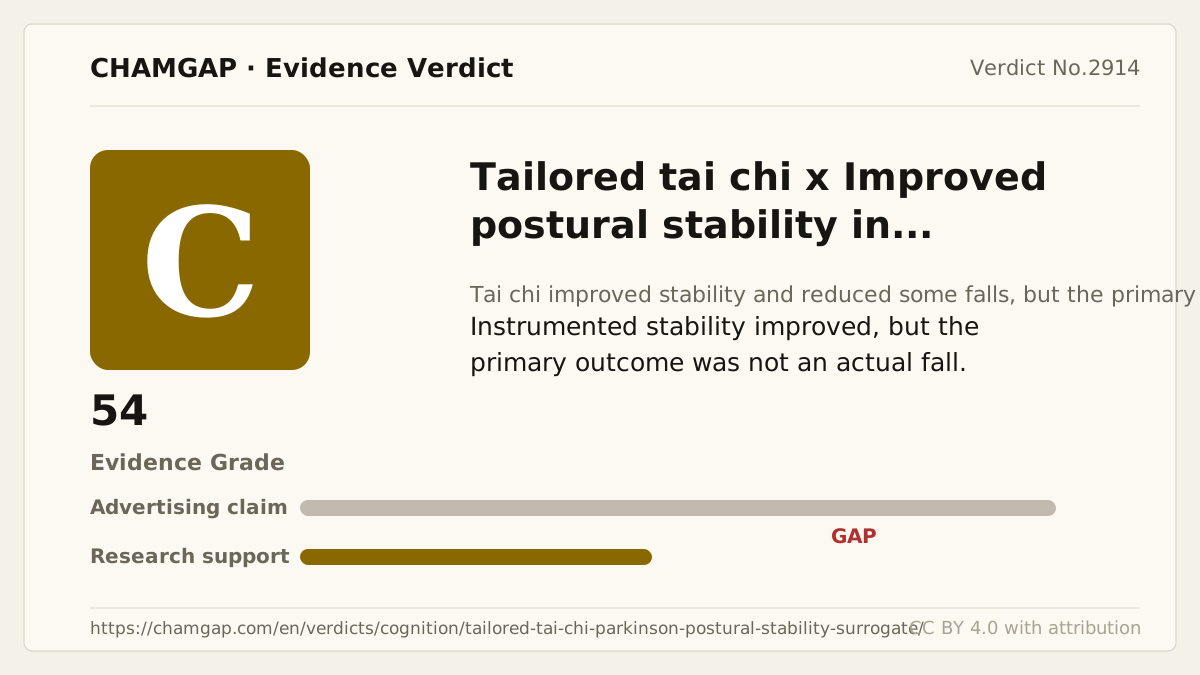
research showsGrade C, 54 points. The paper states that the primary outcomes were "changes from baseline in the limits-of-stability test (maximum excursion and directional control)." Maximum excursion improved by 5.55 points (95% CI 1.12-9.97) versus resistance training and 11.98 points (7.21-16.74) versus stretching. Instrumented postural stability is a surrogate rather than an actual fall event.
ads claimHigher UPDRS III scores are worse. Tai chi decreased the score by 6.42 points at 24 weeks; stretching decreased it by 1.40. Tai chi beat stretching, but strength, timed up-and-go, and UPDRS III were not significantly better than resistance training.
Useful facts when choosing a product
- Sessions were 60 minutes twice weekly for 24 weeks.
- Controls were resistance training and stretching.
- No serious adverse events occurred.
Chamgap Semantic Classification Code
Candidate index · review held
X.tailored-tai-chi.behavioral.parkinson-postural-stability.improve.activeBehaviors, exposures and policies > Tailored tai chi > Behavioral delivery > Postural stability in Parkinson disease > Improvement claim > Active comparator
An automated migration candidate, not an issued permanent code; exact claim scope remains under review. This machine-generated migration candidate helps retrieval but is not a permanent assignment. The original verdict ID and URL remain authoritative.
What the research actually shows
Four-gate review: ① Fewer than 200 participants ② listed item ③ 195 were randomized, 65 per group ④ Parkinson disease recruitment could feasibly exceed 200 across more centers, so counted. ① Active controls only ② listed item ③ resistance training and stretching were the controls ④ a credible placebo that conceals exercise participation is not feasible, so not counted. ① Unmasked subjective endpoint ② listed item ③ participants could not be masked, but outcome assessors were masked and the primary outcome was instrumented ④ criterion not met.
Why this is classified as C (54)
A NIH-funded 195-person trial improved instrumented postural stability; surrogate and small-study limits give C, 54.
Counterpoint. Fall reduction was secondary and the resistance-training comparison touched 1.00.
Rejudgment record. Source checked — Significant improvement in instrumented primary postural-stability outcomes
| Endpoint | S | Surrogate marker - laboratory or imaging measures |
| Replication | R1 | Single confirmatory trial |
| Independence | I2 | Decisive evidence is publicly or non-profit funded |
| Effect size | E+ | Meets the clinically important threshold |
Stored derived and displayed grades match; this is not a current recalculation or validity check (C).
Sub-claim grades by effect
This ingredient is marketed for several effects. A single overall grade blends strong and weak claims together, so each effect is graded separately here. The overall grade reflects the strongest disconfirming or core claim.
| Effect (sub-claim) | Grade | Basis |
|---|---|---|
| Improved postural stability | C | Both instrumented primary measures improved. |
| Reduced falls | C | A secondary outcome favored tai chi versus stretching. |
Cross-check — AI research and Codex final gate
Evidence Table
| Study | Design | Sample | Funding | Endpoint | Result | Weight |
|---|---|---|---|---|---|---|
| Li et al. tai chi Parkinson trial | Assessor-masked three-arm randomized trial | 195 participants, 65 per group | US National Institute of Neurological Disorders and Stroke, NIH | Changes in maximum excursion and directional control on the limits-of-stability test | Maximum excursion: +5.55 points (1.12-9.97) vs resistance training and +11.98 points (7.21-16.74) vs stretching | Publicly funded surrogate-outcome RCT |
Receipt — 1 References
All 1 cited sources were verified for existence at the original page (as of 2026-08-26).
Final verification and publication gate: Codex · Evidence date: 2026-08-26 · Corrections: none
Cite this verdict
[Chamgap] Benefit of Tailored Tai Chi for Postural Stability in Parkinson Disease, a Surrogate Outcome — Evidence Grade C·54. 1 cited sources checked. Source: https://chamgap.com/en/verdicts/cognition/tailored-tai-chi-parkinson-postural-stability-surrogate/ · CC BY 4.0CC BY 4.0 — free to use with attribution; do not distort grades, numbers, or verdict meaning.
What this document does and does not do
Chamgap is an information source. It reports what research has and has not confirmed; it does not tell readers what to take or buy. That decision belongs to readers and, when needed, medical or legal professionals. This verdict reflects literature available up to the search date and may change as new research appears. Nothing here is medical advice.