
Sumatriptan,
does it really help with Two-hour pain freedom and relief of nausea and photophobia during acute migraine attacks in adults?
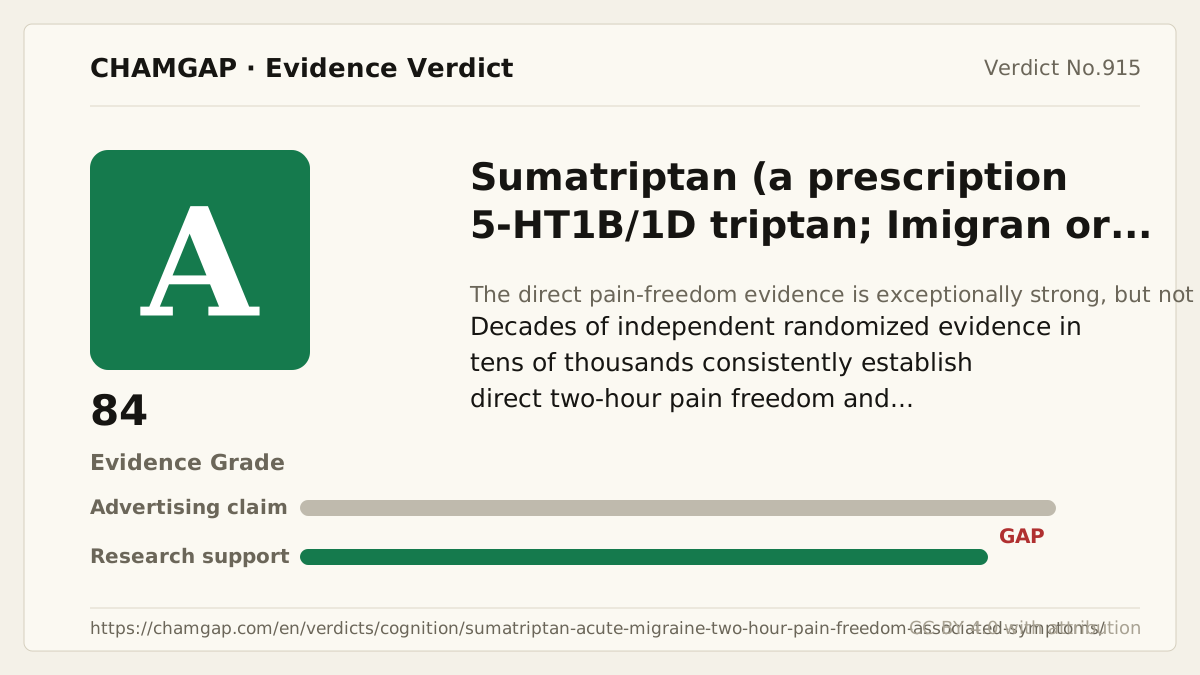
research showsSumatriptan is rated A because it directly increases two-hour pain freedom and relieves associated nausea and photophobia during acute migraine attacks in adults. The oral Cochrane review included 61 randomized double-blind trials and 37,250 participants; two-hour pain freedom with 100 mg was 32% versus 11% with placebo. An overview covering 52,236 participants across all routes and an independent 2024 network meta-analysis of 137 trials and 89,445 participants reinforce consistency, and pain freedom is a direct patient-important clinical outcome rather than a surrogate. Most patients nevertheless are not completely pain free at two hours, and recurrence and medication-overuse headache remain possible, so the result is not universal.
ads claimStatus as a standard treatment can be expanded into complete pain freedom for everyone within two hours, no recurrence, or risk-free repeated dosing. In practice, benefit occurs for a subset of patients and attacks, and formulation choice, contraindication screening, and management of monthly acute-medicine days matter.
Useful facts when choosing a product
- Sumatriptan is an acute treatment used after a migraine attack begins, not a daily preventive medicine, and tablets, nasal formulations, and subcutaneous injections have different doses and redosing intervals that must follow the specific prescription.
- Transient pressure or tightness in the chest, neck, or jaw, tingling, dizziness, and sensations of heat can occur, and severe or persistent chest pain requires urgent assessment.
- It is contraindicated in ischemic coronary disease or coronary vasospasm, prior stroke or transient ischemic attack, peripheral vascular disease, and uncontrolled hypertension, and people at high cardiovascular risk require assessment before initial prescribing.
- Current or recent use of a monoamine oxidase A inhibitor within two weeks is contraindicated, other triptans or ergot medicines require a 24-hour separation, and serotonin syndrome with serotonergic combinations and medication-overuse headache from frequent acute treatment require attention.
Chamgap Semantic Classification Code
Candidate index · review held
M.sumatriptan.UNK.pain-freedom-and-relief-of-nausea-and-photophobia-during-acute-migraine-attacks.relieve.MULTIMedicinal interventions > Sumatriptan > Unknown > pain freedom and relief of nausea and photophobia during acute migraine attacks > Symptom-relief claim > Multiple: primary unresolved
An automated migration candidate, not an issued permanent code; exact claim scope remains under review. This machine-generated migration candidate helps retrieval but is not a permanent assignment. The original verdict ID and URL remain authoritative.
What the research actually shows
The 2012 Cochrane review analyzed 61 randomized double-blind trials and 37,250 participants comparing oral sumatriptan 25, 50, or 100 mg with placebo or an active medicine. For 100 mg in attacks beginning with moderate or severe pain, two-hour pain freedom was 32% versus 11%; 100 mg also outperformed 50 mg for two-hour pain freedom and 24-hour sustained pain freedom, while relief of nausea, photophobia, and phonophobia exceeded placebo. The 2014 overview covered 18 dose-route combinations and 52,236 participants across oral, subcutaneous, intranasal, and rectal delivery. The 2024 BMJ network meta-analysis of 137 double-blind trials and 89,445 participants ranked sumatriptan among the best-performing drugs for two-hour pain freedom and found it superior to several newer options including lasmiditan.
Why this is classified as A (84)
Across 61 oral randomized trials and 37,250 participants, 100 mg produced direct two-hour pain freedom in 32% versus 11% with placebo and also improved associated symptoms and sustained response. A 52,236-participant all-route Cochrane overview and a current independent network meta-analysis of 89,445 participants provide extensive, consistent, direct patient-outcome evidence, placing sumatriptan above lasmiditan at B62 and supporting A with 84 points. The minority absolute pain-free rate and recurrence in about 25% to 35% after initial success lower the score, while the direct endpoint and extensive independent evidence preserve A. Vasoconstrictive contraindications, interactions, and medication-overuse headache remain separate safety issues.
Counterpoint. Failure of one formulation or dose does not rule out a better response to another triptan or route, but cardiovascular contraindications should never be bypassed through unsupervised trials. Frequent acute-medicine use or a changed headache pattern warrants consideration of prevention and evaluation for secondary headache.
Rejudgment record. New verdict — Applied the direct-clinical-outcome criterion to strong consistent evidence from 61 oral randomized double-blind trials and 37,250 participants, a 52,236-participant all-route Cochrane overview, and a current independent network meta-analysis of 137 trials and 89,445 participants, while adjusting the score for absolute pain-freedom and recurrence limits and maintaining corpus separation above lasmiditan at B62
Sub-claim grades by effect
This ingredient is marketed for several effects. A single overall grade blends strong and weak claims together, so each effect is graded separately here. The overall grade reflects the strongest disconfirming or core claim.
| Effect (sub-claim) | Grade | Basis |
|---|---|---|
| Pain freedom two hours after dosing for acute migraine in adults | A | Oral 100 mg achieved 32% versus 11% with placebo, with a direct patient outcome consistent across tens of thousands of independently synthesized trial participants. |
| Relief of nausea, photophobia, and phonophobia during acute migraine in adults | B | A large Cochrane review found better relief than placebo, but reporting of these secondary outcomes was less complete than for the core two-hour pain endpoint. |
| Sustained pain freedom through 24 hours in acute adult migraine | A | Multiple randomized trials found more sustained pain freedom than placebo, but some attacks recur after initial response and frequent use can cause medication-overuse headache. |
Cross-check — AI research and Codex final gate
Evidence Table
| Study | Design | Sample | Funding | Endpoint | Result | Weight |
|---|---|---|---|---|---|---|
| Derry CJ et al. 2012 | Cochrane systematic review of randomized double-blind placebo- and active-controlled trials of oral sumatriptan | 61 trials and 37,250 participants | Academic Cochrane synthesis; sponsorship varied across source trials | Pain freedom and pain relief at one and two hours, sustained response through 24 hours, and associated symptoms | Two-hour pain freedom with oral 100 mg was 32% versus 11% with placebo, and relief of nausea, photophobia, and phonophobia also exceeded placebo. | Key large synthesis of direct patient outcomes |
| Derry CJ et al. 2014 | Overview of four Cochrane reviews of oral, subcutaneous, intranasal, and rectal sumatriptan | Eighteen dose-route combinations and 52,236 participants | Academic Cochrane overview; sponsorship varied across source trials | Route-specific pain freedom and relief at one and two hours, sustained response through 24 hours, and adverse events | All licensed routes were clinically useful; subcutaneous 6 mg was fastest and strongest, while oral 50 mg produced two-hour complete pain relief in 28% versus 11% with placebo. | Cross-route consistency and scale support |
| Karlsson WK et al. 2024 | Systematic review and network meta-analysis of oral monotherapy for acute migraine in adults | 137 double-blind randomized trials, 89,445 participants, and 17 active interventions | Primarily academic and public support with author-level external conflicts disclosed | Pain freedom at two hours and sustained pain freedom from two through 24 hours | Sumatriptan ranked among the most effective drugs for two-hour pain freedom and outperformed several newer agents including lasmiditan. | Current large independent comparative synthesis |
Receipt — 3 References
All 3 cited sources were verified for existence at the original page (as of 2026-07-21).
Final verification and publication gate: Codex · Evidence date: 2026-07-21 · Corrections: none
Cite this verdict
[Chamgap] Sumatriptan x two-hour pain freedom and relief of nausea and photophobia in acute adult migraine — Evidence Grade A·84. 3 cited sources checked. Source: https://chamgap.com/en/verdicts/cognition/sumatriptan-acute-migraine-two-hour-pain-freedom-associated-symptoms/ · CC BY 4.0CC BY 4.0 — free to use with attribution; do not distort grades, numbers, or verdict meaning.
What this document does and does not do
Chamgap is an information source. It reports what research has and has not confirmed; it does not tell readers what to take or buy. That decision belongs to readers and, when needed, medical or legal professionals. This verdict reflects literature available up to the search date and may change as new research appears. Nothing here is medical advice.