
Speed-of-processing training,
does it really help with Reduction of claims-diagnosed dementia over 20 years in initially healthy adults aged 65 or older?
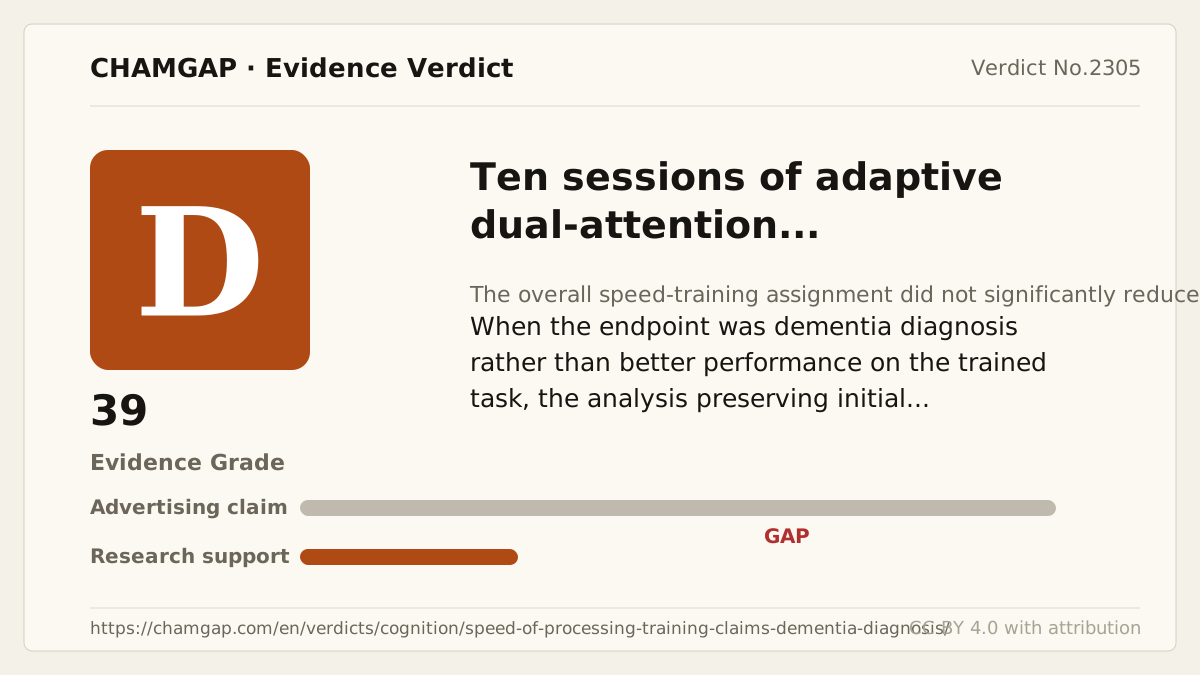
research showsThe grade is D. In a 20-year modified intention-to-treat analysis of 2,021 ACTIVE participants enrolled in traditional Medicare at baseline, claims-diagnosed dementia occurred in 223/512 (43.55%) assigned to speed training and 239/491 (48.68%) assigned to no-contact control; adjusted HR 0.87 (95% CI 0.72 to 1.05). The positive result arose after conditioning on people who completed at least eight of ten initial sessions and became eligible for booster assignment.
ads claimImprovement on a practiced visual task is not dementia prevention. Results among people who completed booster training cannot be marketed as the effect among everyone initially assigned to training.
Useful facts when choosing a product
- The dementia endpoint used the Medicare Chronic Conditions Warehouse claims algorithm rather than clinical adjudication.
- Absolute diagnosis rates were 43.55% in the overall speed arm and 48.68% in control.
- Booster eligibility required completion of at least eight of ten initial sessions.
Chamgap Semantic Classification Code
Candidate index · review held
X.ten-sessions-of-adaptive-dual-attention-speed-of-processing-cognitive-training.behavioral.claims-diagnosed-dementia-over-in-initially-healthy-adults.reduce.UNKBehaviors, exposures and policies > Ten sessions of adaptive dual-attention speed-of-processing cognitive training > Behavioral delivery > claims-diagnosed dementia over in initially healthy adults > Reduction claim > Unknown
An automated migration candidate, not an issued permanent code; exact claim scope remains under review. This machine-generated migration candidate helps retrieval but is not a permanent assignment. The original verdict ID and URL remain authoritative.
What the research actually shows
ACTIVE randomized 2,802 initially healthy adults aged at least 65 to memory, reasoning, speed, or no-contact control. Speed training delivered up to ten 60- to 75-minute sessions over five to six weeks using adaptive dual-attention tasks. Only participants completing at least eight initial sessions became eligible for booster re-randomization. The 2026 analysis used the Chronic Conditions Warehouse claims algorithm rather than clinical adjudication. The analysis preserving initial assignment found 223/512 (43.55%) versus 239/491 (48.68%), adjusted HR 0.87 (95% CI 0.72 to 1.05). Within eligible participants, the comparison preserving booster randomization was HR 0.81 (0.66 to 1.00), also not conclusively positive. The significant HR 0.75 (0.59 to 0.95) conditioned on the 264 eligible participants who actually completed booster training.
Why this is classified as D (34)
The long-term randomized dataset had public funding, but the overall dementia result was null and the positive signal depended on a post hoc completer-conditioned booster analysis, giving D with 34 points.
Counterpoint. The positive 10-year algorithm analysis used the same ACTIVE cohort and is not independent replication. An independent 2026 reanalysis noted that every training-specific interval included one after multiplicity correction and proposed a possible common effect across all three trainings under alternative models. Neither interpretation establishes a specific preventive effect of speed training. Trained-task and everyday-function outcomes were not used to grade this claim.
Rejudgment record. Cross-check applied — The 20-year analysis preserving initial assignment was separated from the booster analysis conditioned on initial-training completion, and the overall null result was used
| Endpoint | H | Hard endpoint - actual events such as death |
| Replication | R1 | Single confirmatory trial |
| Independence | I2 | Decisive evidence is publicly or non-profit funded |
| Effect size | E0 | Null |
| Precision | C0 | The confidence interval leaves room for benefit |
Stored derived and displayed grades match; this is not a current recalculation or validity check (D).
Sub-claim grades by effect
This ingredient is marketed for several effects. A single overall grade blends strong and weak claims together, so each effect is graded separately here. The overall grade reflects the strongest disconfirming or core claim.
| Effect (sub-claim) | Grade | Basis |
|---|---|---|
| Reduced 20-year dementia diagnosis from initial speed-training assignment | D | The result was null at 43.55% versus 48.68%, HR 0.87 (0.72 to 1.05). |
| Reduced dementia diagnosis among booster completers | C | The comparison with control was positive but conditioned on initial adherence and booster participation in a post hoc analysis. |
Cross-check — AI research and Codex final gate
Evidence Table
| Study | Design | Sample | Funding | Endpoint | Result | Weight |
|---|---|---|---|---|---|---|
| Coe et al. 2026 ACTIVE claims linkage | Twenty-year modified intention-to-treat claims analysis of an existing four-arm randomized trial | 2,021 baseline traditional-Medicare participants from 2,802 randomized; 512 speed and 491 control | Public funding from the US National Institute on Aging and National Institute of Nursing Research | Claims-diagnosed dementia from 1999 to 2019 using the CCW algorithm | Overall speed 223/512 (43.55%) versus control 239/491 (48.68%), adjusted HR 0.87 (0.72 to 1.05); speed plus booster 105/264 (39.77%), HR 0.75 (0.59 to 0.95) | Pivotal long-term follow-up evidence |
Receipt — 2 References
All 2 cited sources were verified for existence at the original page (as of 2026-08-05).
Final verification and publication gate: Codex · Evidence date: 2026-08-05 · Corrections: none
Cite this verdict
[Chamgap] Speed-of-processing training x dementia diagnosis — Evidence Grade D·34. 2 cited sources checked. Source: https://chamgap.com/en/verdicts/cognition/speed-of-processing-training-claims-dementia-diagnosis/ · CC BY 4.0CC BY 4.0 — free to use with attribution; do not distort grades, numbers, or verdict meaning.
What this document does and does not do
Chamgap is an information source. It reports what research has and has not confirmed; it does not tell readers what to take or buy. That decision belongs to readers and, when needed, medical or legal professionals. This verdict reflects literature available up to the search date and may change as new research appears. Nothing here is medical advice.