
Shift and night work,
does it really help with Higher incidence of dementia?
research showsThe grade is C with 56 points. Several prospective cohorts associate shift or night work with incident dementia, but none randomized schedules. Numerical sleep-adjusted sensitivity estimates were not reported, the primary analyses lacked a lag despite reverse-causation risk, and exposure misclassification was not addressed with repeated measurement or a validation subsample.
ads claimKorean occupational-health materials treat night work as a risk-management issue. This evidence does not predict dementia for an individual or by itself require immediate cessation. Verdict 2243 is D with 34 points for breast cancer, and verdict 2244 is C with 54 points for type 2 diabetes; those are different outcomes.
Useful facts when choosing a product
- Swedish exposure was self-reported years of shift or night work.
- UK exposure was one-time self-report of current night-shift frequency.
- Neither study randomized schedules.
- The Swedish primary analysis had no early lag; the UK two-year lag was sensitivity analysis.
- Dementia ascertainment relied mainly on registry codes and prescriptions.
Chamgap Semantic Classification Code
Candidate index · review held
X.shift-and-night-work.behavioral.higher-incidence-of-dementia.increase.UNKBehaviors, exposures and policies > Shift and night work > Behavioral delivery > Higher incidence of dementia > Increase claim > Unknown
An automated migration candidate, not an issued permanent code; exact claim scope remains under review. This machine-generated migration candidate helps retrieval but is not a permanent assignment. The original verdict ID and URL remain authoritative.
What the research actually shows
Bokenberger 2018 followed 13,283 STR-1973 and 41,199 SALT participants for median 41.2 and 14.1 years. The cohorts shared authors, funding, registry infrastructure, and 8,904 people, so they are not independent replication. STR recorded 983 dementia cases (7.4%) and shift-work HR 1.36 (1.15-1.60); SALT recorded 1,979 (4.8%) and night-work HR 1.12 (1.01-1.23), trend P=.02. Primary models adjusted age, sex, education, diabetes, cardiovascular disease, and stroke. A SALT older subsample additionally adjusted time in bed, rising time, bedtime, sleep quality, nonrestorative sleep, and heavy snoring; the authors said estimates were unchanged but did not report them. Ren 2023 followed 276,059 UK Biobank workers for median 9.0 years: cases were 817/228,398 day workers, 136/23,347 never/rare night, 139/17,465 some/usual night, and 77/6,849 always night. Fully adjusted HRs were 1, 1.12, 1.24, and 1.35 with a dose trend. Adjustment included age, sex, ethnicity, education, income, deprivation, BMI, sleep duration, chronotype, hypertension, diabetes, cardiovascular disease, cancer, cholesterol, depression, anxiety, sleep apnea, medications, APOE ε4, smoking, alcohol, activity, and diet. The Swedish primary analysis had no diagnosis-free lag; the UK two-year exclusion was sensitivity analysis, not the primary model. Dementia was registry and prescription ascertained in Sweden and registry ascertained in the UK. Funding was NIA, NordForsk, and FORTE for Sweden and NSFC plus Guangdong and Zunyi grants for the UK study.
Why this is classified as C (56)
Positive hard-outcome associations recur, but nonreporting of sleep-adjusted estimates, no primary-analysis lag, and inadequate exposure-misclassification checks are multiple avoidable flaws. This supports grade C.
Counterpoint. Liao followed 170,722 UK Biobank participants with 716 dementia cases over median 12.4 years. Shift-work HR was 1.30 (1.08-1.58), but night versus nonnight work within shift workers was null at HR 1.04 (0.73-1.47). Funding listed NSFC 81925031, 81820108026, and 81872549; Guangzhou 202007030001; and Guangdong 2018B030340001. Its exposure contrast is not directly comparable.
Rejudgment record. Cross-check applied — Original reports were checked for exposure, lag, sleep adjustment, absolute cases, ascertainment, funding, and cohort overlap.
| Endpoint | H | Hard endpoint - actual events such as death |
| Replication | R1 | Single confirmatory trial |
| Independence | I2 | Decisive evidence is publicly or non-profit funded |
| Effect size | E+ | Meets the clinically important threshold |
Stored derived and displayed grades match; this is not a current recalculation or validity check (C).
Sub-claim grades by effect
This ingredient is marketed for several effects. A single overall grade blends strong and weak claims together, so each effect is graded separately here. The overall grade reflects the strongest disconfirming or core claim.
| Effect (sub-claim) | Grade | Basis |
|---|---|---|
| Shift and night work increase incident dementia | C | Positive associations remain observational and have multiple avoidable flaws. |
Cross-check — AI research and Codex final gate
Evidence Table
| Study | Design | Sample | Funding | Endpoint | Result | Weight |
|---|---|---|---|---|---|---|
| Bokenberger et al. 2018 | Two Swedish prospective cohorts | 13,283 and 41,199; 8,904 overlapping | NIA R01-AG08724; NordForsk 74,809; FORTE 2013-2292 and 2013-08,689 | Registry-ascertained incident dementia | HR 1.36 (1.15-1.60) and 1.12 (1.01-1.23) | Pivotal evidence |
| Ren et al. 2023 | UK Biobank prospective cohort | 276,059, with 1,169 dementia cases | NSFC 82173588; Guangdong and Zunyi grants 2019, D222330012, G622080001, 2021A1515011629, F-947 | Registry-ascertained incident dementia | Always-night HR 1.35; trend P<.001 | Supporting evidence |
| Liao et al. 2022 | UK Biobank prospective cohort | 170,722; 716 dementia cases; median 12.4 years | NSFC 81925031, 81820108026, 81872549; Guangzhou 202007030001; Guangdong 2018B030340001 | Registry-ascertained incident dementia | Shift work HR 1.30 (1.08-1.58); night vs nonnight among shift workers HR 1.04 (0.73-1.47) | Counterevidence |
Receipt — 3 References
All 3 cited sources were verified for existence at the original page (as of 2026-08-07).
Final verification and publication gate: Codex · Evidence date: 2026-08-07 · Corrections: none
Cite this verdict
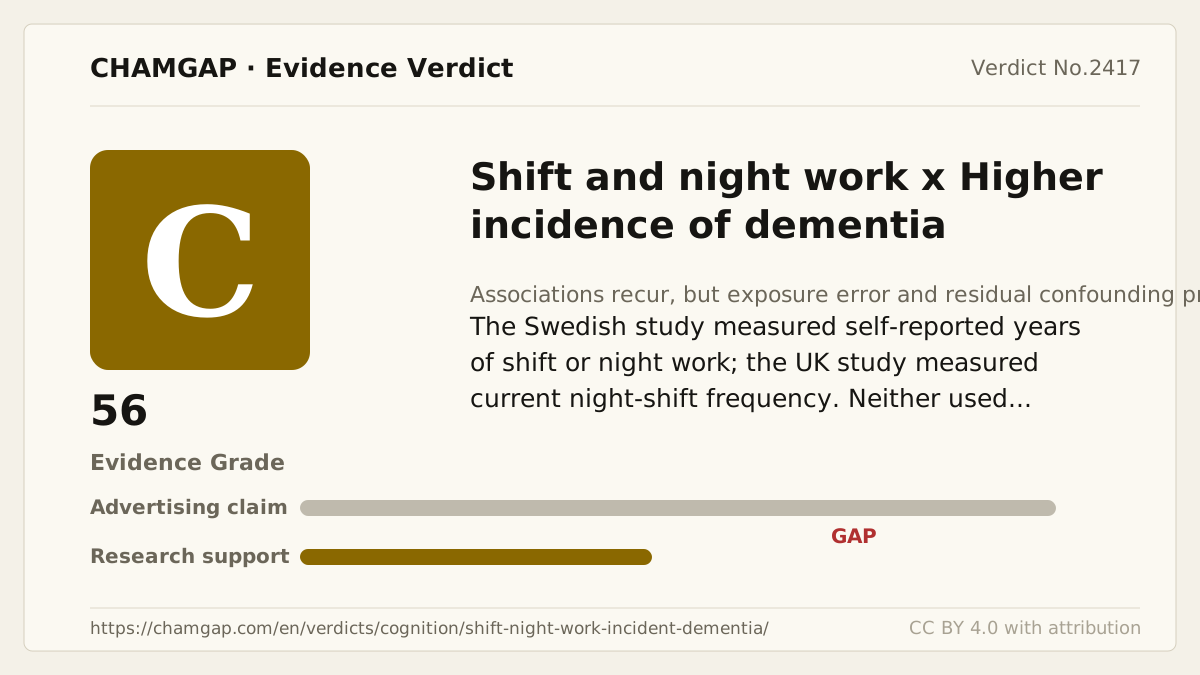
[Chamgap] Shift and night work × incident dementia — Evidence Grade C·56. 3 cited sources checked. Source: https://chamgap.com/en/verdicts/cognition/shift-night-work-incident-dementia/ · CC BY 4.0CC BY 4.0 — free to use with attribution; do not distort grades, numbers, or verdict meaning.
What this document does and does not do
Chamgap is an information source. It reports what research has and has not confirmed; it does not tell readers what to take or buy. That decision belongs to readers and, when needed, medical or legal professionals. This verdict reflects literature available up to the search date and may change as new research appears. Nothing here is medical advice.