
Saffron extract,
does it really help with Reduced core inattention, hyperactivity, and impulsivity symptoms of ADHD in children and adolescents?
research showsSaffron extract is rated C because it has a positive human signal for core ADHD symptoms in children and adolescents. A six-week double-blind exploratory trial in 2019 assigned 54 participants aged 6 to 17 years to saffron at 20 to 30 mg/day or methylphenidate at 20 to 30 mg/day and found no difference between groups in parent- or teacher-rated ADHD-RS-IV change. It was a small, single-center, placebo-free active-comparator pilot with no formal noninferiority margin, so no significant difference does not establish equivalent efficacy. A 2024 systematic review included only four studies and 118 patients in total and called for independent multicenter replication and longer functional outcomes. Short-term rating-scale signals for inattention and hyperactivity or impulsivity are therefore accepted but limited to C with 43 points. Generally favorable short-term tolerability, gastrointestinal effects, possible high-dose toxicity, and caution with medicinal doses during pregnancy remain separate safety issues.
ads claimMarketing turns a placebo-free exploratory finding into claims such as natural methylphenidate, a concentration cure, or an adverse-effect-free replacement for ADHD treatment. The trial tested one saffron capsule for six weeks and did not validate every marketed extract, long-term use, or discontinuation of standard therapy.
Useful facts when choosing a product
- Saffron supplements are sold as dried stigma powder, aqueous or alcoholic extracts, and standardized ingredients, and their crocin and safranal content and extraction methods can differ.
- The key exploratory trial used a specific saffron capsule at 20 or 30 mg/day according to body weight for six weeks, so its findings cannot be transferred directly to other concentrations, formulations, or culinary intake.
- ADHD assessment and care should consider sleep, learning disorders, anxiety or depression, tics, cardiovascular status, and function at home and school; a supplement does not replace medication management or behavioral and educational support.
- Short trials suggest generally good tolerability, but nausea and abdominal discomfort can occur and high doses raise concern for blood-pressure, hematologic, and toxic effects. Medicinal dosing during pregnancy should be avoided or discussed with a clinician because of possible uterine stimulation.
Chamgap Semantic Classification Code
Candidate index · review held
S.saffron-extract-from-crocus-sativus.UNK.core-inattention-hyperactivity-and-impulsivity-symptoms-of-adhd-and-adolescents.reduce.MULTISupplements and nutraceuticals > Saffron extract from Crocus sativus > Unknown > core inattention, hyperactivity, and impulsivity symptoms of ADHD and adolescents > Reduction claim > Multiple: primary unresolved
An automated migration candidate, not an issued permanent code; exact claim scope remains under review. This machine-generated migration candidate helps retrieval but is not a permanent assignment. The original verdict ID and URL remain authoritative.
What the research actually shows
Baziar and colleagues used weight-based saffron or methylphenidate doses of 20 to 30 mg/day for six weeks. Fifty of 54 participants completed the study, and group differences in change over time and final change on parent and teacher ADHD-RS-IV ratings were nonsignificant. The single-center pilot was supported by Tehran University of Medical Sciences. The 2024 review by Seyedi-Sahebari and colleagues synthesized four studies involving 118 patients, including saffron monotherapy, add-on therapy with methylphenidate, and a nonrandomized study; it described promise but called for well-designed multicenter studies. These data concern short-term symptom ratings, not academic achievement, accidents, hospitalization, long-term function, or replacement of standard care.
Why this is classified as C (43)
Direct positive pediatric ADHD evidence makes D inappropriate. The key study, however, was a six-week, 54-participant, single-center, placebo-free active-comparator pilot with no formal noninferiority margin, while the 2024 synthesis contained only four heterogeneous studies and 118 patients. Parent and teacher ratings and a nonsignificant active-comparator difference do not prove equivalent efficacy or functional benefit, so the result is C with 43 points. Tolerability and high-dose or pregnancy precautions are independent of efficacy grading.
Counterpoint. Reassessment requires an independent multicenter placebo-controlled trial of a standardized extract. It should prespecify inattention and hyperactivity or impulsivity scales, school function, quality of life, discontinuation, and longer-term adverse events; any methylphenidate noninferiority claim also needs a justified margin and adequate power.
Rejudgment record. Cross-check incorporated — Accepted a positive human signal from the six-week double-blind placebo-free active-comparator pilot in 54 participants, but treated the nonsignificant group difference as insufficient to establish equivalent efficacy because no formal noninferiority margin was set; small single-center enrollment and a 2024 review of only four studies and 118 patients support a low C
Sub-claim grades by effect
This ingredient is marketed for several effects. A single overall grade blends strong and weak claims together, so each effect is graded separately here. The overall grade reflects the strongest disconfirming or core claim.
| Effect (sub-claim) | Grade | Basis |
|---|---|---|
| Reduced inattention in children and adolescents with ADHD | C | Parent and teacher ADHD-RS-IV ratings provide a short-term signal, but the key study was a placebo-free active-comparator pilot in 54 participants without large independent replication. |
| Reduced hyperactivity in children and adolescents with ADHD | C | Core-symptom ratings improved, but the placebo-adjusted effect size for hyperactivity and long-term school function have not been established. |
| Reduced impulsivity in children and adolescents with ADHD | C | A positive human signal is accepted, but small size, no placebo, and lack of replication do not establish efficacy as a replacement for standard care. |
Cross-check — AI research and Codex final gate
Evidence Table
| Study | Design | Sample | Funding | Endpoint | Result | Weight |
|---|---|---|---|---|---|---|
| Baziar S et al. 2019 | Randomized double-blind placebo-free active-comparator pilot trial | 54 participants aged 6 to 17 years with ADHD randomized; 50 completed | Grant support from Tehran University of Medical Sciences | Change in parent and teacher ADHD-RS-IV total scores at weeks 3 and 6 | Change did not differ significantly between saffron at 20 to 30 mg/day and methylphenidate at 20 to 30 mg/day, and both groups improved. | Key positive human signal limited by no placebo and small size |
| Seyedi-Sahebari S et al. 2024 | Systematic review of clinical studies of saffron for ADHD | Four studies and 118 patients in total | Authors reported no conflicts; no large independent replication was available | ADHD symptoms and short-term safety | Found promising results for saffron alone or as add-on therapy but called for well-designed multicenter studies. | Evidence-volume and replication assessment |
Receipt — 3 References
All 3 cited sources were verified for existence at the original page (as of 2026-07-21).
Final verification and publication gate: Codex · Evidence date: 2026-07-21 · Corrections: none
Cite this verdict
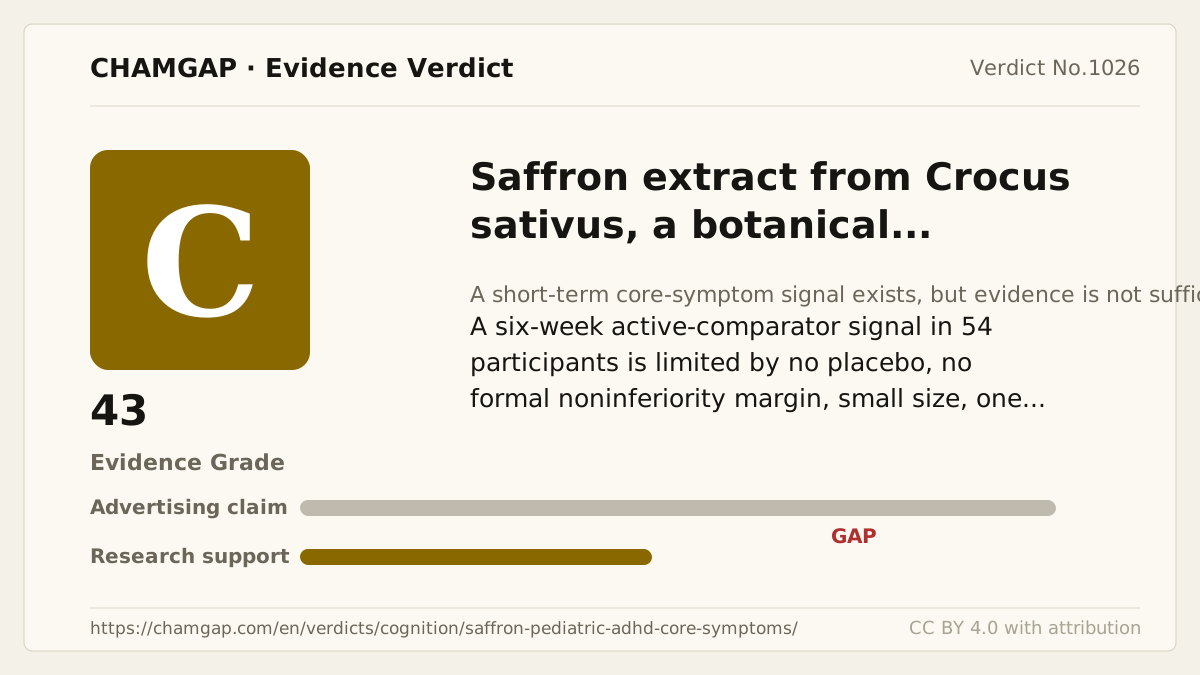
[Chamgap] Saffron extract x reduced core ADHD symptoms in children and adolescents — Evidence Grade C·43. 3 cited sources checked. Source: https://chamgap.com/en/verdicts/cognition/saffron-pediatric-adhd-core-symptoms/ · CC BY 4.0CC BY 4.0 — free to use with attribution; do not distort grades, numbers, or verdict meaning.
What this document does and does not do
Chamgap is an information source. It reports what research has and has not confirmed; it does not tell readers what to take or buy. That decision belongs to readers and, when needed, medical or legal professionals. This verdict reflects literature available up to the search date and may change as new research appears. Nothing here is medical advice.